Quality Magazine logo
search
cart
facebook twitter linkedin youtube
  • Sign In
  • Create Account
  • Sign Out
  • My Account
Quality Magazine logo
  • NEWS
  • PRODUCTS
    • FEATURED PRODUCTS
    • SUBMIT YOUR PRODUCT
  • CHANNELS
    • AUTOMATION
    • MANAGEMENT
    • MEASUREMENT
    • NDT
    • QUALITY 101
    • SOFTWARE
    • TEST & INSPECTION
    • VISION & SENSORS
  • MARKETS
    • AEROSPACE
    • AUTOMOTIVE
    • ENERGY
    • GREEN MANUFACTURING
    • MEDICAL
  • MEDIA
    • A WORD ON QUALITY PUZZLE
    • EBOOK
    • PODCASTS
    • VIDEOS
    • WEBINARS
  • EVENTS
    • EVENT CALENDAR
    • IMTS
  • DIRECTORIES
    • BUYERS GUIDE >
      • Supplier Insights
    • NDT SOURCEBOOK
    • VISION & SENSORS
    • TAKE A TOUR
  • INFOCENTERS
    • Digital Quality Management Systems
    • NEXT GENERATION SPC & QUALITY ANALYTICS
  • AWARDS
    • ROOKIE OF THE YEAR
    • PLANT OF THE YEAR
    • PROFESSIONAL OF THE YEAR
  • MORE
    • Expert Columns
    • NEWSLETTERS
    • QUALITY STORE
    • INDUSTRY LINKS
    • SPONSOR INSIGHTS
  • EMAG
    • eMAGAZINE
    • ARCHIVES
    • CONTACT
    • ADVERTISE
  • SIGN UP!

Quality 101:Calibrating Micrometers

Gloved hands holding a handheld digital micrometer.
Source: Apicha Thumvisead / iStock / Getty Images Plus via Getty Images
April 1, 2004
Regular calibration intervals help ensure micrometer accuracy.

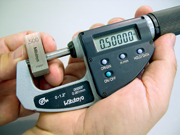
The standard used in calibrating measuring gages must possess an accuracy greater than a 4:1 ratio over the accuracy of the gage being calibrated. The accuracy of a gage block is typically ±0.000002 inch, and the accuracy of a micrometer is typically ±0.0001 inch. This exceeds the 4:1 ratio. Photo: Mitutoyo America Corp.


The inventor of the modern micrometer, Jean Laurent Palmer, introduced the basic principles of magnification based on screw threads. His design is based on a 1-millimeter, single-pitch open screw thread. One rotation, or 1 millimeter, was divided into 20 equal parts, bringing the smallest resolution to 0.05 millimeter. His design was so advanced and complete, that nothing has been added to or subtracted from his original concept in terms of the principles of operation.

To ensure accuracy, micrometers must be calibrated at regular intervals.


The 4 to 1 rule

• The standard used in calibrating measuring gages must possess an accuracy greater than a 4 to 1 ratio over the accuracy of a gage being calibrated. This common rule of thumb originated some 40 years ago from MIL-STD-45662A, which was first published in 1960. A gage block is used to calibrate an unknown micrometer. The "unknown" is the micrometer and the "known" is the gage block being used. This gage block must have a certificate of traceability to the National Institute of Standards and Technology (NIST).

• The use of gage blocks is always the best, because no other standards are more accurate than the gage blocks, and they are the highest in the hierarchy of precision.

• There is a dedicated standard for large micrometers called "standard bar." Often, the bar is supplied with large-size micrometers, and its end is either spherical or flat.

• It is suggested that the bar without certificate be compared against a traceable gage block or immediately compared against a traceable gage block. This can be done on top of the granite surface plate.


Calibration guidelines for micrometers using a five-point calibration method

1. Look at the frame, for signs of damage, such as indications that it was dropped on the floor.

2. Observe both spindle and anvil faces. They must be flat, free of pinholes and clean. Frosted surfaces may indicate wear.

3. If the micrometer needs repairs, they must be done first. Calibration may proceed only when the gage is in good working order. Move the micrometer from 0 to 25 millimeters (0 to 1 inch) or the entire range and check if the spindle feels continuously smooth throughout the range. In short, check if it is good enough for its intended use. A hard to turn spindle is a sign of age or damage. Do not force it to rotate and have someone look into the cause of malfunction.

4. The micrometer should turn smoothly and freely throughout the entire range, and it should not bind or freeze during the check.

5. Check five points. In inch micrometers check 1.000, 0.500, 0.250, 0.125 and 0.0625 with traceable gage blocks. The zero point is repeatedly checked but never reported. The check points presented here are one suggestion: take the entire range, split it in half, split it in half, split it in half again and split it for the last time. The points checked may be even better if they are replaced by 0.997, 0.502, 0.246, 0.128, 0.611 or any other number for that matter.

6. If 18.5 millimeters is checked on a daily basis, by all means include that number in the calibration procedure to safeguard the system.

Share This Story

Looking for a reprint of this article?
From high-res PDFs to custom plaques, order your copy today!

Recommended Content

JOIN TODAY
to unlock your recommendations.

Already have an account? Sign In

  • 2024 Quality Rookie of the Year Justin Wise 1440x750px banner with "Quality Rookie of the Year" logo inset

    Meet the 2024 Quality Rookie of the Year: Justin Wise

    Justin Wise is an exceptional individual who has been...
    Aerospace
    By: Michelle Bangert
  • Man with umbrella and coat stands outside while it rains at night looking at a building.

    Nondestructive Testing: Is there an ethics problem?

    I was a whistleblower who exposed fraudulent activities...
    NDT
    By: Dale Norwood
  • Unraveling Deflategate: Football stadium with closeup of football on field

    Unraveling the Tom Brady Deflategate

    The Deflategate scandal erupted following the 2014 AFC...
    Measurement
    By: Greg Cenker and Henry Zumbrun
Manage My Account
  • eMagazine Subscriptions
  • Newsletters
  • Online Registration
  • Subscription Customer Service
  • Manage My Preferences

More Videos

Sponsored Content

Sponsored Content is a special paid section where industry companies provide high quality, objective, non-commercial content around topics of interest to the Quality audience. All Sponsored Content is supplied by the advertising company and any opinions expressed in this article are those of the author and not necessarily reflect the views of Quality or its parent company, BNP Media. Interested in participating in our Sponsored Content section? Contact your local rep!

close
  • Key Takeaways for Quality Leaders
    Sponsored byComplianceQuest

    Key Takeaways for Quality Leaders from the 2026 Gartner Magic Quadrant™ for QMS

  • This image shows a person seated next to a Bobcat T66 compact track loader.
    Sponsored byPolyWorks by InnovMetric

    Supercharging Digital Gauging at Bobcat North America

  • Dorsey Calibration Lab photo by Tom LaBarbera Picture this Studios
    Sponsored byDorsey Metrology International

    Ensuring Product Quality in a Competitive Manufacturing Landscape

Popular Stories

a titanium diaphragm speaker driver

The One Thing Elon Gets Right Is Designed to Scare You

This image shows a person seated next to a Bobcat T66 compact track loader.

Supercharging Digital Gauging at Bobcat North America

Dorsey Calibration Lab photo by Tom LaBarbera Picture this Studios

Ensuring Product Quality in a Competitive Manufacturing Landscape

2026 Quality Professional of the Year!

Events

June 9, 2026

Future-Proof your Quality Processes with Advanced 3D Optical CMM Technology

Discover how to effortlessly capture complex data, leverage true multi-sensor automation, and ensure continuous operation without creating inspection delays.

June 22, 2026

Automate 2026

Automate is North America's largest robotics and automation event — and the best place to take your ideas from insight to impact.
 
Our show floor features the world’s leading automation solutions, from AI and robotics to motion control, vision systems, and more. Plus, our educational conference is second to none, led by the brightest minds in automation today.
 
Ready to transform the way you work? Take the next step at Automate.
View All Submit An Event

Products

Lean Manufacturing and Service Fundamentals, Applications, and Case Studies

Lean Manufacturing and Service Fundamentals, Applications, and Case Studies

See More Products
Quality Podcast Channel Custom Content

Related Articles

  • Quality 101: Caliper Basics

    See More
  • Quality 101: Make It Snappy

    See More
  • calibration

    Calibrating Humidity for Data Centers

    See More

Related Products

See More Products
  • Quality Improvement Through Planned Experimentation 3/E

  • Juran Institute's Six Sigma Breakthrough and Beyond Quality Performance Breakthrough Methods

See More Products

Related Directories

  • Quality Calibration Service Inc.

    QCS is an ISO/IEC 17025 - A2LA accredited full-service metrology lab providing gage calibration (all types and brands), CMM dimensional inspection, electronic test & measurement instrumentation calibration & repair, hand tool repair services and on-site calibration of major metrology & inspection gages / instruments. New gage & equipment sales.
×

Stay in the know with Quality’s comprehensive coverage of
the manufacturing and metrology industries.

Newsletters | Website | eMagazine

JOIN TODAY!
  • RESOURCES
    • Advertise
    • Contact Us
    • Directories
    • Manufacturing Division
    • Store
    • Want More
  • SIGN UP TODAY
    • Create Account
    • eMagazine
    • Newsletters
    • Customer Service
    • Manage Preferences
  • SERVICES
    • Marketing Services
    • Market Research
    • Reprints
    • List Rental
    • Survey/Respondent Access
  • STAY CONNECTED
    • LinkedIn
    • Facebook
    • YouTube
    • X (Twitter)
  • PRIVACY
    • PRIVACY POLICY
    • TERMS & CONDITIONS
    • DO NOT SELL MY PERSONAL INFORMATION
    • PRIVACY REQUEST
    • ACCESSIBILITY

Copyright ©2026. All Rights Reserved BNP Media, Inc. and BNP Media II, LLC.

Design, CMS, Hosting & Web Development :: ePublishing