Quality Magazine logo
search
cart
facebook twitter linkedin youtube
  • Sign In
  • Create Account
  • Sign Out
  • My Account
Quality Magazine logo
  • NEWS
  • PRODUCTS
    • FEATURED PRODUCTS
    • SUBMIT YOUR PRODUCT
  • CHANNELS
    • AUTOMATION
    • MANAGEMENT
    • MEASUREMENT
    • NDT
    • QUALITY 101
    • SOFTWARE
    • TEST & INSPECTION
    • VISION & SENSORS
  • MARKETS
    • AEROSPACE
    • AUTOMOTIVE
    • ENERGY
    • GREEN MANUFACTURING
    • MEDICAL
  • MEDIA
    • A WORD ON QUALITY PUZZLE
    • EBOOK
    • PODCASTS
    • VIDEOS
    • WEBINARS
  • EVENTS
    • EVENT CALENDAR
    • IMTS
  • DIRECTORIES
    • BUYERS GUIDE >
      • Supplier Insights
    • NDT SOURCEBOOK
    • VISION & SENSORS
    • TAKE A TOUR
  • INFOCENTERS
    • Digital Quality Management Systems
    • NEXT GENERATION SPC & QUALITY ANALYTICS
  • AWARDS
    • ROOKIE OF THE YEAR
    • PLANT OF THE YEAR
    • PROFESSIONAL OF THE YEAR
  • MORE
    • Expert Columns
    • NEWSLETTERS
    • QUALITY STORE
    • INDUSTRY LINKS
    • SPONSOR INSIGHTS
  • EMAG
    • eMAGAZINE
    • ARCHIVES
    • CONTACT
    • ADVERTISE
  • SIGN UP!

From the Moon to Mars, and Beyond
By Larry Adams
July 1, 2004
A new plan to explore the solar system is found to be doable.

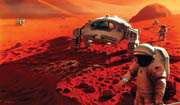
An artist rendering of a crew exploring Mars’ surface with new, as yet undeveloped and unfunded, vehicles and space suits. Photo: NASA/Pat Rawlings of SAIC.


Mars, the red planet, has captivated mankind throughout history; it is an orb that, next to the moon and Venus, is Earths closest celestial neighbor. But close is relative; setting foot on the craggy ground of a planet that sits millions of miles away and has wild fluctuations in temperatures is the stuff of science fiction and of fantasy.

It may also be a mission that is thoroughly achievable, according to a Presidential commission on the future of the country's space program.

In January, President Bush released his vision for the future of space program. It was a vision of returning to the moon, and from there launching the human race into the galaxy with human and robotic missions. The President created the Commission on Implementation of United States Space Exploration Policy and gave it 180 days to come up with a plan that would "give NASA a new focus and vision for future exploration," the President said Jan. 14. "We will build new ships to carry man forward into the universe, to gain a new foothold on the moon to prepare for new journeys to worlds beyond our own."

In mid-June that nine-member commission, released a report that found that the President's vision was an ambitious plan that is fraught with potential failure and risk, but that it is doable and should be done. It is hoped that the mission will inspire young people to enter technical fields, as well as add jobs and improve the competitiveness of the U.S. industrial base. "This journey of exploration will sustain vital national objectives here on Earth," said E.C. Aldridge Jr., chairman of the commission.


A new vision

The plan would reinvent the National Aeronautics and Space Administration (NASA). It would place the private sector at the forefront of a new space industry, and promote an industry that would seek to find profit in space. New technologies would need to be created, and the agency would be required to look to private industry, both in the United States and abroad, and within the current space-related industry and from unrelated fields. Prizes in the millions, even hundreds of millions, would be offered to encourage companies to enter the field.

The broad plan, which purposefully does not try to lay out the nuts and bolts of accomplishing the overarching goals, would use what Sean O'Keefe, NASA's administrator, called a building block strategy. The plan would build on a progressively complex series of missions. Each builds on the shoulders of its predecessor "with measurable milestones" and each is "executed on the basis of available resources, accumulated experience and technology readiness, according to the report.

The evolutionary aspect of this plan would begin with returning the space shuttle to flight and completing the International Space Station (ISS). After the ISS is complete, the shuttle would be phased out, in about 2010, and new ships would take its place. Next, robotic orbiters and later manned expeditions would be sent to the moon as early as 2015, but no later than 2020, and robotic missions to Mars in preparation for a future human expedition would follow.

Emphasizing pragmatic reasons for expanding the space operations, the report says that this plan would create a space industry that does not exist now. "Over the next several decades-if the exploration vision is implemented to encourage this-an entirely new set of businesses can emerge that will seek profit in space."

NASA's role, while still the lead agency and guiding force behind future space missions, would be limited to only those areas where there is "irrefutable demonstration that only government can perform the proposed activity," such as launching human crews. This requires, "extraordinary care and will likely remain the providence of the government for at least the near-term," according to the report.

The commission envisions that private industry "most immediately" can offer technology for the initial boost in low-Earth orbit for the payloads associated with the vision. The Commission believes that NASA should procure all of its low-Earth orbit launch services competitively on the commercial market. In fact, on June 21, a private company, Scaled Composites, accomplished this feat.


Enabling technologies

To accomplish these goals, a number of enabling technologies must be built and built within reasonable schedules and affordable costs. The list of potential technologies is long and evolving, and while, for the most part, not prioritized, a heavy-lift capability is at the top of the list.

According to the report, since the Apollo program and the last launch of a Saturn V, the United States has relied on the Space Shuttle for placing large payloads of roughly 55,000 pounds into low-Earth orbit. Saturn V carried a far greater payload, approximately 250,000 pounds to low-Earth orbit. Newly developed vehicles, called the Evolved Expendable Launch Vehicles (EELV) will soon come on-line with a capacity of lifting up to 50,000 pounds into low-Earth orbit or 30,000 pounds into geosynchronous transfer orbit.

Neither the shuttle's nor the EELV's lift capability is sufficient in the long term and additional capabilities must be developed. Before that can happen, interim technologies must be created ranging from hydrocarbon and hydrogen propellant engine development to advanced sensors for structural and environmental monitoring.

"Heavy-lift capability is a critical enabling technology for mission accomplishment and a plan for achieving this capability needs to be developed now," the report says.


A new way

NASA, which has already undergone much restructuring as a result of the Columbia Accident Investigation Board's report, would undergo further changes. Current NASA centers such as the Kennedy Space Center in Florida and the Langley Research Center in Virginia would be reconfigured as Federally Funded Research and Development Centers.

In addition, three new NASA organizations would be formed. These include a technical advisory board for independent advice on technology and risk mitigation plans; a cost estimating organization to ensure cost realism and accuracy; and a research and technology organization that sponsors high risk/high payoff technology advancement while tolerating periodic failures.

Finally, the Commission suggests that NASA's management practices be built around three core concepts: system-of-systems architecture; lead systems integrator procurement; and spiral, evolutionary development.

"Technology developed, problems solved and scientific discoveries made in the initial spirals must all be sequenced to support subsequent work," the report says. "America will not set out immediately to Mars. The capability to do so will emerge in time, only as part of a planned series of interrelated discoveries and accomplishments."

Share This Story

Looking for a reprint of this article?
From high-res PDFs to custom plaques, order your copy today!

Recommended Content

JOIN TODAY
to unlock your recommendations.

Already have an account? Sign In

  • 2024 Quality Rookie of the Year Justin Wise 1440x750px banner with "Quality Rookie of the Year" logo inset

    Meet the 2024 Quality Rookie of the Year: Justin Wise

    Justin Wise is an exceptional individual who has been...
    Aerospace
    By: Michelle Bangert
  • Man with umbrella and coat stands outside while it rains at night looking at a building.

    Nondestructive Testing: Is there an ethics problem?

    I was a whistleblower who exposed fraudulent activities...
    NDT
    By: Dale Norwood
  • Unraveling Deflategate: Football stadium with closeup of football on field

    Unraveling the Tom Brady Deflategate

    The Deflategate scandal erupted following the 2014 AFC...
    Measurement
    By: Greg Cenker and Henry Zumbrun
Manage My Account
  • eMagazine Subscriptions
  • Newsletters
  • Online Registration
  • Subscription Customer Service
  • Manage My Preferences

More Videos

Sponsored Content

Sponsored Content is a special paid section where industry companies provide high quality, objective, non-commercial content around topics of interest to the Quality audience. All Sponsored Content is supplied by the advertising company and any opinions expressed in this article are those of the author and not necessarily reflect the views of Quality or its parent company, BNP Media. Interested in participating in our Sponsored Content section? Contact your local rep!

close
  • Key Takeaways for Quality Leaders
    Sponsored byComplianceQuest

    Key Takeaways for Quality Leaders from the 2026 Gartner Magic Quadrant™ for QMS

  • This image shows a person seated next to a Bobcat T66 compact track loader.
    Sponsored byPolyWorks by InnovMetric

    Supercharging Digital Gauging at Bobcat North America

  • Dorsey Calibration Lab photo by Tom LaBarbera Picture this Studios
    Sponsored byDorsey Metrology International

    Ensuring Product Quality in a Competitive Manufacturing Landscape

Popular Stories

a titanium diaphragm speaker driver

The One Thing Elon Gets Right Is Designed to Scare You

This image shows a person seated next to a Bobcat T66 compact track loader.

Supercharging Digital Gauging at Bobcat North America

Dorsey Calibration Lab photo by Tom LaBarbera Picture this Studios

Ensuring Product Quality in a Competitive Manufacturing Landscape

2026 Quality Professional of the Year!

Events

June 9, 2026

Future-Proof your Quality Processes with Advanced 3D Optical CMM Technology

Discover how to effortlessly capture complex data, leverage true multi-sensor automation, and ensure continuous operation without creating inspection delays.

June 22, 2026

Automate 2026

Automate is North America's largest robotics and automation event — and the best place to take your ideas from insight to impact.
 
Our show floor features the world’s leading automation solutions, from AI and robotics to motion control, vision systems, and more. Plus, our educational conference is second to none, led by the brightest minds in automation today.
 
Ready to transform the way you work? Take the next step at Automate.
View All Submit An Event

Products

Lean Manufacturing and Service Fundamentals, Applications, and Case Studies

Lean Manufacturing and Service Fundamentals, Applications, and Case Studies

See More Products
Quality Podcast Channel Custom Content

Related Articles

  • KULRAndretti

    KULR Partners With Andretti Technologies to Bring Mars Rover Technology to EV Motorsports

    See More
  • NasaArtemis.jpeg

    NASA Science Heads to Moon on First US Private Robotic Artemis Flight

    See More
  • From the Publisher: Japan Can Learn Quality from the U.S.

    See More

Related Products

See More Products
  • Incorporating Lean: From the Factory to Front Office DVD

  • image.jpg

    Management Lessons from Taiichi Ohno: What Every Leader Can Learn from the Man who Invented the Toyota Production System

  • Juran Institute's Six Sigma Breakthrough and Beyond Quality Performance Breakthrough Methods

See More Products

Events

View AllSubmit An Event
  • December 2, 2025

    From the Field: Lessons Learned in Quality Management

    On Demand Quality management goes beyond checking boxes - it's what keeps customers, contracts and reputations strong.
  • June 24, 2025

    From Compliance Chaos to Certification Confidence: How QA Teams Can Win Audits With the Right Systems & Partners

    On Demand Audits don’t have to be stressful. In this session, you'll learn how to confidently prepare for ISO and regulatory audits by understanding the distinct roles of certification bodies and implementation partners.
View AllSubmit An Event
×

Stay in the know with Quality’s comprehensive coverage of
the manufacturing and metrology industries.

Newsletters | Website | eMagazine

JOIN TODAY!
  • RESOURCES
    • Advertise
    • Contact Us
    • Directories
    • Manufacturing Division
    • Store
    • Want More
  • SIGN UP TODAY
    • Create Account
    • eMagazine
    • Newsletters
    • Customer Service
    • Manage Preferences
  • SERVICES
    • Marketing Services
    • Market Research
    • Reprints
    • List Rental
    • Survey/Respondent Access
  • STAY CONNECTED
    • LinkedIn
    • Facebook
    • YouTube
    • X (Twitter)
  • PRIVACY
    • PRIVACY POLICY
    • TERMS & CONDITIONS
    • DO NOT SELL MY PERSONAL INFORMATION
    • PRIVACY REQUEST
    • ACCESSIBILITY

Copyright ©2026. All Rights Reserved BNP Media, Inc. and BNP Media II, LLC.

Design, CMS, Hosting & Web Development :: ePublishing