Enhance First Article Inspection

The Discus screen displays a drawing with part characteristic markers (balloons) that have been placed on the drawing, specification documents, a list of the characteristics with requirements and an image of the requirement extracted from the drawing. Source: Renaissance Services
AS 9102 has been the aerospace industry standard for first article inspections for more than five years. An aerospace supply chain quality engineer will likely have two comments about AS 9102. The first will be that AS 9102 has brought much needed discipline and consistency to the first article process. Then they will say that AS 9102 compliance requires considerable effort and commitment of resources.
Virtually all of the major aerospace primes and system integrators have adopted AS 9102 and require its application by their suppliers. With its emphasis on accountability at the characteristic level and its consistency in both reporting methods and format, AS 9102 application has helped enhance first article accuracy and reduce quality escapes at all levels of the supply chain.
These “escapes”-which often mean that nonconforming hardware reaches customers-result in costly field fixes and warranty claims. The price tag for a single major escape can easily exceed $1 million. Given the stakes involved, the first article process is viewed as an essential ingredient in the realization of process capability relative to design intent during production.
While AS 9102 has clearly provided benefits to the industry, its widespread adoption and flow down have placed increased demands on suppliers’ technical resources-particularly their quality and manufacturing engineers.
Shortly after the start of widespread AS 9102 adoption, suppliers offered anecdotal evidence of the volume of first articles and the level of human resources devoted to their completion. It was not unusual for them to cite numbers in excess of 40 hours to complete an AS 9102 compliant first article inspection. Moreover, the volume of first article inspections at some suppliers was reported to be 100 or more annually. This combination of effort and volume represented a substantial drain on their limited technical resources.
The first challenge was to better understand the validity of these numbers. If they were supported by objective data, there would be a clear indication of the need for better, more efficient methods and tools for the AS 9102 process.

The Net-inspect screen example displays AS 9102 Form 3 data entry screen with requirement data extracted with Discus automatically filled in. Source: Renaissance Services
Needs Analysis
In 2004, the Air Force awarded a contract for the Electronic Industry-wide Network for Characteristics & Specifications (e-LINCS) to Renaissance Services. The e-LINCS program seeks to establish and implement universally accessible tools to flow detailed technical requirements to all levels of the aerospace supply chain-both commercial and military.A key task in the early phases of e-LINCS was an extensive needs analysis. Its objective was to achieve a fundamental understanding of how the flow, interpretation, verification and management of detailed technical requirements took place in the supply chain. Part of this assessment was to better understand the existing first article process and determine if actual data would support the anecdotal reports.
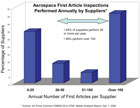
The needs analysis was a comprehensive effort that combined case studies, site visits and surveys, with a primary focus on the second and third tiers of the aerospace supply chain. The median supplier size was fewer than 100 employees. Overall, the needs analysis supported the anecdotal evidence. The suppliers reported that two first articles per week was not an unusual workload. In fact, 46% experience that volume, and 64% perform at least two first article inspections each month.
In terms of resource commitment, 57% of the suppliers reported devoting at least one full-time person to first articles, while some 40% have more than one dedicated person. Those suppliers with 100 or fewer employees are committing 1% to 2% of their total human resources to first articles. In terms of their technical resource base-where the entire quality and engineering staff might consist of five people or less-the commitment can run as high as 50%. The aerospace supply chain consists of thousands of suppliers; within that group, AS 9102 compliance was revealed to be consuming millions of labor hours.
Improve Productivity
The volume of activity and level of resource commitment associated with AS 9102 compliance offers a clear opportunity for tools that enable efficiency. At first they focused on completion of the AS 9102 forms. These forms, with some modest tailoring, are the same across the industry. Electronic and Web-based systems have added some intelligence and reusability to the AS 9102 forms.Intelligence is typically illustrated through tolerance bands in the forms’ measurement results fields. When a value is entered, its pass/fail status is immediately indicated, usually with a color code. This allows suppliers and their customers to easily find out-of-tolerance characteristics and manage the exceptions.
Reusability provides for modification to individual characteristics associated with revision levels, allowing these changes to take place without the necessity to create an entirely new set of AS 9102 forms. Because these systems are Web-enabled, aerospace primes can adopt and make them accessible to suppliers through their existing supply chain portals.
The most widely used of these systems-with more than 800 active suppliers-is offered by Net-Inspect. It includes AS 9102 compliant formats, Web-enabled access and features that enhance the efficiency and accuracy of the first article process. Application is growing, with some 15,000 AS 9102 compliant first article inspections completed using this system.
Tools that enable more efficient completion of AS 9102 forms assist the input, or back-end stage of the first article process. The Air Force-sponsored needs analysis, however, indicated that the most labor-intensive, error-prone part of the process was during the front-end, characteristic identification stage. At this point each dimension, geometry, note and specification is given a unique identification number in the form of an indicator, or “balloon.”
The manual ballooning process involves a quality engineer, armed with a straightedge, a template and a pencil, poring over a drawing and painstakingly marking each characteristic to be included on the AS 9102 forms. These inputs are then manually transcribed onto the forms. The shortcomings in this process are obvious-manual intensity, opportunity for transcription errors and inability to effectively distribute or reuse the ballooned drawing.
Since completion of the needs analysis in late 2004, software tools that can enhance the characteristic identification process have been made available commercially. These tools allow suppliers to take an electronic version of a paper drawing, such as a PDF or a CAD image, and rapidly and accurately identify, number and organize each characteristic. They can then take these characteristics and seamlessly upload them to a variety of electronic AS 9102 formats, ranging from Excel to Net-Inspect. The most widely applied commercially available ballooning tools are DISCUS and BCT’s Inspector. Both offer electronic characteristic identification and automated upload to the full range of AS 9102 formats. The quality engineers who have applied these tools report productivity gains as high as 70%.

Promising Results
As companies adopt the tools, both their results and enthusiasm for the products grow. Ferco Tech (Franklin, OH) produces components for jet engines. Company chairman Joseph Murphy notes, “These tools provide a two-fold benefit. First, they greatly enhance the productivity of our quality engineers. But the real savings is in their error-proofing capabilities. If something escapes, it’s hard to calculate the cost. But the software gives you more assurance that products will be built right the first time, saving more than what we would ever pay for the service.” These comments are reinforced by the results at a large aerospace company that applied tools for AS 9102 compliance across its supply chain. Within two years of implementation, quality escapes were reduced by 53%.Robert Sprole, president of Therm (Ithaca, NY), a producer of complex turbine components, reports, “We have been using a PC-based blueprint ballooning software product that produces a FAIR in the AS 9102 format. The industry-wide adoption of such a system would definitely enhance productivity and compliance to AS 9102.” Therm, which uses the DISCUS tool, is one of the sites where 70% gains in productivity have been achieved.
William Lewandowski, vice president of supplier management for the Aerospace Industries Association (Arlington, VA), is responsible for finding ways to improve the working relationship between aerospace primes and their suppliers. One area of particular concern for Lewandowski is the way in which technical requirements are flowed throughout the supply chain. After reviewing a fully integrated application of characteristic identification and AS 9102 reporting tools, he says, “We have an extended supply chain that is constantly being asked [by the primes] to take on more responsibility for the ultimate product. This is just what the industry needs to improve quality and enhance productivity at every level.”
AS 9102 application has proven its value to the aerospace industry. Most suppliers agree that adoption has made it easier to work with their various customers during the first article process. There is similarly a growing level of enthusiasm for the tools that make AS 9102 compliance more efficient. As these tools continue to evolve, the level of productivity and the resulting gains will lead to continually higher quality and more affordable products at every level of the aerospace supply chain.
Tech tips
- AS 9102 has been the aerospace industry standard for first article inspections for more than five years.
- Virtually all of the major aerospace primes and system integrators have adopted AS 9102 and require its application by their suppliers.
- With its emphasis on accountability at the characteristic level and its consistency in both reporting methods and format, AS 9102 application has helped enhance first article accuracy and reduce quality escapes at all levels of the supply chain.
Looking for a reprint of this article?
From high-res PDFs to custom plaques, order your copy today!