Hardness Testing Help
Hardness testing-a quick, relatively inexpensive nondestructive test-is used to characterize materials and determine if they are suitable for their intended use. Though many complex tests are available, hardness testing gets the job done.
Instron’s (Norwood, MA) Wilson Instruments introduced the first Rockwell tester to the market more than 80 years ago. Stanley P. Rockwell invented the test that changed hardness testing and allowed the part to be used after testing. Today the company’s hardness testing product lines include Rockwell along with microindentation, automatic computer controlled systems, Brinell, portable testers, Shore durometers and accessories.
The industry encompasses a range of applications, products and choices. For those applications requiring a hardness test, there is no shortage of options for testing materials.
“It’s the easiest and fastest test to see if it fits the purpose,” says John Piller, a specialist from Zwick Roell’s (Ulm, Germany) Indentec hardness testing division. “A room temperature hardness test gives a customer a very quick and accurate means to see if the sample fits the purpose.”
Zwick Roell provides a range of hardness testers for tests on metals, plastics, rubber and special materials according to all relevant and worldwide standards. The company offers hardness testing solutions from standard applications up to fully automatic and high-end test systems. With such a focus on traceability, Piller says everything the company offers is certified.
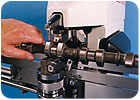
A range of hardness testers is available for use on metals, plastics, rubber and special materials according to all relevant and worldwide standards. Source: Zwick Roell
Automation Ahead
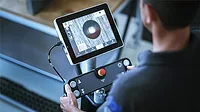
Among the range of hardness testing products available, automation is generating particular interest.“One of our big focuses right now is both developing and selling the automatic products,” says Bill O’Neill, Americas sales manager for hardness products at Wilson Instruments/Instron. “It has been a growing trend, and it continues with the economic situation. People realize they have to do more with less.”
More customers want automated systems, primarily to speed up their process, Piller says. In addition, automated vision systems also reduce the uncertainty of measurement.
“In essence, the smaller the uncertainty, the better,” Piller says.
Another growing requirement is for specialized tooling, Piller says, allowing a test component to test complex shapes. With the correct support and tooling, fixtures make the job easy.
While hardness testing experienced steady growth during the past 10 years, Piller says, in the past six months, the company has seen a small downturn in requirements for a number of machines, but an increase in requirements for automation. This year, Piller predicts sales may increase due to the complexity of systems they are selling.
Zwick Roell has hundreds of robotic systems working around the world, which include hardness testing. Some systems allow a range of tests-such as hardness, roughness, tensile or impact-on the same sample. While these types of products are in the minority, they are equal in order value, Piller says.
Robotic systems often work best when manufacturers have continuous production feeding a product into the robotic system, such as steel or other raw material manufacturers. Though these complex robotic systems may be ideal, a basic hardness tester can still get the job done. If necessary, customers can then upgrade to more advanced testing methods at a later date.
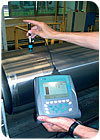
When testing the hardness of a steel roll, the roll hardness must be within a certain range for optimal performance without failure. Source: Proceq
Getting It Right
Hardness testing, though a basic test, must be done correctly, and Zwick Roell often receives requests for information and support.If operators do not understand the basics of hardness testing, this can create problems. Using the machine to do something it is not supposed to do is another problem, Piller says.
Tom Ott, sales and marketing manager of Proceq USA Inc. (Aliquippa, PA), says the biggest mistake he sees is companies trying to test a surface without smoothing it out to clean grease or remove paint. Because it is a surface-related test, anything that gets between the metal and the indenter is going to cause a problem, Ott says. Smoothing the sample with sandpaper can solve this issue.
Using equipment that does not match the application is another common mistake. Matching the application and the tester will ensure the best results and minimize false readings. To learn what hardness tester would work best for an application, consult the suppliers. They likely have seen the application before and can suggest the best fit.
Suppliers also can provide upgrades for new machines as customers aim to comply with new accuracy standards. For some applications the test time is 20 to 30 seconds, but preparing the sample takes five minutes. Customers always want to reduce or eliminate the prep time for the sample, Piller say.
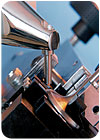
Understanding the basics of hardness testing can prevent problems with the test method. Source: Zwick Roell
Worldwide Standards
The global nature of business is another issue to consider when hardness testing, as hardness testing methods differ. O’Neill says the Americas are more of a Rockwell territory, whereas Europe uses more Knoop and Vickers. When working with people in other parts of the world, companies may need to adapt to the different types of testing.If production is done around the world, it also is important to ensure that NIST standards, as well as those in China, Russia and South Africa, all have the same standard primary calibration machines.
Rich Wismer, regional sales manager at Newage (Feasterville, PA), a division of Ametek, says today’s companies need to meet both ASTM and international standards. “Companies need to be able to do business every place to do business well,” Wismer says.
Keeping up with ASTM standards is important, as the ASTM standards have changed in the past several years.
“That’s one place that a customer can lean on a supplier to keep them up to date on some of these changes,” Wismer says. “They should also be doing a little more homework to make sure they’re not missing things.”
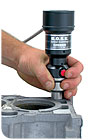
A Brinell scope is used on an engine block. Source: Newage Testing Instruments, Ametek Inc.
Portable Priority
Ott says Proceq’s portable hardness testers, the Equotip and the Equostat, offer convenient testing, even for those unfamiliar with the test.However, every test has its limitations, and hardness testers such as the Equotip are no different, Ott says. Physics limit the size and thickness of the hardness being tested. In the Equotip’s case-and unlike benchtop testers-the bigger the part, the easier it is to measure. The Equotip uses a Leeb rebound testing method, a dynamic hardness test developed by Proceq.
While Rockwell or Brinell tests measure the effort to put a permanent indentation on the surface, Ott says the Equotip measures the loss of speed. But if the part is not a good fit for the tester, say, too small or too thin, this can create false readings. In that case, the Equistat would come in. Like Rockwell tests, it measures a depth of indentation rather than vibration.
In Ott’s more than a decade in hardness testing, he has seen equipment change significantly, particularly the portable tester environment. Companies have provided smaller products with more complex displays. The latest products display the hardness readings and conversions to other hardness scales that customers can program directly into the device. The tester also can identify locations by bar code, and provides an onboard data storage of more than a 100,000 readings.
“That’s a lot, but you’d be surprised,” Ott says. “Working in a production mode, you can fill that in pretty fast.”
Hardness testing use is tied to industry, Ott says, and if industry shrinks, so does the demand. Once a car is assembled and on the showroom floor, it won’t need a hardness test, he points out. While automotive may not be growing, Ott says hardness testing is still a stable industry and used in a variety of industries.
“Just about any industry that’s working with metal is a customer of ours,” Ott says, including large forgings and castings such as engine blocks, tooling and the stamping industry.
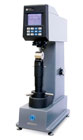
This Rockwell hardness tester works for flat and cylindrical work pieces in both laboratory and workshop testing. Source: Wilson Instruments
Throughput can be one of the most important factors, Wismer agrees. A Rockwell benchtop tester would work for most applications, but if operators need to test 200 parts per hour, specific fixturing would be required.
“That is probably the one place where customers err on the side of saving money,” Wismer says, “not thinking about throughput and how much time it takes to get it done.” While this approach may cost less upfront, costs down the road are often higher.
“The numbers of parts that need to go through the machine is very critical,” says Wismer.
The training of the operator is another factor to consider, Wismer says. If the operator has many other duties, the supplier can put the knowledge into the piece of equipment.
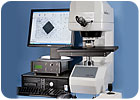
Hardness testing solutions vary from standard applications up to fully-automatic and high-end test systems. Source: Zwick Roell
The Future
While hardness testers have been around for many years, they-like computers and other technology-also have evolved and improved.Many applications require the smallest possible indentation on a finished part, and the trend is moving toward using significantly smaller test forces and indentations, which may be due to more testing requirements in pharmaceutical and biomedical. Automotive and aerospace are well established with hardness testing machines, but as the use expands, less instrusive, more nondestructive testing is becoming a priority. Q
For more information on the companies mentioned in this article, please visit:
Instron, www.instron.com
Newage Testing Instruments, www.hardnesstesters.com
Proceq, www.proceq.com
Zwick Roell, www.zwick.com
Quality Online
For more information on hardness testing, visit www.qualitymag.com to read the following:“Easier Hardness Testing”
“Not So Hard”
“Rockwell Standard Revealed”
Tech Tips
Looking for a reprint of this article?
From high-res PDFs to custom plaques, order your copy today!