Ultrasonics Offers Flexibility

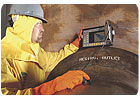
Weld inspection using a phased array instrument
is shown here. Source: GE Inspection Technologies
Ultrasonics is that branch of science and technology that uses either the transmission or the transmission and reflection of sound waves within a medium to detect discontinuities or other objects within that medium. These sound waves are transmitted at frequencies above that of normal sound and that, nominally, describes anything above 20 kilohertz. Bats navigate by ultrasound at frequencies in the range 20 to 100 kilohertz but industrial ultrasonics employs frequencies in the range of 500 kilohertz to 20 megahertz.
As new materials and new methods are employed in the manufacture of new products from aircraft to ships to munitions, ultrasonics is increasingly deployed to help solve inspection problems, which has proved difficult for other more mature modalities.
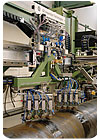
Automated spiral SAW pipeline inspection is demonstrated. Source: GE Inspection Technologies
Early Developments
Developments in ultrasonics have taken place in three separate areas: probes or transducers, instrumentation and data analysis. Naturally, these developments have not taken place in isolation but developments in the specific areas have allowed a synergistic development in the technology as a whole.Early ultrasonic transducers used the properties of quartz crystals to change their size when an electrical voltage is applied. It was found that by applying an alternating voltage, these piezoelectric crystals could be made to oscillate at very high frequencies, generating high-frequency sound waves. Another useful feature of piezoelectric crystals was that they generate a voltage when a force is applied to them, so they can operate as both ultrasonic transmitters and ultrasonic receivers. Today, transducers use piezoceramic materials, such as lead zirconate titanate, but new materials such as piezo-polymers and composites also are being adopted.
The first ultrasonic transducers were longitudinal, or compression, transducers and two types evolved: contact and immersion. Contact transducers were used for manual inspections, as they still are, and are coupled to the component being inspected by water, grease or oils. Immersion transducers operated in a liquid environment, such as a water tank, and still are used in fixed inspection systems, predominantly during manufacturing processes.
Further developments saw the appearance of dual-element transducers, with discrete transmitting and receiving elements and then delay line transducers, where there is a time delay between the generation of the sound wave and the reception of any reflected signal. At the same time, angle beam transducers were developed to provide improved inspection of welded areas.
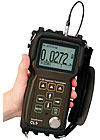
Battery-powered, digital thickness gages can offer both A-scan display
and recording of thickness as well as a digital readout, to make data
collection easier and better. Source:
GE Inspection Technologies
Equipment
Much the same as today, early flaw detectors used a generator to supply the AC voltage to produce the ultrasound and then used the received echo or through transmission to produce a voltage. Fortunately, the electronics to make sense of this information became available in the 1940s, with the result that ultrasonic data could be displayed on a cathode ray oscilloscope and the ubiquitous A-scan was born. As is to be expected, these devices were valve-based, heavy and not very portable, although they did prove efficient and reliable. With advances in electronics came size reduction and portability, as well as unexpected advances such as automated ultrasonics.With the invention of the multiplexer, it became possible to mount a number of probes on a controllable carrier and fire them in any sequence, while the carrier was moved around a pipe or weld, for example. Much of this technology derived from the burgeoning nuclear sector, where inspection accessibility posed a constant problem, but it was soon adopted in other sectors, notably the process and oil industries.
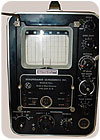
Much the same as today, early flaw detectors used a generator to supply
the AC voltage to produce the ultrasound and then used the received echo or
though transmission to produce a voltage. Source:
GE Inspection Technologies
Data Analysis
Data display and analysis was originally restricted to interpreting A-scan information. This needed skillful manipulation of the various parameters involved and then a great degree of expertise to provide an assessment of the displayed data. All of which imbued ultrasonics with an aura of mystique. Fortunately, various other data display and analysis techniques evolved, not least the C-scan, a 2-D graphical presentation in which the discontinuity echoes are displayed in a top view on the test surface.Display media also have improved, notably with the introduction of LED and LCD screens, but the area where greatest advances have been made has been that of data analysis. Flaw and corrosion detection has been eminently achievable since the birth of the technology. However, the holy grail has always been the accurate sizing and characterization of flaws and corrosion. Flaws were originally sized using the simple 12 decibel (dB), or 6 dB or 20 dB, drop method, where the flaws’ extremities were identified when the received signal dropped by a gated 12 dB. This was complemented in the 1980s by techniques such as time of flight diffraction, first announced in 1977, where wave diffraction from the tips of a flaw provide a more accurate indication of size.
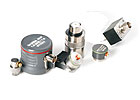
A typical range of probes is displayed here. Source:
GE Inspection Technologies
Ultrasonics Today
The evolution of ultrasonics as an inspection technology has been brought about because of the developments in transducers, equipment and methods of data analysis to produce inspection systems to meet specific needs.For example, current battery-powered digital thickness gages offer both A-scan display and recording of thickness, as well as a digital readout, to make data collection easier and better. Furthermore, built-in data logging allows thousands of measurements to be recorded, and easy and flexible data management is provided through optional programmable data recorders, using standard SD cards, which can be downloaded to a PC for further analysis.
Standard flaw detectors also have evolved and now have built-in algorithms to provide fast and accurate sizing and characterization of flaws. They operate with a range of transducers, such as high temperature transducers, transducers of various geometries and dialogue transducers, which provide fail-safe identification to ensure inspection reliability.
Transducer manipulation systems, too, have kept pace with advances in electronics and today’s girth weld inspection and other crawler systems feature the latest multiplexing and positional encoding technology.
Recent developments in girth weld inspection have seen the introduction of phased array transducers, which now are even finding their way into standard flaw detection equipment, allowing operators more flexibility and asset owners more confidence. However, as well as allowing greater probability of detection and reducing inspection times, one of the prime advantages of phased array technology lies in its imagery. Although phased array systems can produce conventional A-, B-, C- and D-scans, they also create sector scans, which are real-time images of the component being inspected.
The automation of inspection processes also has advanced with the development of installed sensors. Currently, these are used to monitor corrosion, predominantly in the oil and gas sector, but could well be extended to other applications.
Perhaps the area of greatest growth in ultrasonics has been in the creation of software to allow data analysis to be more reliable, more comprehensive, more usable and more understandable. This is because it is often not sufficient merely to detect a flaw or corrosion. Increasingly, there is a need to qualify that flaw or corrosion and provide some indication of its effect on the expected life or required function of the component or piece being inspected.
As a result, inspection data must be suitable for on-board and off-line analysis and new analysis tools have been developed to meet the requirements of new manufacturing methods, new materials and new inspection techniques.
One area which is attracting a great deal of attention is the development of automatic defect recognition tools, which will go a long way to improving the efficiency and reproducibility of the inspection process.
The Future
Trying to predict the future is always fraught with danger. However there is no doubt that ultrasonics will continue to develop.
On the probe front, for example, current research programs are looking at capacitive micromachined ultrasonic transducers, which offer advantages over piezoelectric transducers, particularly in terms of their small size and low manufacturing cost. Flaw detectors increasingly contain more on-board functionality and analytical capability to provide operators with data that is more comprehensive and, at the same time, easier to understand.
However, the greatest advances will probably be in the software applied in the NDE sector generally, where an emerging generation of software offers a step change in the ability to meet inspection needs while allowing interchangeability and communication between different inspection systems. These new software developments break down software functionality into three separate but connected areas.
First, data acquisition software must be able to interact with the inspection source to collect digital information. Then review and analysis software accepts the acquired data, as well as data from other relevant sources and features application tools for analysis, enhancement and measurement. Then management of all the generated information is carried out by archiving software, which can provide on-line and near-line image storage, as well as single media archiving by CD/DVD for distribution and viewing on any PC. As a result, information sharing is simplified and flexible and access to any information is much faster.
These software developments also create other possibilities. For example, databases created by the archiving and storage software open the way for developments in data mining, where different databases, typically relating to flow, temperature and pressure, can be compared and analyzed to investigate the effect that these and other parameters have on defect development. This takes NDT into diagnostics akin to medical diagnostics, where it will be possible to forecast future trends and treat the underlying cause of the defect rather than merely correcting the defect itself.
Data fusion also is an area of future software development, allowing the fusing of information from different sensors of the same NDT modality, as well as the fusing of information from sensors of different modalities. This will be carried out using data stored from previous inspections, to provide a better analysis platform. Data also can be compared from simultaneous inspections, such as eddy current information for surface inspection and ultrasonic information for volumetric inspection.
Yet another area under investigation is the development of software to allow inspection data to control manufacturing processes via statistical process control programs.
Ultrasonics is the youngest of the NDE modalities. Like all of the other modalities, it alone does not offer a universal solution to inspection problems. It is however, a powerful and flexible inspection tool and will continue to play an important part in the growth and development of the discipline of nondestructive examination.
Looking for a reprint of this article?
From high-res PDFs to custom plaques, order your copy today!


