Advances in Spectroscopy Spark New NDT Applications
With increases in sensitivity and decreases in size and cost, spectroscopy is now an option for quality analysis in a growing number of industries.

Spectroscopy, the study of the interaction of light and matter, has long been a staple of laboratory analysis. In recent years, advances in equipment and technology have made in situ, real-time measurements in environments outside the lab a reality, opening up a wide range of applications in science and industry.
There are dozens of types of spectroscopy, depending on the elements under study and methods, and equipment used. For the purposes of quality testing, laser induced breakdown spectroscopy (LIBS) is emerging as a viable standard for elemental analysis due to its minimal sample preparation, real-time response, sensitivity and ability to generate a great deal of data from a single event.
As explained in detail below, LIBS is not, strictly speaking, a nondestructive technique. However, the laser ablation used is so small that for all practical purposes, it is considered a nondestructive test method. It is even considered safe enough for use on delicate pieces of art and antiques.
The complexity, limited spectral coverage, and bulky and expensive nature of early LIBS systems confined them to the laboratory for use in only very specific applications, such as characterization of metal alloys. Current systems feature simplified operation, expanded spectral coverage over the entire range of 200 to 980 nanometers, compact footprint and lower investment costs. Beyond metals detection, LIBS is now used in environmental monitoring, medical diagnosis, biochemical agent detection and industrial quality testing, offering an alternative to traditional methods such as fluorescence spectrometry and mass spectrometry.
Samples are ablated with a high power short-pulse laser (~7 nanoseconds) to create a microplasma. By converting the sample into a plasma, the chemical bonds are broken, producing electronically excited atoms and ions that give off resonant and sharp radiation at specific wavelengths. A simple setup consisting of an optical fiber and spectrometer with a charge-coupled device array detector captures and resolves the light energy emitted by these atomic components, reading each element’s discrete spectral fingerprint.
 By capturing the light from the microplasma within the 200 to 980 nanometer range, elements are identified by their specific wavelengths; chemical abundances are measured by the intensity of the light at specific wavelengths; and all matter is detected since all elements have emission lines in the 200 to 980 nanometer range.
With a response time of less than 1 second, LIBS provides real-time data essential in fast moving production and industrial environments. Inherently very sensitive, it generates a tremendous amount of data from the tiny amount of matter (picogram to nanogram) that is ablated each time a laser fires. A usable spectrum is produced by every laser shot.
The technique is very good at interrogating small areas, making it very useful for impurity and defect analysis. The test area is invisible to the naked eye. The depth of sample penetration is operator controlled, and falls between approximately 50 to 100 to microns.
By incorporating high-speed data transfer technology, such as USB 2.0 in these systems, full spectral scans can be sent to a PC’s memory in less than 100 milliseconds, raising elemental qualification to computer speed. The spectrometer system is designed to provide ~ 0.1 nanometer full width half maximum (FWHM) resolution, therefore enabling the system to resolve very discrete emission line structures.
LIBS is much simpler than mass spectrometry, the most popular characterization technique, as it can operate at atmospheric pressure in order to produce useful plasma emission intensities. Mass spectroscopy also is costly, requires time-consuming sample preparation and is not field-portable. For LIBS analysis, little or no sample preparation is required, making the technique easy to use in industrial environments.
Other common techniques such as scanning electron microscopy-energy dispersive spectroscopy (SEM/EDS), electron probe microanalysis (EPMA), X-ray fluorescence (XRF) and laser ablation-inductively coupled plasma-mass spectrometry (LA-ICP-MS) all have inherent drawbacks when compared with LIBS. For production environments where multiple systems may be deployed, LIBS makes the most sense economically. The least expensive of the alternative methods (SEM/EDS and XRF) are roughly double the cost of LIBS; the most expensive (EPMA) is close to 10 times more costly. However, cost is not at the expense of performance as its analysis time is far faster than competitive technologies, with good discrimination. With the highest ease of use, LIBS transfers well to industrial floors where users are not necessarily trained scientific researchers.
LIBS has been used in chemical analysis since the early 1980s; today its applications range from art restoration and environmental analysis to the more sobering tasks of identifying hazardous materials, potential disease, and chemical and biological warfare agents. It has been used to analyze soil composition for remediation of heavy metals contamination and to detect cancer cells in tissues.
This type of spectroscopy can be used for analyzing trace amounts of materials, making it practical for use as a scanning tool. Hazardous materials and contaminants introduced into production lines can spell disaster for a number of industrial products. In standoff-mode, the spectroscopy method is used to rapidly interrogate large volumes of containers, such as finished products or raw materials on a conveyor belt, or to quickly examine single items.
LIBS systems have been introduced into recycling sorting lines to quickly identify the elemental composition of aluminum alloys. It also is being used to determine the chemical fingerprint of gems, including properties of industrial diamonds. Its use in testing electronics for the presence of lead, cadmium, mercury and other dangerous substances for RoHS compliance is growing.
LIBS also has been shown to be effective in materials analysis such as testing concrete building materials for chloride and sulfur damage. The possibilities continue to grow as customers work with LIBS systems manufacturers to develop custom solutions for their testing needs.
In traditional LIBS analysis, the sensitivity is determined by the duration, size and characteristics of the microplasma generated by the laser. Adding a microwave cavity to the process visibly increases the plasma size and extends its lifetime. In LAMPS, a very small, contained microwave field interacts with the larger plasma, resulting in 10 to 1,000 times improvement in sensitivity depending on sample type.
The microwave cavity uses the same frequency as a consumer microwave oven. It is safe to use an industrial environment without any additional special shielding. Despite being a microwave system, LAMPS is still compatible with metals analysis as only the laser pulse plasma, and not the sample itself, is introduced into the microwave chamber.
Application of the new LAMPS technology, as well as progress in the miniaturization of LIBS and LAMPS components such as compact high power lasers and technological improvements in charge-coupled device array spectrometers, sampling probes and batteries, will make possible the further development of lightweight, portable systems for even more commercial quality control and testing applications.
A relatively simple laser spark analytical technique, LIBS can determine the elemental composition of various solids, liquids and gases.
With a response time of less than 1 second, LIBS provides real-time data essential in fast moving production and industrial environments.
The latest advance in LIBS technology is laser assisted microwave plasma spectroscopy.
A complete LIBS system operation. Source: Ocean Optics
Spectroscopy, the study of the interaction of light and matter, has long been a staple of laboratory analysis. In recent years, advances in equipment and technology have made in situ, real-time measurements in environments outside the lab a reality, opening up a wide range of applications in science and industry.
There are dozens of types of spectroscopy, depending on the elements under study and methods, and equipment used. For the purposes of quality testing, laser induced breakdown spectroscopy (LIBS) is emerging as a viable standard for elemental analysis due to its minimal sample preparation, real-time response, sensitivity and ability to generate a great deal of data from a single event.
As explained in detail below, LIBS is not, strictly speaking, a nondestructive technique. However, the laser ablation used is so small that for all practical purposes, it is considered a nondestructive test method. It is even considered safe enough for use on delicate pieces of art and antiques.
The complexity, limited spectral coverage, and bulky and expensive nature of early LIBS systems confined them to the laboratory for use in only very specific applications, such as characterization of metal alloys. Current systems feature simplified operation, expanded spectral coverage over the entire range of 200 to 980 nanometers, compact footprint and lower investment costs. Beyond metals detection, LIBS is now used in environmental monitoring, medical diagnosis, biochemical agent detection and industrial quality testing, offering an alternative to traditional methods such as fluorescence spectrometry and mass spectrometry.
A Lesson in LIBS
A relatively simple laser spark analytical technique, LIBS can determine the elemental composition of various solids, liquids and gases. By focusing a high-power laser pulse on a sample, a plasma or laser spark is generated. A time-gated spectrometer collects and analyzes the light energy emitted by the plasma’s atoms and ions, using the atomic spectral lines to determine elemental composition-and concentrations in some systems.Samples are ablated with a high power short-pulse laser (~7 nanoseconds) to create a microplasma. By converting the sample into a plasma, the chemical bonds are broken, producing electronically excited atoms and ions that give off resonant and sharp radiation at specific wavelengths. A simple setup consisting of an optical fiber and spectrometer with a charge-coupled device array detector captures and resolves the light energy emitted by these atomic components, reading each element’s discrete spectral fingerprint.
This is a photographic representation of the same sample plasma under traditional LIBS Analysis (left) and microwave-enhanced with LAMPS (right). Source: Envimetrics Corp.
With a response time of less than 1 second, LIBS provides real-time data essential in fast moving production and industrial environments. Inherently very sensitive, it generates a tremendous amount of data from the tiny amount of matter (picogram to nanogram) that is ablated each time a laser fires. A usable spectrum is produced by every laser shot.
The technique is very good at interrogating small areas, making it very useful for impurity and defect analysis. The test area is invisible to the naked eye. The depth of sample penetration is operator controlled, and falls between approximately 50 to 100 to microns.
By incorporating high-speed data transfer technology, such as USB 2.0 in these systems, full spectral scans can be sent to a PC’s memory in less than 100 milliseconds, raising elemental qualification to computer speed. The spectrometer system is designed to provide ~ 0.1 nanometer full width half maximum (FWHM) resolution, therefore enabling the system to resolve very discrete emission line structures.
LIBS is much simpler than mass spectrometry, the most popular characterization technique, as it can operate at atmospheric pressure in order to produce useful plasma emission intensities. Mass spectroscopy also is costly, requires time-consuming sample preparation and is not field-portable. For LIBS analysis, little or no sample preparation is required, making the technique easy to use in industrial environments.
Other common techniques such as scanning electron microscopy-energy dispersive spectroscopy (SEM/EDS), electron probe microanalysis (EPMA), X-ray fluorescence (XRF) and laser ablation-inductively coupled plasma-mass spectrometry (LA-ICP-MS) all have inherent drawbacks when compared with LIBS. For production environments where multiple systems may be deployed, LIBS makes the most sense economically. The least expensive of the alternative methods (SEM/EDS and XRF) are roughly double the cost of LIBS; the most expensive (EPMA) is close to 10 times more costly. However, cost is not at the expense of performance as its analysis time is far faster than competitive technologies, with good discrimination. With the highest ease of use, LIBS transfers well to industrial floors where users are not necessarily trained scientific researchers.
LIBS has been used in chemical analysis since the early 1980s; today its applications range from art restoration and environmental analysis to the more sobering tasks of identifying hazardous materials, potential disease, and chemical and biological warfare agents. It has been used to analyze soil composition for remediation of heavy metals contamination and to detect cancer cells in tissues.
This type of spectroscopy can be used for analyzing trace amounts of materials, making it practical for use as a scanning tool. Hazardous materials and contaminants introduced into production lines can spell disaster for a number of industrial products. In standoff-mode, the spectroscopy method is used to rapidly interrogate large volumes of containers, such as finished products or raw materials on a conveyor belt, or to quickly examine single items.
LIBS systems have been introduced into recycling sorting lines to quickly identify the elemental composition of aluminum alloys. It also is being used to determine the chemical fingerprint of gems, including properties of industrial diamonds. Its use in testing electronics for the presence of lead, cadmium, mercury and other dangerous substances for RoHS compliance is growing.
LIBS also has been shown to be effective in materials analysis such as testing concrete building materials for chloride and sulfur damage. The possibilities continue to grow as customers work with LIBS systems manufacturers to develop custom solutions for their testing needs.
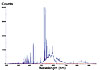
Shown here is a comparison of spectra generated by metal slurry sample under traditional LIBS (in red) and microwave-enhanced with LAMPS (purple). Source: Ocean Optics
LAMPS Opens Possibilities
Initial deployments of LIBS systems have shown its versatility and discriminating capability. The latest advance in LIBS technology is laser assisted microwave plasma spectroscopy (LAMPS). A proprietary method and instrument, LAMPS offers even greater sensitivity for qualitative analysis of trace elements.In traditional LIBS analysis, the sensitivity is determined by the duration, size and characteristics of the microplasma generated by the laser. Adding a microwave cavity to the process visibly increases the plasma size and extends its lifetime. In LAMPS, a very small, contained microwave field interacts with the larger plasma, resulting in 10 to 1,000 times improvement in sensitivity depending on sample type.
The microwave cavity uses the same frequency as a consumer microwave oven. It is safe to use an industrial environment without any additional special shielding. Despite being a microwave system, LAMPS is still compatible with metals analysis as only the laser pulse plasma, and not the sample itself, is introduced into the microwave chamber.
Application of the new LAMPS technology, as well as progress in the miniaturization of LIBS and LAMPS components such as compact high power lasers and technological improvements in charge-coupled device array spectrometers, sampling probes and batteries, will make possible the further development of lightweight, portable systems for even more commercial quality control and testing applications.
Tech Tips
Looking for a reprint of this article?
From high-res PDFs to custom plaques, order your copy today!