Management
A Feeling of Accomplishment
Quality professionals are satisfied with their career, according to our State of the Profession Survey

What is your primary business/industry?
Which of the following resources do you expect to see increased during the next 12 months? (Select all that apply)
Region
For how many years have you been employed at your current company?
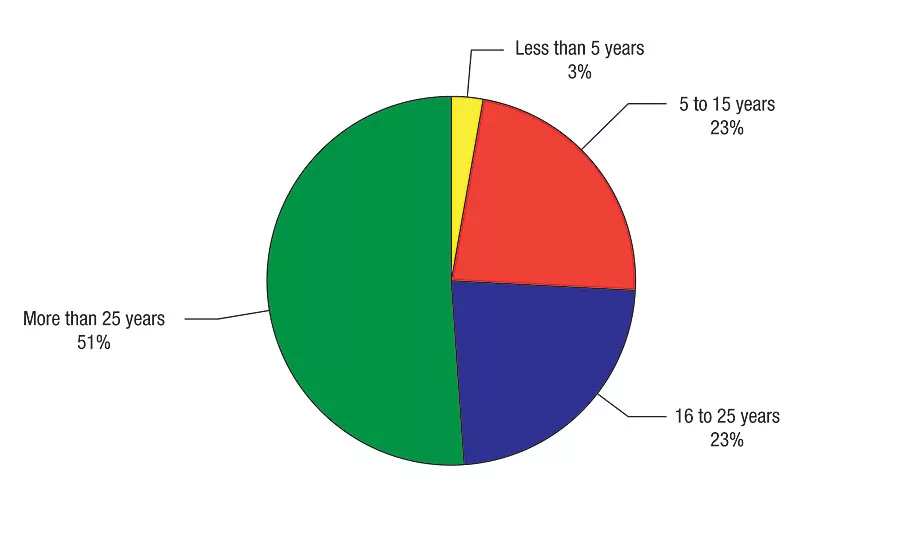
How many years of experience do you have in the quality manufacturing industry?
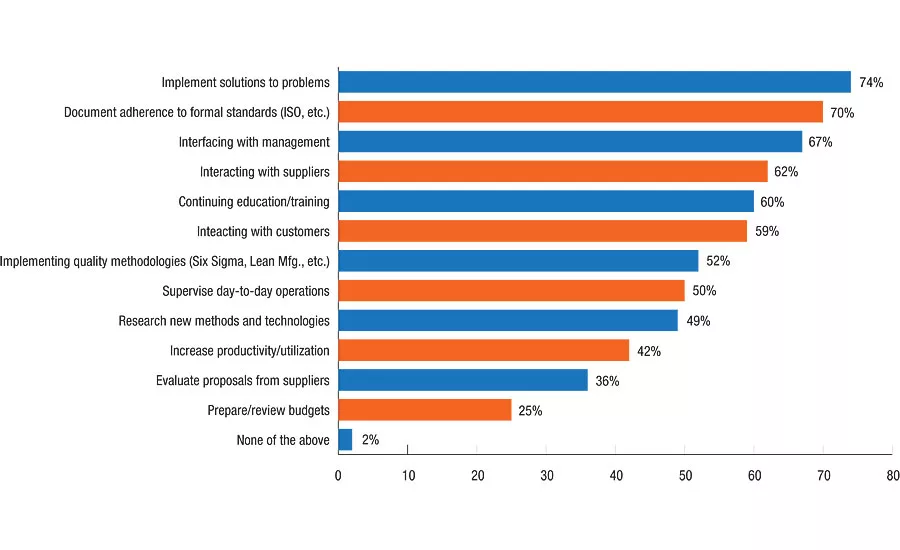
What quality-related work activities were part of your primary responsibilities in the past 12 months? (Select all that apply)
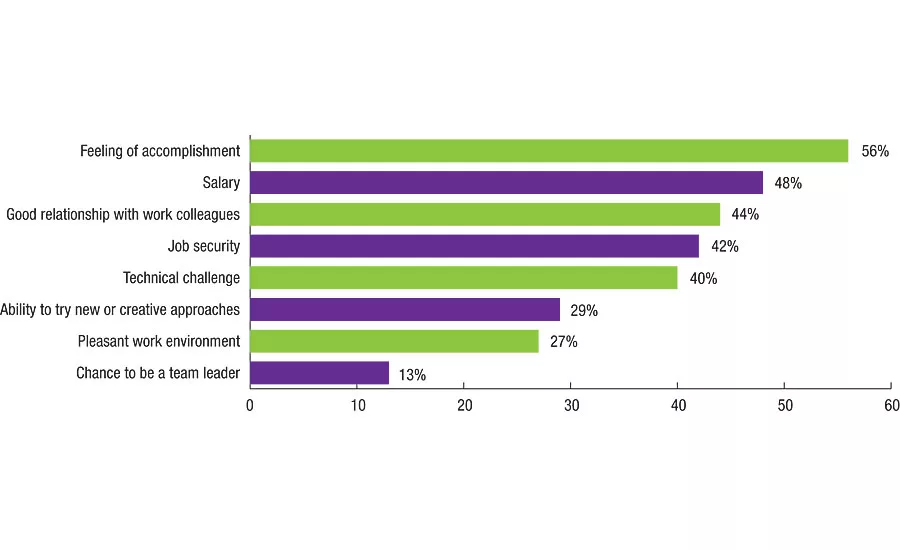
Please rank the top five most important attributes to you in your current position. (ranked in top 3)
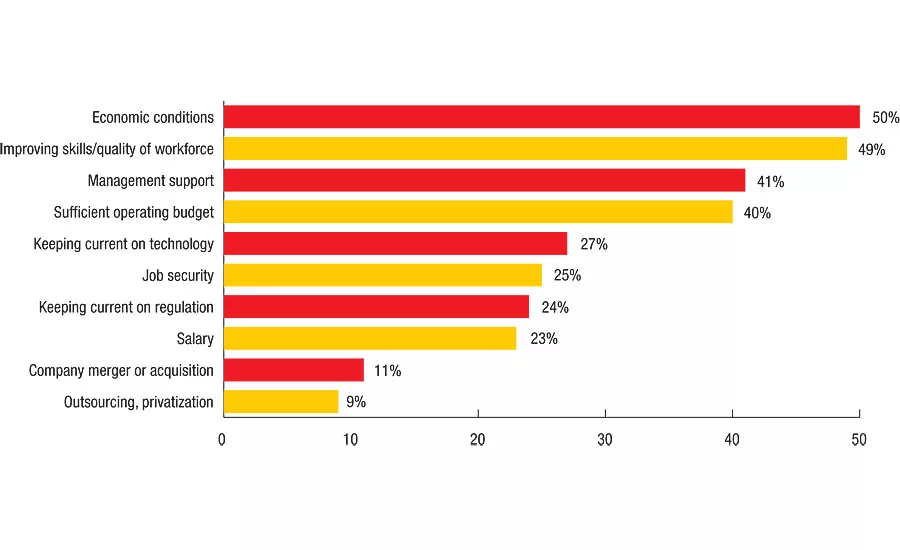
Please rank your top five concerns in regards to your job.(ranked in top 3)
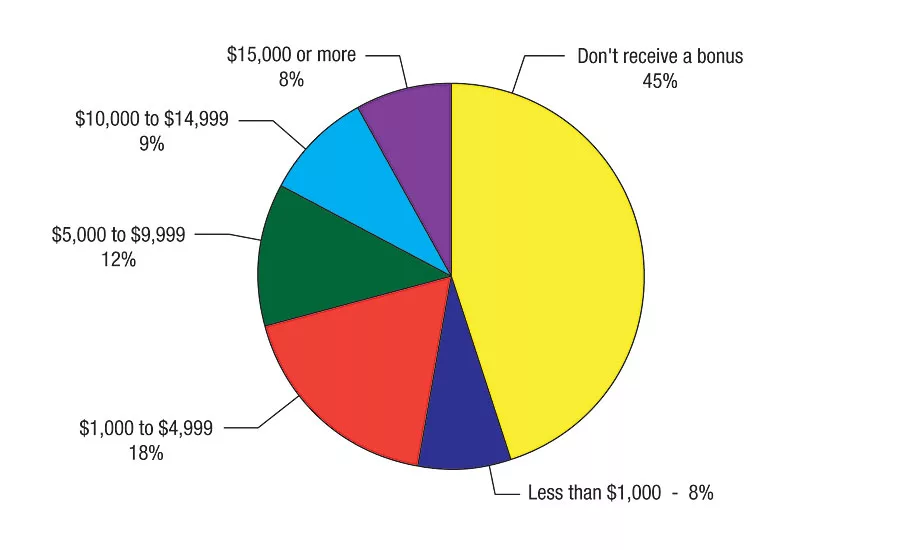
What is your approximate annual bonus (as a dollar value), as of January 1, 2016?
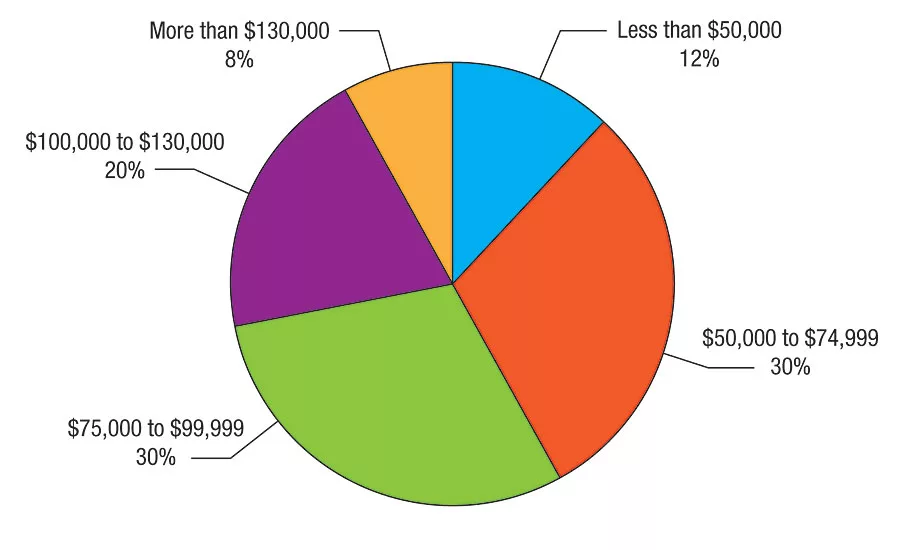
What is your annual salary (before taxes, excluding bonuses), as of January 1, 2016?
The state of the quality profession remains strong, according to our 16th Annual State of the Profession Survey.
More than half of quality professionals reported that they are highly satisfied with their work. Their concerns have not changed compared to last year, and they are interested in learning more technical skills. Some product categories have seen changes, but software and gages are still the top two purchases made by quality professionals.
The survey looks at trends in employee compensation, work hours and job constraints; overall job satisfaction; improvements to quality operations; and a demographic profile of industry professionals. Read on to learn what your peers in the industry think about their profession, and see how your career fits in.
TECH TIPS
|
COMPANY OVERVIEW
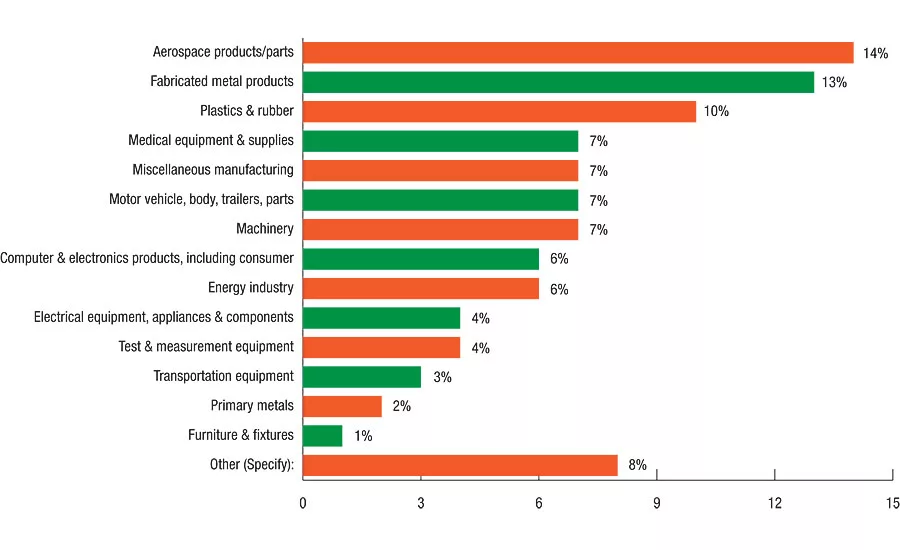
Respondents work in a variety of industries, from aerospace to plastics to medical and motor vehicles. Aerospace was the most common primary business (14%), followed by fabricated metal products (13%), and plastics and rubber (10%).
Forty percent of respondents work for an original equipment manufacturer (OEM), followed by 28% in components and parts manufacturing, and 17% in a job shop. The remaining section of respondents fell into the other category, including consultants, service providers and distributors.
A quarter of respondents’ companies have annual revenues between $10 and $49.9 million. The median company revenue is $24.5 million. Thirteen percent work at a company with revenues of less than one million, 23% with one to 9.99 million, 16% with revenues of $50 to 99.9 million, and the remaining 12% work at companies of more than a billion in annual revenue.
Nearly three-quarters of respondents’ companies employ fewer than 500 people including all locations. The median number of employees is 165. Company size remained mostly consistent during the past year (according to 45% of respondents), though 37% reported an increase. Nineteen percent said company size decreased.
QUALITY PURCHASES
The quality control group is primarily responsible for quality-related purchases. Groups responsible for quality-related purchases are most involved in the need determination, brand recommendation/evaluation and purchase approval.
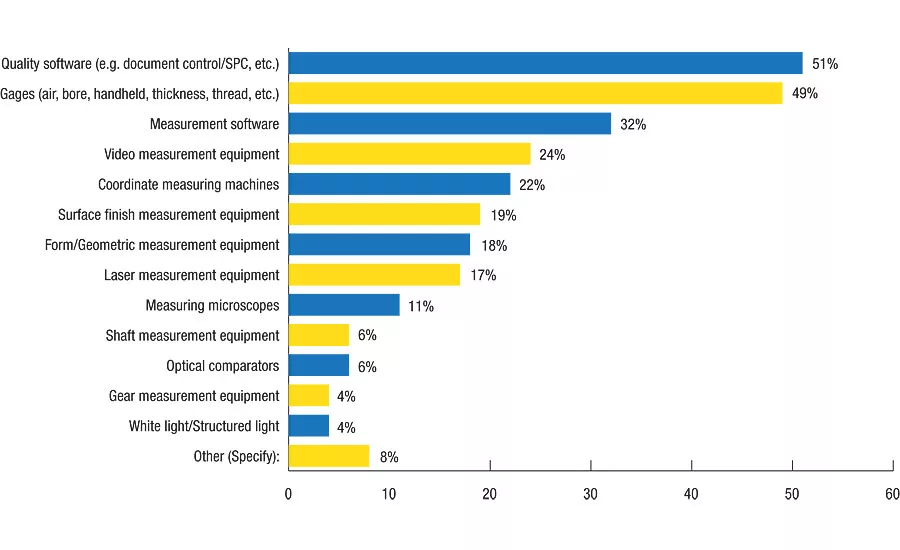
More than half (56%) said they thought their companies would spend the same amount of resources toward improving quality operations in the next year, but 36% said they would commit more resources. The primary categories expected to see an increase were quality software (51%) and gages (49%), followed by measurement software, video measurement equipment (which jumped to 24% from last year’s 12%), CMMs, surface finish measurement equipment, form/geometric measurement equipment, laser measurement equipment, measuring microscopes, optical comparators, shaft measurement equipment, gear measurement equipment, and white light/structured light. Other resources mentioned included force measurement, heat treat measuring equipment, infrared/thermocouples, and training.
When asked about embracing new technology, respondents said their companies are willing to be one of the early leaders (36%) or wait for others to successfully use it (33%).
Half of respondents’ companies have production only in the United States. Other top countries were China (28%) and Mexico (20%). The average number of countries or regions with production was three. Other locations mentioned include Germany, Canada, the United Kingdom, Brazil, India, France, Japan, Italy, Taiwan, the Middle East, Australia, Russia, as well as production in other countries in Europe, Africa, South America and Central America.
This year we introduced a question about reshoring. Less than a tenth of respondents currently reshore quality control operations and plan to continue doing so. The majority of respondents reported no current or future plans related to reshoring.
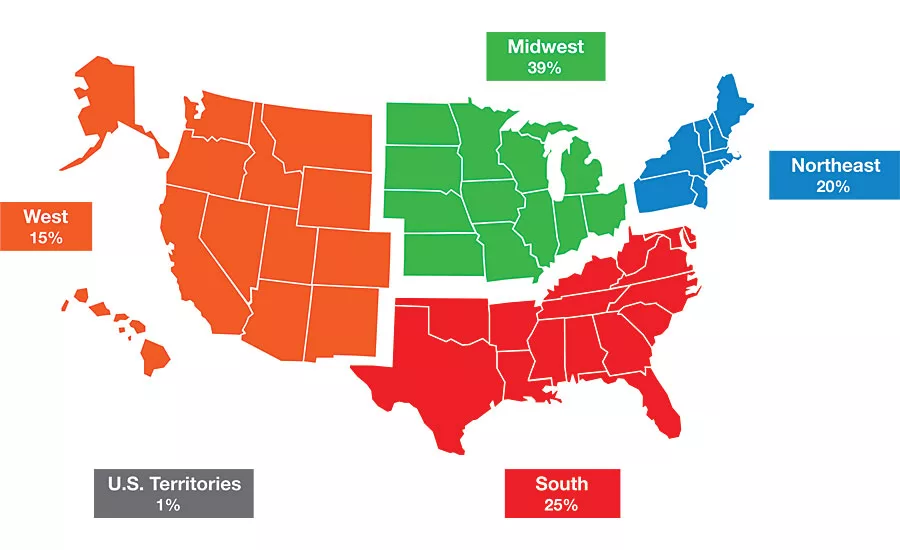
Most respondents work in the Midwest (39%), followed by the South at 25%, the Northeast at 20%, and the West at 15%. One percent came from U.S. Territories.
The average age of respondents is 56. Two-thirds of respondents have a bachelor’s or associate’s degree. Fifty-eight percent do not hold any ASQ certifications or Six Sigma belts.
A CLOSER LOOK AT THE QUALITY FIELD
The majority of respondents are in quality management (39%), followed by quality engineering (20%), corporate or executive management (13%), manufacturing engineering (7%), manufacturing operations/production/supply chain management (7%), engineering (6%), and research and development (1%).
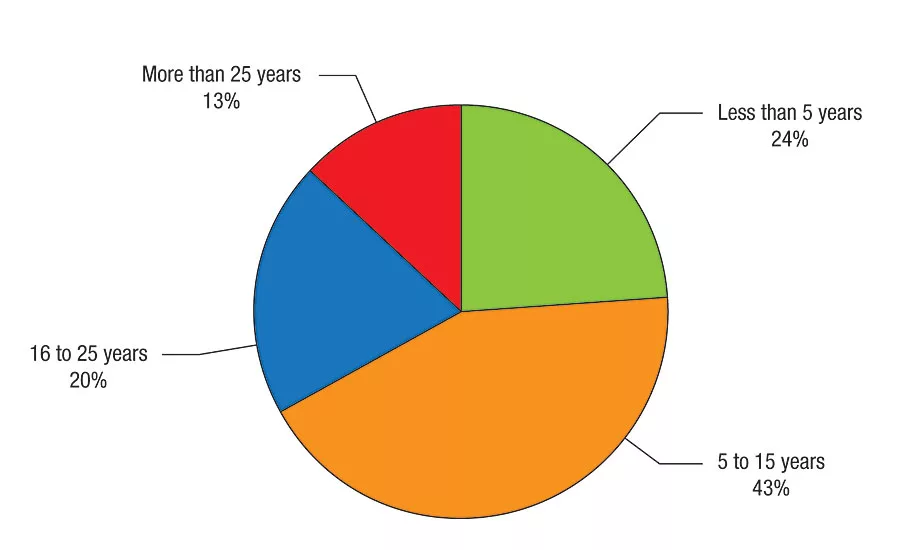
About two-thirds of respondents have been employed at their current company for 15 years or fewer, with the mean being 13 years. More than half have more than 25 years (also the mean) working in the quality manufacturing industry.
Among the two-thirds of respondents who have supervisory responsibilities, most supervise less than five people. Almost all respondents work at least 40 hours per week on average, with 20% working more than 50 hours per week. The mean is 46 hours.
The work week length remained the same for most respondents (75%) in the past year, although 15% indicated an increase, on average by six hours. In the upcoming year, the majority expect it to remain the same while 14% expect a longer work week.
And this longer work week makes sense when you consider all of the responsibilities quality professionals handle. The top quality-related responsibility cited was implementing solutions to problems (74%), followed by document adherence to formal standards such as ISO (70%), and interfacing with management (67%). Other responsibilities include interacting with customers and suppliers, continuing education and training, implementing quality methodologies like Six Sigma and Lean, supervising day-to-day operations, research new methods and technologies, increase productivity and utilization, evaluate proposals from suppliers, and prepare and review budgets.
With all of these responsibilities, the main barrier is time. Half said time constraints were the top barrier to their work. Other constraints mentioned included budget cutbacks, skilled labor shortages, management support, new and existing standards, interacting with customers, making new technology work, keeping up with state-of-the-art technologies, information overload, global competition, integrating in-process measurement, interacting with suppliers, and mergers and acquisitions.
Sixty-seven percent of respondents are a member of at least one quality team or committee, with the new processes, productivity and new product development teams coming out on top.
JOB SATISFACTION AND CONCERNS
Despite all of the challenges, the majority of respondents are satisfied with their work. More than half (54%) are extremely satisfied with their job, while 41% are moderately satisfied.
The most important factor at work is a feeling of accomplishment, following by salary, a good relationship with work colleagues, job security, technical challenges, ability to try new approaches, a pleasant work environment and a chance to be a team leader.
The most important job concerns are economic conditions, improving skills and quality of the workforce, management support, sufficient operating budget, keeping current on technology, job security, keeping current on regulation, salary, company mergers or acquisitions, and outsourcing or privatization.
Speaking of salary, 60% of respondents earn an annual salary of between $50,000 and $100,000. The mean salary is $84,615. Of those who receive an annual bonus, the average amount is $8,692.
More than half (55%) reported a salary increase during the past year, on average by 5%. Fifty-five percent expect a change in salary at their next performance review as well. Eight percent of companies do not do performance reviews. The potential reasons for an unchanged salary include economic conditions, budget constraints, no review was conducted, a salary freeze, or reaching the top pay level.
For those who saw a change in salary, reasons cited included the overall company performance, a performance review, the plant’s overall operating performance, maintain standards such as ISO, meeting deadlines for new projects, meeting product quality requirements, leadership in implementing new quality technology, and effective use of existing equipment. Other reasons mentioned were launching a new product, revising existing inspection processes, support-oriented tasks, creating a new measurement process and establishing a good network of suppliers.
The top company-paid benefits include health insurance (85%), paid vacation (85%), dental insurance (80%), life insurance (77%), and 401(k) matching (76%). Other benefits mentioned include vision insurance, tuition reimbursement, on-the-job training, flexible hours, profit sharing, stock purchase plan, pension and childcare. Nearly three-fourths of respondents expect that they will be paying more for healthcare insurance premiums in the next year. Twenty percent expect no change.
The types of training taken vary, with ISO, FDA and other regulatory standards coming in at 33%. Certifications was the next most common, at 31%, followed by software/PC training for 21%, management training (20%), methodologies such as Six Sigma or others (20%) and equipment operation/repair for 18%. Thirty-three percent did not take any of these trainings listed.
In looking at new skills, technical skills were the ones respondents are most likely to develop in the next year, mentioned by half of respondents. Certifications were listed by 40% and problem-solving by 27%. Other skills respondents were interested in developing included time management, teamwork, public speaking, employee supervision, finance and accounting, and writing reports and proposals.
SURVEY DETAILS
Thank you to everyone who filled out this year’s survey. BNP Media’s Market Research division conducted the survey on behalf of Quality. The survey was sent to a random sample of active, qualified Quality subscribers. The survey was fielded March 24 to April 11, 2016. Two hundred and fifteen surveys were completed, yielding a response rate of 1.44%. Q
Looking for a reprint of this article?
From high-res PDFs to custom plaques, order your copy today!


