Different Machine Vision Network Interface Options
Choosing the right network interface is an important part of developing successful machine vision applications.
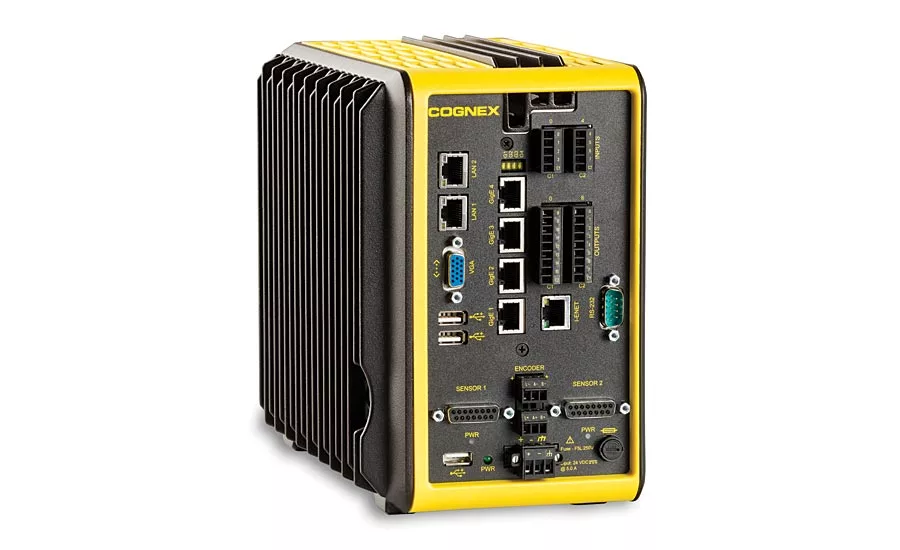
The VC5 Vision Controller directly connects to GigE Vision cameras. Source: Cognex
Applications of machine vision technology are expanding at a rapid rate because of its ability to deliver substantial improvements in quality such as providing 100% inline inspection while addressing concerns over the attention span and fatigue level of human operators. The range of potential applications is being further increased by improvements that make it possible to inspect ever finer details and color gradients and even the third dimension. At the same time, increasing vision applications and camera capabilities put greater strains on the network interfaces used to transmit data to and from cameras.
The challenge is greater for personal computer (PC) based vision systems which generate higher bandwidth demands because each image is uploaded from the camera to the PC for analysis. The specialized vision interfaces used in these applications are evolving to keep up with increasing demands. On the other hand, smart cameras that combine image acquisition and analysis in a single package don’t demand as much from the interface because they typically only upload images for archival purposes. This article will provide an overview of machine vision network interface technology and how it is evolving to reliably meet the challenges posed by the rapid increase in machine vision capabilities and applications.
The two main categories of machine vision systems—smart cameras and PC vision— have very different network interface requirements. Smart cameras or vision systems provide a self-contained platform for image acquisition and analysis, reducing the volume of data that must be transmitted over the network. The primary interface requirement of smart cameras is usually to communicate with the control system, such as to provide information on whether the part passed or failed the inspection. The result is that the network interface requirements of smart cameras can often be accommodated by production networks such as Ethernet/IP and PROFINET that are commonly used for communications between control systems and equipment on the factory floor. This approach has the advantage of eliminating the need for a separate network to handle vision data.
In many applications, smart cameras also need to send images to a server where they are archived and accessed after the fact such as to investigate the cause of defects. Transmittal of archival images is usually not a time-sensitive task so it can typically occur as a background task on production networks when network traffic is low. Production networks are frequently successfully used to archive images or send them to a human machine interface (HMI). Typically, images can be sent via File Transfer Protocol (FTP) to a server, as a TCP/IP message to a display or via HTTP to a web browser architecture such as Wonderware.
The latest generations of smart cameras and image-based barcode readers provide drivers, templates and sample code for open standard industrial Ethernet communications protocols such as EtherNet/IP, Modbus TCP/IP, SLMP, and Profinet for connection to a wide range of PLCs and other automation devices. Vision systems can communicate with mostly any make or model of robot and pre-configured drivers, ready-to-use templates and sample code are available for the most popular models. Discrete I/O and serial protocols are available to support older PLCs and devices without network connectivity. Direct Ethernet communications between the machine vision system or ID reader and the factory network improves scalability by making it possible to add ID readers or vision systems without having to add other hardware or software. The latest generation of vision systems and ID readers also generally includes RS-232 and USB connectivity which enables direct connection to a PC for setup and troubleshooting as well as implementation in legacy applications. Networked vision systems, vision sensors and ID readers enable data and images from all devices to be collected at a central point, viewed on a single monitor and archived for trend analysis and continuous process improvement. Networking also allows vision systems to increase manufacturing agility by automating procedures such as changeovers for mixed-model processing.
On the other hand, PC vision applications on the factory floor require all images be delivered in a very short and known amount of time from the camera to the PC so that the images can be analyzed and a pass-fail decision can be made in time to reject faulty parts or assemblies before further value is added to them. So the cameras in PC vision applications nearly always send images to PCs on physically separate networks that are specifically designed to meet the challenging requirements of vision applications. In these applications, the PC usually exchanges control information with the production network or may even control the machine itself.
A Closer Look at Network Interfaces
Let’s take a look at the most popular network interfaces for PC vision applications. FireWire, also known as the IEEE 1394 interface, offers a simple method of connecting a camera to a standard interface. This interface was originally developed for consumer applications in the 1990s. FireWire offers the potential to use a low-cost interface board to replace a more expensive frame grabber. A limitation of the FireWire interface is that the adapter cards do not provide image buffers so the possibility exists of losing images under high bus traffic. For these reasons, FireWire has largely lost favor in the machine vision industry and is best suited for applications that do not require the determinism and error detection provided by frame grabbers.
The Camera Link communications protocol is an interface standard that was developed in 2000 by a consortium of frame grabber and camera manufacturers to offer high speed data communications along with deterministic triggering and timing. Camera Link has carved out a considerable niche at the high end of the industrial vision market due to its high reliability and support for relatively long cables. A drawback of Camera Link is that it requires special cables, connectors, and frame grabber cards that are usually more expensive than networking equipment made in higher volumes for a broader market.
The GigE Vision standard is a vision-oriented version of the popular Gigabit Ethernet protocol. A key advantage of GigE Vision is that it leverages networking components that are produced in high volumes for the general networking market so they can be purchased at a relatively low cost. In most cases, the frame grabber is replaced with a standard Gigabit Ethernet network interface card that connects directly to a GigE Vision camera and insulates it from general network traffic. GigE Vision offers device discovery capabilities, making it easy for hardware and software providers to offer plug and play installation. GigE Vision also offers a typical maximum cabling length of 100 meters, higher than most other networking protocols. Since its introduction in 2006, GigE Vision has grown rapidly to become the most popular machine vision networking protocol.
The USB3 Vision standard has gained traction based on its ability to transfer image data over off-the-shelf USB hardware at a throughput up to 3 Gb/s. The core USB3 standard is widely used in business and consumer products so the hardware is available at a relatively low cost and is familiar and easy to use. The USB3 Vision standard is hosted by the AIA, a machine vision trade association with 330 member companies, which publishes the standard and oversees the validation process.
CoaXPress is another vison network interface standard that has staked out a market niche on the high-speed end of the vision networking spectrum. CoaXPress allows 6.25 Gbit/s of image data to be transferred over a single coaxial cable from camera to frame grabber. For even higher data rates, multiple CoaXPress channels can be used. The primary element limiting the adoption of this networking standard has been the high cost of cameras and frame grabbers but with prices starting to go down the technology is positioning itself to move into the mainstream.
The large and rapidly growing list of inspection and identification applications in today’s factories creates the need for machine vision network interface alternatives that meet the needs of both smart camera and PC vision applications. Choosing the right network interface is an important part of developing successful machine vision applications that can help your company maintain the extremely high levels of quality and productivity needed to gain a competitive edge.
Looking for a reprint of this article?
From high-res PDFs to custom plaques, order your copy today!