Advancing Factory Automation with Smart 3D Imaging and Inspection
The Industrial Internet of Things and the Move Toward Smart Technologies
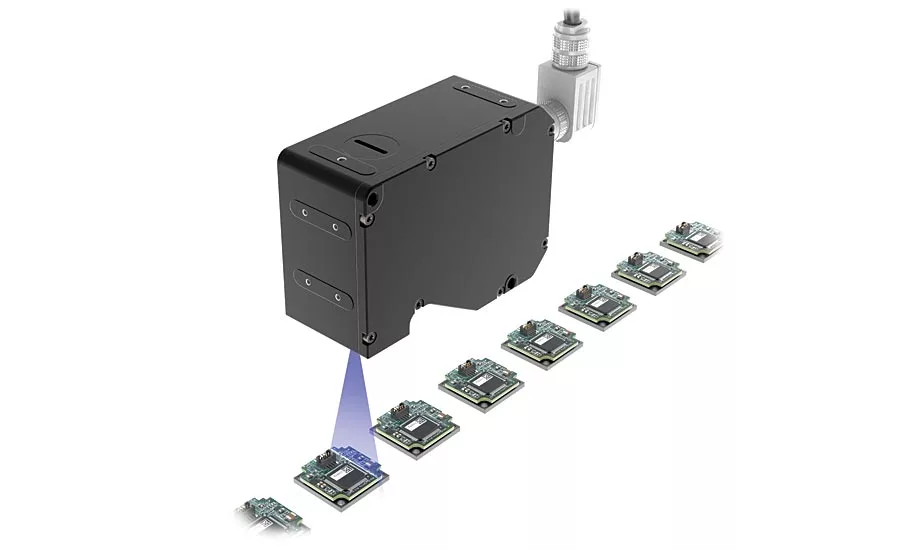
Inline inspection requires a combination of high-speed, resolution and repeatability.
The Industrial Internet of Things (IIoT) is a term used to describe interconnectivity in relation to factory automation. The term captures the complex interrelationship of smart hardware feeding actionable data over a network, in order to drive deep learning systems toward optimized factory output. IIoT represents a technology paradigm shift that is causing fundamental advancements in the way products are manufactured and delivered.
Inline quality control is an essential part of the IIoT equation. Three-dimensional imaging devices such as smart sensors are driving factory automation forward with their ability to measure critical part tolerances, communicate seamlessly with factory robots and networks, and deliver real-time data in order to increase factory efficiency and achieve 100% quality control and material optimization in high-speed inline production environments.
The Power of 1%
To put the potential impact of this “smart revolution” into perspective, studies have shown a 1% improvement in factory efficiency and utility operating costs in the following five industries—oil and gas, power, healthcare, aviation, and rail—could add up to $276 billion in savings over 15 years. North American industries alone stand to achieve $500 million in annual savings as a result of leveraging smart technologies in their factory systems and processes.
3D Smart Sensors, IIoT, and the Smart Factory
Three-dimensional smart sensors advance smart factory automation by offering a tight integration of noncontact 3D imaging and measurement to make critical decisions and communicate this to factory networks—all within a single, compact and cost-efficient package.
Smart sensors are essential to achieving 100% quality inspection on today’s production lines, providing IIoT capability powered by web browser-based technology for easy configuration and monitoring by mobile devices.
Understanding the Markets for 3D Imaging
The 3D technology market is made up of two primary sectors: (1) metrology and (2) inspection.
Metrology is carried out in an offline measuring environment that is clean and controlled—typically a dedicated measuring room. Solutions used for metrology applications are largely based on the use of coordinate measuring machines (CMMs) and contact-based touch probes. These solutions are used to perform geometric dimensioning and tolerancing (GD&T) analysis and reporting for first article type parts that can require hours of setup and measurement.
In contrast, inspection requires an entirely different set of 3D imaging capabilities. Inspection applications are typically inline or at-line, and conducted in harsh factory environments that introduce adverse conditions such as ambient lighting, vibration, temperature fluctuation, dust, water, oil, etc. Furthermore, data acquisition and measurement (i.e., cycle and takt times) are extremely short for quality inspection applications due to the high number of individual parts/assemblies that need to be inspected.
Laser-based solutions are well-suited to the inspection environment, where the sensor must deliver accurate pass/fail decisions on manufactured parts being scanned continuously at production speed. Traditional metrology has the luxury of time, whereas inline inspection does not. And, metrology machinery can be calibrated and recalibrated, whereas inline sensors must be installed to deliver pre-calibrated, reliable output year after year—with no chance for recalibration later.
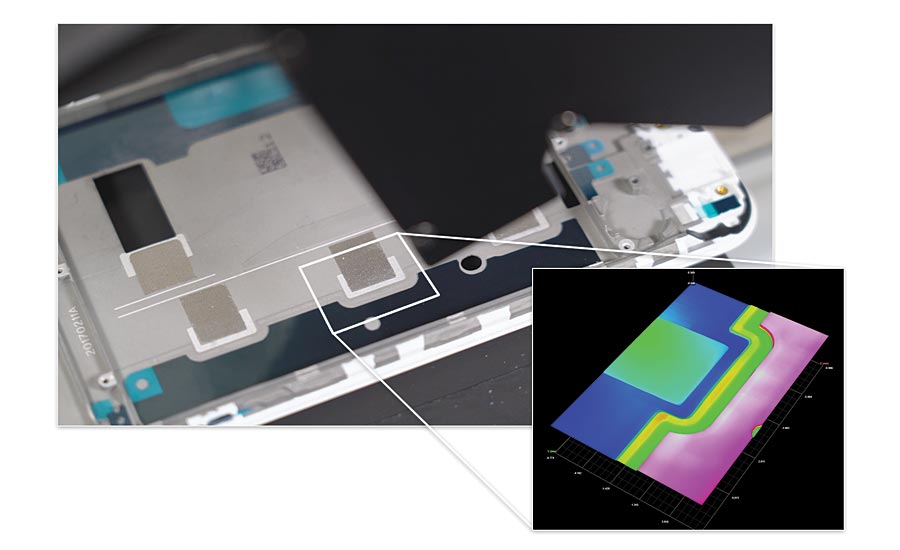
Only 3D imaging can provide essential shape-based measurement for robust quality inspection.
Key Challenges of Inline Measurement
For inline measurement applications, the topmost drivers that 3D sensors must address are resolution, repeatability, and reliability. First, sensors have to scan with high enough resolution to identify and confirm critical features are meeting tight manufacturing tolerances. Resolution must be at least twice as high as the feature to ensure detection.
Second, sensors must deliver the same measurement for the same part with minimal variation. Such high repeatability requires the sensor to have low “noise” and resilient to previously mentioned external factors such as temperature or ambient lighting. For measurement repeatability, resolution must be at least 4-8x as high as the feature size to ensure enough data points for repeatable results.
Third, the sensor must be reliable—delivering the same performance on day one as on day 1,000. This means its internal electro-optical-mechanical design has to be robust and maintain its factory calibration performance over time with no degradation in the optical path.
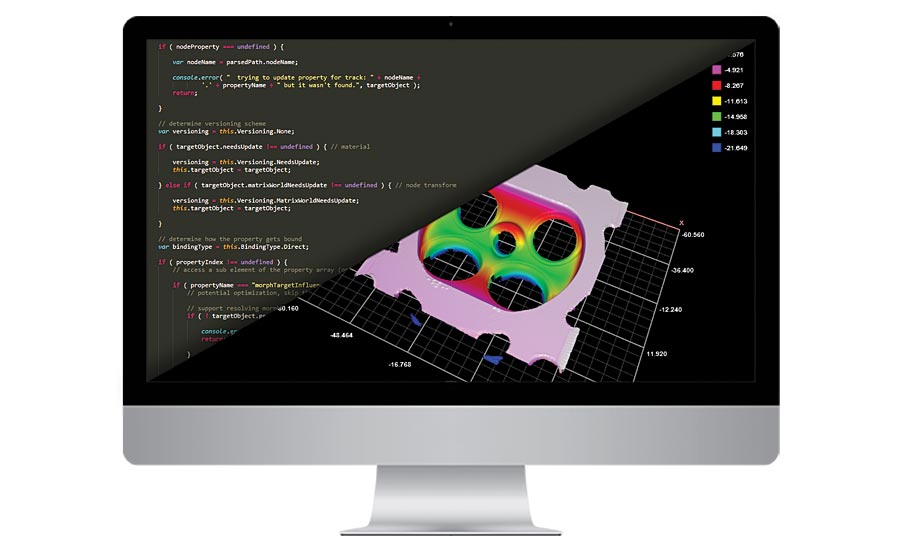
A firmware development kit allows engineers to create their own unique inspection solution by adding custom measurement algorithms to the sensor.
Shape-Based 3D Imaging and Inspection
One of the key advantages of 3D imaging over 2D imaging is its ability to capture shape data. In a 3D smart sensor, tools are available for measuring geometry such as the diameter of a hole located on the side of an object. Shape-based inspection is not affected by the color of the object, whereas 2D relies solely on the contrast or “color” in an image.
With all-in-one processing, a smart sensor allows users to acquire 3D point clouds in addition to 2D intensity data, then identify edges based on shape or contrast and produce detailed feature and volumetric measurements that are collected for downstream pass/fail control decisions.
Tag, Track, Control
In addition to 3D inspection based on shape, smart sensors offer built-in processing to carry out tagging and tracking of moving parts. This allows pass/fail decisions to be stamped by the time and position of the part on a conveyor for downstream coordination with ejection or sorting hardware.
When the part arrives at a sort or reject bin, the pass/fail decision determines if dedicated eject hardware is activated or not. This requires the sensor to manage a queue of hundreds of parts in its memory that are individually tracked and processed after inspection is completed.
Sensor Customization
Standard sensors deliver fixed functionality in scanning. Smart sensors extend scanning by adding built-in measurement and communication support. But in the end, what you purchase is what you get. The most advanced smart sensors on the market, however, open the possibility for developers to add custom measurement algorithms that run in the sensor by replacing the embedded firmware.
With this progressive approach, engineers can embed their own custom measurement tools into the sensor firmware—with the same functionality as native built-in tools—while benefiting from the ease-of-use of a web-based user setup that leverages built-in 3D visualization and drag-and-drop workflow.
Smart Vision Acceleration
For applications such as consumer electronics (CE) inspection where a standard one-second cycle time is required, data processing acceleration is necessary for end users to meet tight quality control tolerances and throughput specifications.
Smart vision acceleration is a powerful solution used to add the necessary data processing power to an inspection system. Acceleration comes in the form of either software or a dedicated hardware device. Both can significantly increase processing speed and speed up cycle times, remove memory limitations, and allow the user to handle large 3D point clouds for measurement and inspection in the required cycle time. For example, in the case of hardware-based acceleration, a magnitude increase in speed is achieved by leveraging a new breed of computing based on embedded multi-core GPU data processing.
Virtual Sensor Capability
Reviewing recorded data from factory production lines to optimize measurement parameters is a common requirement to optimize inline inspection performance. For this reason, advanced smart sensor technology will provide users with a “virtual” sensor that can be used as a safe, offline testing environment to ensure algorithms are reliable and performing well for inline production environments.
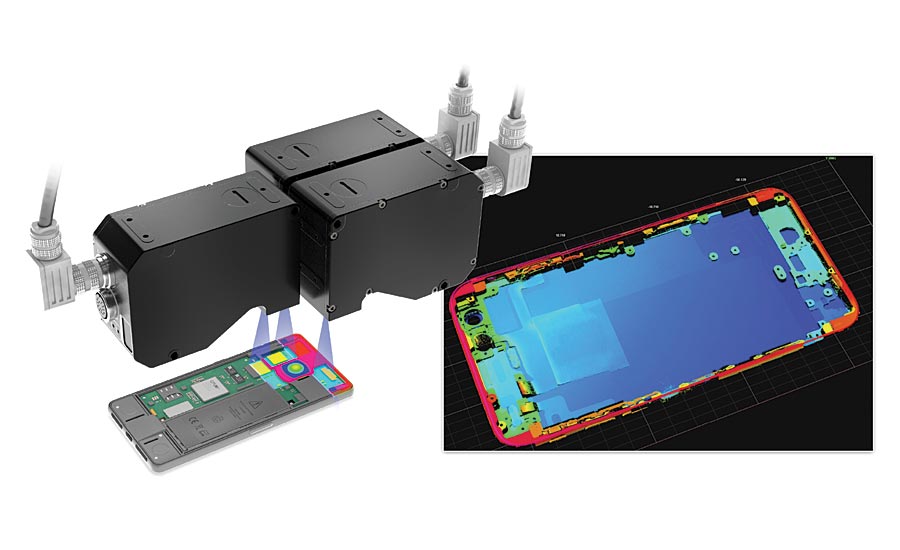
Multi-sensor networking allows users to generate a complete 3D image of the target object.
This approach gives programmers the ability to determine issues with current sensor configurations, test custom measurement algorithms, and design and test improvements in an offline environment prior to deploying their solution onto an actual sensor.
Multi-Sensor Networking
The vast majority of inline inspection applications require multiple sensors, set up in a variety of orientations, to provide 3D point clouds that cover 360º of an object and eliminate any occlusions that might occur.
Smart sensors can be configured in a range of multi-sensor layouts to fit these individual inspection needs. Both dense and sparse multi-sensor configurations are supported within the sensor. Dense configurations result in merging all sensor data streams into a single 3D point cloud, whereas sparse networks result in processing sensor data individually (e.g., where gaps between sensors are not filled in). In either case, calibration methods are built-in to support the transformation of data from each sensor in the network to a common world coordinate system.
A master controller is used for the seamless networking of individual sensors. The master controller is a dedicated solution for distributing power, data synchronization and laser safety in a multi-sensor network. Master controllers allow users to easily scale from a single sensor up to a 24-sensor system, provide synchronization within 1 µs accuracy, and feature simple all-in-one cabling to carry data directly between sensors and a network switch. Synchronized data is broadcast to all sensors and includes a timestamp, encoder stamp, and the status of direct inputs wired to the master controller.
Summary
Smart sensors provide all the necessary features and functionality to drive smart 3D imaging and inspection. From 3D+2D inspection, to sensor customization, acceleration, emulation and multi-sensor networking, 3D smart sensors are designed for the demands of IIoT and the modern smart factory. V&S
Looking for a reprint of this article?
From high-res PDFs to custom plaques, order your copy today!


