New Technologies Enhance Comparator Productivity
Optical comparators have been a popular choice for quality control inspection for more than 70 years.
Optical comparators have been a popular choice for quality control inspection for more than 70 years.
At its most basic level, a comparator projects an enlarged profile or shadow of a part onto a viewing screen at an exact optical magnification. Typically, the magnified projected profile of a part feature is directly compared to one of several matching master profiles printed on customized overlay charts. The appropriate chart is placed over the viewing screen, and the projected profile is measured by comparison to it. The overlay chart typically shows the nominal feature shape, as well as its specified min/max profile tolerances.
The use of chart gages and measurement by comparison requires a good eye but it is not rocket science. It is easy to learn and teach, allowing relatively unskilled operators to easily determine the conformance of a part to its specifications.
Today, technical advances in optical comparators allow them to perform the tasks they have always performed, but now with expanded capabilities.

There is a new virtual reality in optical comparator technological enhancements-CAD to virtual chart. Through the integration of computer software and internal comparator hardware, a CAD model of a part is used to project a “virtual chart” with tolerance bands directly onto a comparator viewing screen.
Not only can virtual charts do what traditional charts do, but because they are computer-generated, virtual charts can do more. Unlike static overlay charts showing fixed tolerance zones that leave their interpretation up to the operator, multiple tolerance zones as defined by the CAD file or the operator are projected on the viewing screen, showing whether the part is in- or out-of-tolerance via different projected color bands. The variously colored bands are user-definable and customizable. Now, the inspector can see that a part is out of tolerance, at a glance-right on the comparator screen.
Using this virtual chart method speeds inspection and improves productivity. Unlike traditional fixed charts, the virtual chart can be synchronized to the part image-the virtual chart follows the part profile as operators drive the worktable around to inspect critical segments of the part to determine if they are within tolerance. And magnification can be changed at any point with the virtual chart automatically rescaling to the new magnification.
Since these charts are virtual, there are no storage or physical damage concerns.
The addition of a computer allows a comparator to use 2-D metrology software specifically designed for comparators. Comparator metrology software allows full measurement and construction of points, midpoints, angles, lines, arcs, circles, distances, widths, included angles, angle intersections, line/circle intersections, point-to-line distances, and gage ball tangent to two parallel or non-parallel lines. In addition, on systems with motorized worktables, comparator metrology software provides full “hands-off” CNC operation, including automatic worktable motion, auto-edge-detection (if so equipped), geometric measurement and analysis, and data output. Comparator metrology software is intuitive and easy-to-use, which facilitates its use and speeds training.
Some comparator metrology software has the useful capability of importing CAD files to automatically generate measurement routines. Measurement routines can then be edited, run and saved for future use, as any other routine would. The operator simply identifies the part location and runs the routine.
GD&T/fitting software often is configured to mesh seamlessly with comparator metrology software, accepting measurement data as it is created and performing 2-D composite profiles automatically. Fitting software analyzes all part features simultaneously, and automatically performs the most valid fit method based on the absence or presence of datum features and geometric tolerances.
GD&T and color-coded graphic results can be displayed immediately, and statistical summaries are available, too. Each fitting method provides XY translation values to help with tooling modifications. Unlike individual geometric measurements of part details, fitting all the measurement data at once makes trouble spots, trends and potential assembly problems clear, adding value to the manufacturing effort.
To get high brightness, they draw a lot of current. Tungsten lamps also are extremely hot, requiring careful handling for safety reasons, and thermal isolation from objects being measured. Although they are relatively inexpensive, service life of tungsten lamps is short, sometimes in the tens of hours, which adds to the expense of their replacement when system downtime is considered.
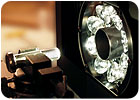
Today, some optical comparators are available with all-LED illumination. LED illumination consumes a fraction of the energy required for tungsten, thereby lowering operating costs. LEDs offer long service lives, providing up to 60,000 hours of service.
Optical comparators are doing what they have always done, but technology offers advancements for the next generation of optical comparators, and we all benefit from improved product quality of the parts inspected on these comparators. Q
Now integrated into select optical comparators, LED illuminators offer many advantages over traditional tungsten lamps. Among these are long service life (up to 60,000 hours), variable intensities, selectable directional illumination and low operating costs. Source: Optical Gaging Products Inc.
Optical comparators have been a popular choice for quality control inspection for more than 70 years.
At its most basic level, a comparator projects an enlarged profile or shadow of a part onto a viewing screen at an exact optical magnification. Typically, the magnified projected profile of a part feature is directly compared to one of several matching master profiles printed on customized overlay charts. The appropriate chart is placed over the viewing screen, and the projected profile is measured by comparison to it. The overlay chart typically shows the nominal feature shape, as well as its specified min/max profile tolerances.
The use of chart gages and measurement by comparison requires a good eye but it is not rocket science. It is easy to learn and teach, allowing relatively unskilled operators to easily determine the conformance of a part to its specifications.
Today, technical advances in optical comparators allow them to perform the tasks they have always performed, but now with expanded capabilities.
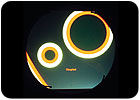
Virtual chart on a part at 20x
Virtual Charts vs. Physical Chart Gages
To remain competitive, nimble manufacturers today must respond to rapid design changes. Making new overlay charts to keep up with those design changes takes time, when time is at a premium. Computer-aided design (CAD) has sped up product design, but until now there has not been an easy way to use CAD for both design and inspections by optical comparator.There is a new virtual reality in optical comparator technological enhancements-CAD to virtual chart. Through the integration of computer software and internal comparator hardware, a CAD model of a part is used to project a “virtual chart” with tolerance bands directly onto a comparator viewing screen.
Not only can virtual charts do what traditional charts do, but because they are computer-generated, virtual charts can do more. Unlike static overlay charts showing fixed tolerance zones that leave their interpretation up to the operator, multiple tolerance zones as defined by the CAD file or the operator are projected on the viewing screen, showing whether the part is in- or out-of-tolerance via different projected color bands. The variously colored bands are user-definable and customizable. Now, the inspector can see that a part is out of tolerance, at a glance-right on the comparator screen.
Using this virtual chart method speeds inspection and improves productivity. Unlike traditional fixed charts, the virtual chart can be synchronized to the part image-the virtual chart follows the part profile as operators drive the worktable around to inspect critical segments of the part to determine if they are within tolerance. And magnification can be changed at any point with the virtual chart automatically rescaling to the new magnification.
Since these charts are virtual, there are no storage or physical damage concerns.
Same virtual chart and part at 50x
Bringing Measurement Software into Play
From the outset, optical comparators have been used for simple inspections and measurement by comparison. Later, digital readouts (DROs) and edge-detection capability were added to allow comparator operators to measure more precisely, albeit manually. Eventually, computer numerical control (CNC) operation of motorized worktables and automatic edge detection allowed unattended comparator operation. DRO capabilities have expanded to provide detailed geometric measurements. But now it is possible to do even more with part data.The addition of a computer allows a comparator to use 2-D metrology software specifically designed for comparators. Comparator metrology software allows full measurement and construction of points, midpoints, angles, lines, arcs, circles, distances, widths, included angles, angle intersections, line/circle intersections, point-to-line distances, and gage ball tangent to two parallel or non-parallel lines. In addition, on systems with motorized worktables, comparator metrology software provides full “hands-off” CNC operation, including automatic worktable motion, auto-edge-detection (if so equipped), geometric measurement and analysis, and data output. Comparator metrology software is intuitive and easy-to-use, which facilitates its use and speeds training.
Some comparator metrology software has the useful capability of importing CAD files to automatically generate measurement routines. Measurement routines can then be edited, run and saved for future use, as any other routine would. The operator simply identifies the part location and runs the routine.
More Software, Capability
After a computer is integrated into optical comparator operation, the level of possible detailed analysis increases substantially. Some optical comparator/computer combinations can now be equipped to work with geometric dimensioning and tolerancing (GD&T) and fitting software, allowing composite profile and GD&T analysis of 2-D part features.GD&T/fitting software often is configured to mesh seamlessly with comparator metrology software, accepting measurement data as it is created and performing 2-D composite profiles automatically. Fitting software analyzes all part features simultaneously, and automatically performs the most valid fit method based on the absence or presence of datum features and geometric tolerances.
GD&T and color-coded graphic results can be displayed immediately, and statistical summaries are available, too. Each fitting method provides XY translation values to help with tooling modifications. Unlike individual geometric measurements of part details, fitting all the measurement data at once makes trouble spots, trends and potential assembly problems clear, adding value to the manufacturing effort.
New Illumination Methods
Another technological change is the use of LED illumination. Since their inception, optical comparators have mainly relied on tungsten or tungsten-halogen illumination sources. Tungsten sources provide bright, white light, but they have some disadvantages.To get high brightness, they draw a lot of current. Tungsten lamps also are extremely hot, requiring careful handling for safety reasons, and thermal isolation from objects being measured. Although they are relatively inexpensive, service life of tungsten lamps is short, sometimes in the tens of hours, which adds to the expense of their replacement when system downtime is considered.
Today, some optical comparators are available with all-LED illumination. LED illumination consumes a fraction of the energy required for tungsten, thereby lowering operating costs. LEDs offer long service lives, providing up to 60,000 hours of service.
Optical comparators are doing what they have always done, but technology offers advancements for the next generation of optical comparators, and we all benefit from improved product quality of the parts inspected on these comparators. Q
Tech Tips
- Through the integration of computer software and internal comparator hardware, a CAD model of a part is used to project a “virtual chart” with tolerance bands directly onto a comparator viewing screen.
- After a computer is integrated into optical comparator operation, the level of possible detailed analysis increases.
- Some optical comparators are available with all-LED illumination, which consumes a fraction of the energy required for tungsten, thereby lowering operating costs.
Looking for a reprint of this article?
From high-res PDFs to custom plaques, order your copy today!