Is Penetrant Testing Still Relevant?

With less penetrant inspection companies around, it may seem that penetrant testing has gone by the wayside and some new, improved processes have taken over. This is far from the truth; penetrant testing has not disappeared, nor has a new, improved process replaced it. Penetrant testing is still being used in more applications and industries than ever before.
Penetrant testing, often called PT or liquid penetrant, was originally called the oil-and-whiting method when it was first used on locomotive parts such as rail car wheels, rods, axles and crankshafts. Parts were first cleaned in boiling caustic soda, then dried and immersed in a tank of oil. The penetrant used was heavy lubricating oil (600W), often thinned with kerosene. Used motor oil also was used to give a darker contrast. Dwell or penetration time ranged from a few hours to a couple of days. The oil was removed with rags dampened with kerosene. After the parts were cleaned and dried, they were painted with a mixture of whiting, or chalk, diluted in denatured alcohol. Where cracks existed, the oil seeped through the white coating, indicating the presence of discontinuities. This was useful only for detecting large, deep cracks. Control over mixing solutions or how long they were applied was left to the operators.

How does penetrant testing work?
Solvent removable, visible dye, process is the easiest and most portable penetrant process. The first step in penetrant testing is cleaning the surface to be inspected. Typical cleaning methods are steam, vapor degrease, ultrasonic and solvent cleaning. Solvent cleaning is the most commonly used method. This involves saturating a clean, lint-free cloth with acetone and wiping the surface thoroughly, followed by a dwell period of about 5 minutes. Cleaning removes foreign matter such as grease, oil, dirt, lint, scale, salts and other extraneous matter obscuring surface openings interfering with the test. After the cleaning operation is complete, dye penetrant is applied liberally to the surface by spraying, brushing or emersion and left to typically dwell for 15 to 20 minutes. The penetrant is pulled into a defect by capillary action.After the penetrant has had time to seep into a discontinuity, excess penetrant on the surface must be removed without removing penetrant from the discontinuity. To do this, the inspector must use a cloth lightly dampened with remover. This is where experience and technique play the biggest role in consistent results. After the part is wiped with remover and sufficient dwell time to let residual remover evaporate has passed, developer is applied by brushing or spraying. Applying the developer in a thin, even layer is important so the penetrant in a discontinuity will bleed out into the developer. Heavy areas or pools of developer can mask small discontinuities. After the developer has dried for several minutes, part inspection may begin.
Fluorescent penetrant testing is similar to visible dye testing except there are additional processing steps, and the area of interest needs to be inspected in a darkened area. Cleaning prior to fluorescent penetrant application is done the same as for visible dye. The difference is in removing the excess penetrant. Water washable penetrants use water to remove excess penetrant. Post emulsification uses an emulsifier to remove excess penetrant followed by a water rinse to remove the emulsifier. After excess penetrant is removed, the part must be dried. Drying may be accomplished by oven baking, natural evaporation or forced warm air. After the part is dried, the developer is applied by spraying, brushing or dusting. The part is then placed in a darkened area and a high-intensity black light is used for inspection.
Penetrant testing has a limitation of only detecting discontinuities open to the surface. Typical discontinuities found in welds and surfaces by penetrant testing are cracks, porosity, lack of bond, forging laps, lack of fusion and cold shuts. When a defect is found, the bleed out of penetrant does not indicate the actual size of the defect; it only indicates a defect's presence. After developer has been applied, it is important to look for indications to form-the faster the indication forms, the more volume the indication has. Time for indication formation is a critical factor in determining the type and size of indications. The more time it takes for an indication to form, the less volume the indication has. Some acceptance standards require acceptance based on indication size (bleed out) and others require acceptance based on discontinuity size (actual size of defect).

Penetrant's evolution
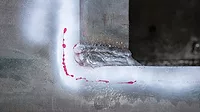
From the whiting process of early days to penetrant testing in the present, the principles of the process have not changed much. Features that have changed in penetrant testing include adding additives to penetrants to make them flow into discontinuities faster, increased sensitivity to detect smaller discontinuities, brighter fluorescence for better visibility of fine discontinuities and lessened resistance to overcleaning. The visible dye penetrant testing process uses a red-dye-based penetrant against a white background to form a contrast easily visible under normal lighting.Fluorescent penetrants have fluorescent material added to the penetrant so when a high-intensity black or ultraviolet light is shined on a discontinuity, a green glow against a white background is present. Post-emulsification penetrants use either lipophilic, or oil-
soluble, emulsifier or hydrophilic, or water-soluble, emulsifier. The emulsifier acts like a solvent remover. Instead of being wiped on with a cloth, the emulsifiers are sprayed on or immersed and left on for as little as 45 to 180 seconds. They are washed off with a water spray. The fine-ground chalk used in the whiting process is classified as a dry power.
Aqueous powder suspension, nonaqueous solvent-suspendible and water-soluble developers have been expanded for use in different types of penetrants used today. Dry developers are generally used with fluorescent penetrants. They are applied to parts after excess penetrant has been removed, all moisture has dried from the surface of the part and just prior to the inspection process.
Aqueous developers are used with fluorescent penetrants and with visible dye penetrants. Aqueous developers can be applied to the part surfaces after the washing process has removed excess surface penetrant and before the drying process.

Possible penetrant replacements
Newer electronic instrument test methods have a place and perform useful functions; however, they do not replace penetrant testing-instead they complement it. Penetrant testing is used along with volumetric inspections such as radiography and ultrasonic testing to detect surface discontinuities that may not be found by other methods. This is because of the orientation of the discontinuity in relation to the direction of the X-ray beam or the sound wave.Penetrant testing is still relevant in industry today for a variety of reasons including:
• Large areas such as aircraft structures or complex shapes can be inspected in less time and more economically than with other methods.
• The versatility of inspected materials such as ceramics, glass, plastics and most metals compared to other methods.
• The ability to detect discontinuities that may not be seen by an optical microscope.
• When magnetic particle testing cannot be performed because the part is too small.
Penetrant indications magnify discontinuities missed by other methods and automated stations can inspect large quantities of parts effectively and economically. When defects in welds are found and repair is required, penetrant testing can be used for grinders to visually see the defect and to determine when the defect has been completely removed.
Penetrant testing today
Of the thousands of parts made for the space shuttle, hundreds are inspected by penetrant testing. Items such as valves, pipelines, tanks and structural membranes used in space vehicles' liquid oxygen systems are penetrant inspected for flaws. Turbine engine blades are usually inspected using radiography, eddy current and penetrant testing to ensure there is no premature failure of the blades. During maintenance of honeycomb and adhesively bonded aircraft structures, radiography can detect the presence of corrosion or water, but it cannot detect the origin of the water. Penetrant testing can find these areas before water and corrosion happen.The automotive industry uses penetrant testing to ensure flaw-free parts such as steering spindles, aluminum suspension parts and aluminum rims. Fluorescent dye is used in locating leaks in air conditioning systems in automobiles. The fluorescent dye is added to the system and run for several minutes; a high-intensity black light locates leaks in the system. Back in the 1960s it was thought by nondestructive testing engineers that penetrant testing days were numbered and new technology would replace it.
Penetrant testing may not be used as much as it was in the past, but it still has a place in a wide range of industries and applications. Penetrant testing is going to be around for many years to come. NDT
Looking for a reprint of this article?
From high-res PDFs to custom plaques, order your copy today!