Quality Magazine
  Home
  Subscribe
  Subscribe to eNewsletter
  Subscription Customer Service
  Online
  Industry Headlines
  eXtras
  Blogs
  Quality Product Spotlights
  White Papers on the Web
  Quality Downloads
  Webinars
  Quality Showcases
  e-Inserts Plus
  Online Store
  More Product Info
  Archive
  Q-Tube
  Q-Cast Podcasts
  Quality Showrooms
  Current Issue
  Coming Events
  Features
  Departments
  Columns
  Brain Teasers
  Products
  Quality Quick Clicks
  Special Sections
  NDT
  Vision & Sensors
  Aerospace
  How To Guide
  Global Editions
  China Editions
  Quality Guides
  Quality Buyers Guide
  Software Selector
  Registrars Guide
  Services Guide
  Quality Services
  Job Marketplace
  Industry Links
  Classifieds
  Career Center
  Events
  2010 Quality Conferences
  Quality Expo South 2010
  IMTS 2010
  Meetings and Shows
  Industry Webinars
  Quality Awards
  2011 Quality Plant of the Year
  2011 Quality Professional of the Year
  Quality Leadership 100
  Quality Info
Search in: EditorialProductsCompanies
NDT Applications: Laser Adjusts Motion System of Ultrasonic Scanner

October 1, 2006

ARTICLE TOOLS
EmailEmailPrintPrintReprintsReprintsshareShare

The Faro laser tracker system measures large objects within a 230-foot range. Source: Faro Technologies


The Joint Strike Fighter (JSF), now under construction at Lockheed Martin, is being made in an assembly process like a car, drawing parts from many suppliers to feed a mile-long assembly line. The JSF is designed with complex 3-D surfaces produced from composites that do not reflect radar. Because of the complexity of these parts, they are manufactured via fiber-placement technology to near net shapes. Component manufacturers inspect parts with nondestructive test (NDT) systems to ensure that they do not hide flaws that can become stress risers during supersonic flight or high g-force turns.

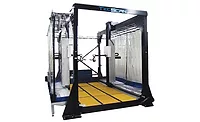
Matec Instruments (Northborough, MA) builds ultrasonic inspection robots that look through these parts to locate voids or delaminations. The instrument is based on two identical gantries that resemble the towers on a suspension bridge, each supporting a horizontal beam (a manipulator) that moves in X-Y directions. On the end of one manipulator, the machine carries an ultrasound transducer; on the end of the other is a receiver. Together, they work in a master/slave configuration. With a travel of 40 feet in the X-axis and 18 feet in the Y-axis, the system is an NDT scanner with a large inspection envelope.

The data quality produced by the scanner depends on careful positioning of the ultrasound heads during scanning. Because of their size and machining limitations, the manipulator drives cannot position the ultrasound transducers with the necessary accuracy. The ultrasonic image quality depends on the testing machine’s ability to follow itself and the complex contoured geometry it is inspecting. When the system is performing a through-transmission test, each independent five-axis gantry must track the other while sending ultrasound from one side of the component through the thickness to the other side.

To do this, Matec chose the Faro Laser Tracker, a laser-measuring device from Faro Technologies (Lake Mary, FL) that measures large objects within a 230-foot range with a point accuracy of 0.001-inch. To make measurements, an operator secures the device to a tripod and beams the laser toward the target object. A handheld reflector is guided along the surface to be measured, and the beam is bounced back to the base unit. Using the pointing angle of the laser beam and the distance to the target, the unit’s software calculates the position of each point. Measurements can be taken at a rate of hundreds of points per second. If the beam is interrupted, the software recaptures the beam without requiring the operator to start over.

The system provides a compensation table or map for each machine. Mapping takes place during machine setup and throughout the machine’s life to compensate for wear.

The robot’s drives are set to cover the entire envelope of position. When the drives move the manipulators to a specific X-Y location in space, Matec engineers check the position with the tracker to get the true position, and record it as the correction factor for that location. Thus, for each possible drive location, they can determine a corresponding true position. A chart is produced for each of the robots and becomes part of its operating instructions.



Matec Instruments builds ultrasonic inspection robots that look through parts to locate voids or delaminations. Source: Faro Technologies
A component is positioned between the two gantries. Then, because an air gap reflects ultrasound, a jet of water hits the part to couple the ultrasonic energy into the material under test—similar to how gel is used in a medical ultrasound. The manipulators with the sending and receiving units are brought together near the surface of the part, opposite each other. On one side, the sending unit emits the ultrasound; on the other, the receiving unit picks up the signal and records it in the instrument’s computer. The transducers must maintain orthogonality to the sound-entry surface, which is why the positioning of the drives is important. When everything is in position, it takes only a few microseconds to send and receive the ultrasound energy.


Matec Instruments designs and manufactures customized, fully integrated, ultrasonic NDT systems for the aerospace, railroad, auto, ordinance and tubular industries. Source: Faro Technologies
Part inspection is performed in a raster pattern. The probes move over the surface, measuring the amplitude of the transmitted ultrasonic energy. Then, the probes are indexed and the process begins again until the piece is completely covered, creating a 2-D image of the part’s volume. Parts are examined over a grid with spaces typically 0.01- to 0.1-inch apart.

Matec’s robots have their own map to correct the position of the manipulator heads. The maps become useful when the company is called back to rebuild or recalibrate an instrument. During recalibration, technicians use the laser tracker to create a second chart of the drive envelope. Then, comparing this chart to the first, they can see the extent and location of wear on the machine.

Faro Technologies

(407) 333-9911

www.faro.com


BENEFITS:

• The Faro laser tracker measures large objects within a 230-foot range with a point accuracy of 0.001 inch.

• When everything is in position, it takes only a few microseconds to send and receive the ultrasound energy.

• Matec’s robots each have their own map to correct the position of the manipulator heads.


|PrintEmail

Did you enjoy this article? Click here to subscribe to the magazine.


Most Emailed Articles

  1. Jim's Gems: Achievers Aren't Afraid of Success
  2. Case Study: Self-Serve Metrology Keeps Quality Operations Lean
  3. Lean Six Sigma: Red Hot Relevance
  4. Levels of Precision: A Field Guide to Dimensional Gages
  5. Back to Business
  6. The Ins and Outs of Ballbar Calibration
  7. Quality Innovations: Measure on the Machine
  8. Understanding ISO 13485
  9. Quality Innovations: Measure on the Machine
  10. Understanding ISO 13485
Top Searches
  1. Quality Management Systems
  2. Calibration
  3. Quality 101
  4. six sigma
  5. control charts
  6. GD&T
  7. First Articles
  8. case study
  9. control plans
  10. Cox
Most Popular Articles
  1. Manufacturing Excellence: Old Dog, Same Tricks 06/30/2010
  2. Jim's Gems: Achievers Aren't Afraid of Success 07/19/2010
  3. Understanding ISO 13485 01/02/2008
  4. Quality 101: An Introduction to Gage R&R 12/01/2005
  5. Quality 101: Surface Finish Measurement Basics 09/01/2004
  6. Case Study: Self-Serve Metrology Keeps Quality Operations Lean 06/30/2010
  7. Lean Six Sigma: Red Hot Relevance 06/02/2010
  8. Quality Remix: A Very Cool Solution 07/19/2010
  9. Enhance First Article Inspection 07/16/2007
  10. Quality Measurement: Effects of Screw-Thread Geometry 10/01/2005
© 2010 BNP Media. All rights reserved. | Privacy Policy