Materials Testing Made Easy
No one wants a product to fail. A materials test can prevent problems from occurring. “Materials testing is commonly performed to assess the performance of materials such as metals, plastics and ceramics under stress,” explains Mark Fridman, marketing manager at Mark-10 (Copiague, NY). As such, it is a growing area, with changes ranging from equipment to standards to software.
No one wants a product to fail. A materials test can prevent problems from occurring.
“Materials testing is commonly performed to assess the performance of materials such as metals, plastics and ceramics under stress,” explains Mark Fridman, marketing manager at Mark-10 (Copiague, NY). As such, it is a growing area, with changes ranging from equipment to standards to software.
“Today’s software is more powerful, allowing for more configurable test procedures, protocols and data collection features,” says Fridman. “Lower cost and more basic materials testers also have recently been introduced by some manufacturers.”
These lower cost, basic functionality materials testers have been experiencing significant growth in recent years, including force measurement. “These newer machines share many of the same functions as their more sophisticated counterparts,” says Fridman, “However, their pricing, portability and ease of use allow them to be used for basic force measurement applications at the point of production as well as for more scientific analysis in quality and research laboratories.”
“From a testing standpoint, a lot of people are paying a lot more attention to speeds of testing,” says Richard Gedney, Admet (Norwood, MA) founder and president. People are considering: if the speed of the test varies by X, how will that affect results? This has brought a lot more visibility to the speed of testing.
“A lot of people are still using older machines that are manually operated, and the control of speed is not very good,” Gedney says. “Many people are forced to convert to automatic machines so results will not be polluted by improper speeds.”
By incorporating a new digital measurement system, “they really gain a lot of capability that they simply didn’t have before,” Gedney says. “They can have a program calculate results instead of manually after the fact.”
These capabilities include archiving and generating reports, which can be sent on to customers. “At the same time, they can do tests that they weren’t able to do previously,” Gedney says.
Admet often gets calls from companies asking about retrofitting their machine when their customers have asked them to do something they are not capable of doing, Gedney says.
“Economics drives it,” Gedney says. “Basically the line in the sand, so to speak, is machines of 10,000 pounds capacity and 50 kilonewtons and below. From an economic standpoint, it is better to buy a new machine.”
From a price standpoint, it is better to retrofit a 400,000-pound capacity machine instead of buying a new one, Gedney adds.
From a production standpoint, Gedney says that testing machines also have been put closer and closer, and actually inserted into, assembly lines. Because many assembly lines are operated by PLCs, that has forced testing companies to implement PLC functionalities into their controllers so they will work with the process on the line. Previously, the testing machine sat on a bench, and someone would bring over samples, put the sample in the machine and take it out.
 “There are a lot of improvements being made in a lot of different areas,” Gedney says, and Admet has been incorporating new functionality into its controllers.
These days, the goal is to make machines more accurate and to speed the flow of information, Gedney says. Particularly in the production arena, people focus on ensuring that the test is running at the right speed and according to specification. Speed may force people to switch to computer-controlled equipment. Along with better speeds, this allows them to archive results, generate reports to customers and thus, improve the flow of data.
Drew Hession-Kunz, Innov-X (Woburn, MA) vice president of business development for governmental and national accounts, says that another key development area is on-line XRF for manufacturing and recycling. “For manufacturing of alloy steel components, an in-line system, FOX-IQ, has been developed for quickly identifying the specific grade of an alloy during the manufacturing process to ensure quality at the right level during manufacturing, avoiding any mix-ups and linking directly to the manufacturing/QA reporting network,” says Hession-Kunz.
The FDA monitors many of the companies Platt works with, so it is crucial to have everything running smoothly. Because of Instron’s application knowledge and product knowledge, they can provide input on the system and check its accuracy, Platt says. Generally most problems occur because of an operator issue or test configuration. A system’s success may depend on procedures, and how good the standard operating systems are.
Software is important, as it is generally the operator’s main contact with the system. Software improvements over the past five years can improve test flow and prevent operators from missing steps along the way, Platt says. Usability, productivity, throughput and safety are all important to customers.
“People are willing to spend extra money on systems that they know are safer,” Platt says. “The future benefit of equipment in general can’t put a price tag on safety.”
However, price is still a consideration.
“Most people are looking for a good value,” Platt says. “They want equipment they can trust, but they don’t want to pay a fortune for it.”
Equipment is not the only thing that has changed-operator levels have dropped, says Platt. When Instron was founded, Ph.D.s were the ones using the equipment. Now, the Ph.D.s are not the ones operating the machinery.
Thus, service and training are both important to customers, and Instron offers training at their own facilities or at the customer’s facility. Customers have unique applications, and Instron tailors their service to that application.
“We very, very rarely ever do a quotation without a visit to the customer,” Platt says. With new customers and new applications, Instron will put someone on-site to determine the best materials testing solution. For example, a customer may want to test metals, but also plastics on occasion, and so Instron aims to fit it all together. It is important to look at the material they are testing, Platt says, and the standards they follow.
Mark-10’s Fridman also has some advice on selecting a system. “It is most important to determine if the material tester is large enough for the customer’s sample, and if the force capacity of the machine is high enough for the testing specimen,” he says. “Some other factors to consider are speed, range and software features.”
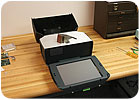 After the customer has purchased materials test equipment, they should do regular maintenance to get the most out of it. Just as drivers maintain their car with regular checkups and oil changes, companies need to do regular preventive maintenance with their equipment.
“It is important to establish materials testing procedures that minimize downtime, as materials testers can be quite expensive,” Fridman says. “Basic force and deflection data operators must also be trained in proper safety procedures. In some high load tests, samples can shatter or break, resulting in a hazardous condition unless appropriate precautions are taken.”
Manufacturers can employ new XRF technology to solve production headaches, ensure inventory quality and evaluate materials, says Hession-Kunz. “For example, testing at incoming inspection can ensure that materials are as ordered and marked. Most manufacturers have found that marking errors or intentional fraud can be an issue from some sources. Screening for these before using them in production can avoid very costly recalls or rejections.
“Another area is to demand flexibility in their portable XRF systems so their units can be readily upgraded or adapted as needs change. Operator training also is important so that point-and-shoot XRF will result in the right results,” Hession-Kunz says.
Companies may perform annual calibration, paying attention to load, speed, displacement and alignment of the system. However, different standards require different verification.
With all of the changes and advances in the industry, the future of materials testing looks promising.
“Even more demands will be placed on manufacturers to test their products,” Fridman says. “Regulations aimed to protect consumers and businesses around the world will put more pressure on manufacturers to adhere to quality control standards.
“The basics of materials testing will likely not change, though the frequency with which it is performed is likely to increase, especially in those markets with high growth manufacturing industries,” says Fridman. “Continued cost pressures on manufacturers should make basic materials testers more prevalent and widely used.”
Innov-X also has predictions for the future of testing. “We see many new XRF uses from evaluating the wear metals in lubricants that can stave off equipment breakdowns, to evaluating fuels for meeting environmental standards,” says Hession-Kunz. “In environmental and industrial fields, making field tests readily available, which formerly were the province of laboratories, has enabled the growth of XRF in more areas so that virtually the sky is the limit. Our portables continue to press forward with ever-lower limits of detection and ever greater capabilities such as thickness measurement and lighter element analysis.
“Our customers are creating new uses and challenging us daily with their ideas,” continues Hession-Kunz. “Our applications group is constantly amazed by the diversity of complex application questions customers bring them. We’re sure there will be many uses we haven’t even thought of that will become key markets over the next five years.” Q
For more information about the companies mentioned in this article, visit their Web sites:
Admet, www.admet.com
Innov-X, www.innovxsys.com
Instron, www.instron.com
Mark-10, www.mark-10.com
Today’s materials testing software allows for more configurable test procedures, protocols and data collection features.
Regulations aimed to protect consumers will put more pressure on manufacturers to adhere to quality control standards.
Continued cost pressures on manufacturers should make basic materials testers more prevalent and widely used.
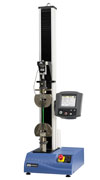
An universal testing system can be used with a TouchPanel controller, rather than a computer and software, for simple QC tests in a lab or on the production floor. Source: Instron
No one wants a product to fail. A materials test can prevent problems from occurring.
“Materials testing is commonly performed to assess the performance of materials such as metals, plastics and ceramics under stress,” explains Mark Fridman, marketing manager at Mark-10 (Copiague, NY). As such, it is a growing area, with changes ranging from equipment to standards to software.
“Today’s software is more powerful, allowing for more configurable test procedures, protocols and data collection features,” says Fridman. “Lower cost and more basic materials testers also have recently been introduced by some manufacturers.”
These lower cost, basic functionality materials testers have been experiencing significant growth in recent years, including force measurement. “These newer machines share many of the same functions as their more sophisticated counterparts,” says Fridman, “However, their pricing, portability and ease of use allow them to be used for basic force measurement applications at the point of production as well as for more scientific analysis in quality and research laboratories.”
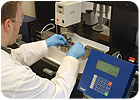
The eXpert 5601 (1kN) single-column testing machine tests medical adhesives and coatings in a saline bath. Source: Admet
Testing Improves
The testing process itself also has undergone improvements. Formerly, operators might run a test, write down the results and then give their report to someone for data entry, with the information eventually residing in a corporate database. More and more companies are interested in streamlining the flow of data from the equipment into the corporate database, thereby speeding up the process.“From a testing standpoint, a lot of people are paying a lot more attention to speeds of testing,” says Richard Gedney, Admet (Norwood, MA) founder and president. People are considering: if the speed of the test varies by X, how will that affect results? This has brought a lot more visibility to the speed of testing.
“A lot of people are still using older machines that are manually operated, and the control of speed is not very good,” Gedney says. “Many people are forced to convert to automatic machines so results will not be polluted by improper speeds.”
By incorporating a new digital measurement system, “they really gain a lot of capability that they simply didn’t have before,” Gedney says. “They can have a program calculate results instead of manually after the fact.”
These capabilities include archiving and generating reports, which can be sent on to customers. “At the same time, they can do tests that they weren’t able to do previously,” Gedney says.
Admet often gets calls from companies asking about retrofitting their machine when their customers have asked them to do something they are not capable of doing, Gedney says.
“Economics drives it,” Gedney says. “Basically the line in the sand, so to speak, is machines of 10,000 pounds capacity and 50 kilonewtons and below. From an economic standpoint, it is better to buy a new machine.”
From a price standpoint, it is better to retrofit a 400,000-pound capacity machine instead of buying a new one, Gedney adds.
From a production standpoint, Gedney says that testing machines also have been put closer and closer, and actually inserted into, assembly lines. Because many assembly lines are operated by PLCs, that has forced testing companies to implement PLC functionalities into their controllers so they will work with the process on the line. Previously, the testing machine sat on a bench, and someone would bring over samples, put the sample in the machine and take it out.
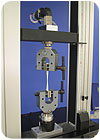
This dual-column testing machine is equipped with torsion actuator and biaxial load cell for applying uniaxial tensile stresses and torsional shearing stresses to plastic specimens. Source: Admet
These days, the goal is to make machines more accurate and to speed the flow of information, Gedney says. Particularly in the production arena, people focus on ensuring that the test is running at the right speed and according to specification. Speed may force people to switch to computer-controlled equipment. Along with better speeds, this allows them to archive results, generate reports to customers and thus, improve the flow of data.
Drew Hession-Kunz, Innov-X (Woburn, MA) vice president of business development for governmental and national accounts, says that another key development area is on-line XRF for manufacturing and recycling. “For manufacturing of alloy steel components, an in-line system, FOX-IQ, has been developed for quickly identifying the specific grade of an alloy during the manufacturing process to ensure quality at the right level during manufacturing, avoiding any mix-ups and linking directly to the manufacturing/QA reporting network,” says Hession-Kunz.
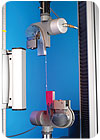
Accuracy in strain measurement is critical for meeting ASTM specifications for Nitinol in tension. Source: Instron
Equipment
Equipment has changed dramatically throughout the years, and the past five years have been no exception. In Meredith Platt’s five years with Instron (Norwood, MA), she has seen a huge increase in the number of people looking at reproducibility and reliability studies. Platt, a 3300 product manager, says that it is important to measure how accurate the gage is, and then use that analysis to see whether the parts are good.The FDA monitors many of the companies Platt works with, so it is crucial to have everything running smoothly. Because of Instron’s application knowledge and product knowledge, they can provide input on the system and check its accuracy, Platt says. Generally most problems occur because of an operator issue or test configuration. A system’s success may depend on procedures, and how good the standard operating systems are.
Software is important, as it is generally the operator’s main contact with the system. Software improvements over the past five years can improve test flow and prevent operators from missing steps along the way, Platt says. Usability, productivity, throughput and safety are all important to customers.
“People are willing to spend extra money on systems that they know are safer,” Platt says. “The future benefit of equipment in general can’t put a price tag on safety.”
However, price is still a consideration.
“Most people are looking for a good value,” Platt says. “They want equipment they can trust, but they don’t want to pay a fortune for it.”
Equipment is not the only thing that has changed-operator levels have dropped, says Platt. When Instron was founded, Ph.D.s were the ones using the equipment. Now, the Ph.D.s are not the ones operating the machinery.
Thus, service and training are both important to customers, and Instron offers training at their own facilities or at the customer’s facility. Customers have unique applications, and Instron tailors their service to that application.
“We very, very rarely ever do a quotation without a visit to the customer,” Platt says. With new customers and new applications, Instron will put someone on-site to determine the best materials testing solution. For example, a customer may want to test metals, but also plastics on occasion, and so Instron aims to fit it all together. It is important to look at the material they are testing, Platt says, and the standards they follow.
Mark-10’s Fridman also has some advice on selecting a system. “It is most important to determine if the material tester is large enough for the customer’s sample, and if the force capacity of the machine is high enough for the testing specimen,” he says. “Some other factors to consider are speed, range and software features.”
The number of applications for XRF continues to grow. Source: Innov-X
“It is important to establish materials testing procedures that minimize downtime, as materials testers can be quite expensive,” Fridman says. “Basic force and deflection data operators must also be trained in proper safety procedures. In some high load tests, samples can shatter or break, resulting in a hazardous condition unless appropriate precautions are taken.”
Manufacturers can employ new XRF technology to solve production headaches, ensure inventory quality and evaluate materials, says Hession-Kunz. “For example, testing at incoming inspection can ensure that materials are as ordered and marked. Most manufacturers have found that marking errors or intentional fraud can be an issue from some sources. Screening for these before using them in production can avoid very costly recalls or rejections.
“Another area is to demand flexibility in their portable XRF systems so their units can be readily upgraded or adapted as needs change. Operator training also is important so that point-and-shoot XRF will result in the right results,” Hession-Kunz says.
Companies may perform annual calibration, paying attention to load, speed, displacement and alignment of the system. However, different standards require different verification.
With all of the changes and advances in the industry, the future of materials testing looks promising.
“Even more demands will be placed on manufacturers to test their products,” Fridman says. “Regulations aimed to protect consumers and businesses around the world will put more pressure on manufacturers to adhere to quality control standards.
“The basics of materials testing will likely not change, though the frequency with which it is performed is likely to increase, especially in those markets with high growth manufacturing industries,” says Fridman. “Continued cost pressures on manufacturers should make basic materials testers more prevalent and widely used.”
Innov-X also has predictions for the future of testing. “We see many new XRF uses from evaluating the wear metals in lubricants that can stave off equipment breakdowns, to evaluating fuels for meeting environmental standards,” says Hession-Kunz. “In environmental and industrial fields, making field tests readily available, which formerly were the province of laboratories, has enabled the growth of XRF in more areas so that virtually the sky is the limit. Our portables continue to press forward with ever-lower limits of detection and ever greater capabilities such as thickness measurement and lighter element analysis.
“Our customers are creating new uses and challenging us daily with their ideas,” continues Hession-Kunz. “Our applications group is constantly amazed by the diversity of complex application questions customers bring them. We’re sure there will be many uses we haven’t even thought of that will become key markets over the next five years.” Q
For more information about the companies mentioned in this article, visit their Web sites:
Admet, www.admet.com
Innov-X, www.innovxsys.com
Instron, www.instron.com
Mark-10, www.mark-10.com
Tech Tips
Looking for a reprint of this article?
From high-res PDFs to custom plaques, order your copy today!