Quality Magazine logo
search
cart
facebook twitter linkedin youtube
  • Sign In
  • Create Account
  • Sign Out
  • My Account
Quality Magazine logo
  • NEWS
  • PRODUCTS
    • FEATURED PRODUCTS
    • SUBMIT YOUR PRODUCT
  • CHANNELS
    • AUTOMATION
    • MANAGEMENT
    • MEASUREMENT
    • NDT
    • QUALITY 101
    • SOFTWARE
    • TEST & INSPECTION
    • VISION & SENSORS
  • MARKETS
    • AEROSPACE
    • AUTOMOTIVE
    • ENERGY
    • GREEN MANUFACTURING
    • MEDICAL
  • MEDIA
    • A WORD ON QUALITY PUZZLE
    • EBOOK
    • PODCASTS
    • VIDEOS
    • WEBINARS
  • EVENTS
    • EVENT CALENDAR
    • IMTS
  • DIRECTORIES
    • BUYERS GUIDE >
      • Supplier Insights
    • NDT SOURCEBOOK
    • VISION & SENSORS
    • TAKE A TOUR
  • INFOCENTERS
    • Digital Quality Management Systems
    • NEXT GENERATION SPC & QUALITY ANALYTICS
  • AWARDS
    • ROOKIE OF THE YEAR
    • PLANT OF THE YEAR
    • PROFESSIONAL OF THE YEAR
  • MORE
    • Expert Columns
    • NEWSLETTERS
    • QUALITY STORE
    • INDUSTRY LINKS
    • SPONSOR INSIGHTS
  • EMAG
    • eMAGAZINE
    • ARCHIVES
    • CONTACT
    • ADVERTISE
  • SIGN UP!

Quality 101: Demystifying Design FMEAs

April 1, 2005
Learn an optimal method for establishing Design FMEA ratings

Last month Quality 101 began exploring the correct way to arrive at the ratings for Design Failure Mode and Effects Analysis (FMEAs) with a discussion on establishing a severity rating system and occurrence rating. This month the discussion continues with establishing detection ratings.


Establishing detection rating

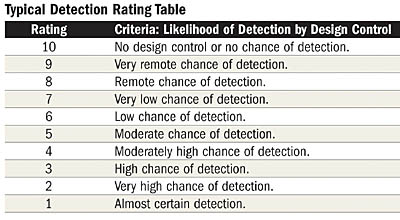
The third rating that must be determined is the detection rating. The detection rating is used to define the effectiveness of the design controls in assessing the probability that the failure mode will occur due to the failure cause to which it is linked. See the table, "Typical Detection Rating."

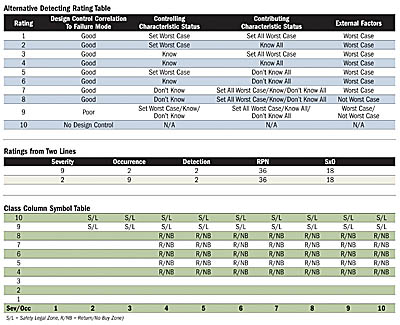
The highly subjective nature of this table makes it difficult to achieve consistent application of the rating system when evaluating the effectiveness of design controls. An alternative rating table that should improve the FMEA group's ability to consistently rate the effectiveness of design controls. See the table, "Alternative Rating Table."

To use the rating table, two definitions must be understood. The first definition is the controlling characteristic. This is the characteristic specification that is on the line of the Design FMEA for which the detection rating is being developed. If developing the detection rating for the first row of the example, the controlling characteristic would be the component material thickness.

The second definition is contributing characteristics. These are the characteristic specifications that are on all the other lines where design control being evaluated can be found. For example, there is one contributing characteristic-component material type.

The Road Durability Test has good correlation with the road impact resistance that is being evaluated and represents the worst-case impacts that will be experienced during the life of the component. The tested component material thickness is known at the time of testing but is not at the minimum of the specification. All of the component material properties have not been measured. Using the Alternative Detection Rating Table, the detection rating of 6 is assigned to the material thickness line and the rating of 7 assigned to the material properties line.

When using the alternative rating table, it is not uncommon to assign ratings in the 5 to 8 range. Many of the vehicle level tests being required by the automotive companies today fall in this category.


What to work on

Now that the ratings have been developed, the FMEA group must decide which lines of the Design FMEA to work on. The approach recommended by most FMEA manuals is to calculate the Risk Priority Number (RPN=severity x occurrence x detection) and begin working on the highest RPNs first. Some companies have gone as far as establishing RPN limits for improvement action activity. A typical approach is to require recommended actions for all RPNs over 100 and suggest recommended actions for RPNs greater than 36 but less

than 100.

With this method, there is a high probability that the wrong issues will be selected for action. See the table, "Rating from Two Lines."

The table provides the ratings from two lines of a Design FMEA. The first line indicates that although the probability is low, there is a likelihood that a failure could result in injury. The table also shows excellent design controls exist to confirm the prediction. The second line indicates there is a high probability of a noise or appearance failure occurring that the customer will not find objectionable enough to return. Excellent design controls exist to confirm the second line prediction as well.

If one uses RPN to decide what to work on, both of the lines will be given the same importance. In some companies no action would be required because the RPN falls below the action limit. Realizing the inherent weakness when using RPN to prioritize required actions, some companies have decided to only use the SxO calculation (Severity x Occurrence). Although the SxO prioritization method is more effective than the RPN method, the provided example shows it does not work all the time. A completely new method of prioritization is needed-the class column.


In the zone

Three zones were introduced in the severity rating table discussion: Safety/Legal Zone, Return/No Buy Zone and Conditioned Response Zone. The Safety/Legal Zone is the most expensive zone to have an issue. When an issue occurs in this zone, it must be worked on first. If an occurrence rating of 1 is given, the failure is unlikely; the Safety/Legal Zone is defined as lines in the Design FMEA which have severity ratings of 9 to 10 and occurrence ratings of 2 to 10.

The Return/No Buy Zone is the second most expensive zone for a company. Although companies do not like to have issues that result in return or non-

purchase of their product, there is a low level of return/no buy zone issues where it is more expensive to make these issues go away than to absorb the loss when they occur. Many companies use an occurrence rating of 4 to establish the limit.

Because Conditioned Response Zone issues have no immediate financial impact on the company, they should never be worked on. See the table, "Class Column Symbol Table." Different companies have different symbols to designate the zones. The symbol is placed in the class column of the Design FMEA.

Sometimes, there will be more than one item in the same zone. When this occurs, lines with the high SxO within the zone should be worked on first. If the SxOs are the same, use the RPN calculation for prioritization.

Once the failure modes, failure causes and design controls in the Design FMEA have been defined, an efficient methodology is required to accurately identify where company resources should be used to achieve the greatest payback in design improvement.

Share This Story

Looking for a reprint of this article?
From high-res PDFs to custom plaques, order your copy today!

Recommended Content

JOIN TODAY
to unlock your recommendations.

Already have an account? Sign In

  • 2024 Quality Rookie of the Year Justin Wise 1440x750px banner with "Quality Rookie of the Year" logo inset

    Meet the 2024 Quality Rookie of the Year: Justin Wise

    Justin Wise is an exceptional individual who has been...
    Aerospace
    By: Michelle Bangert
  • Man with umbrella and coat stands outside while it rains at night looking at a building.

    Nondestructive Testing: Is there an ethics problem?

    I was a whistleblower who exposed fraudulent activities...
    NDT
    By: Dale Norwood
  • Unraveling Deflategate: Football stadium with closeup of football on field

    Unraveling the Tom Brady Deflategate

    The Deflategate scandal erupted following the 2014 AFC...
    Measurement
    By: Greg Cenker and Henry Zumbrun
Manage My Account
  • eMagazine Subscriptions
  • Newsletters
  • Online Registration
  • Subscription Customer Service
  • Manage My Preferences

More Videos

Sponsored Content

Sponsored Content is a special paid section where industry companies provide high quality, objective, non-commercial content around topics of interest to the Quality audience. All Sponsored Content is supplied by the advertising company and any opinions expressed in this article are those of the author and not necessarily reflect the views of Quality or its parent company, BNP Media. Interested in participating in our Sponsored Content section? Contact your local rep!

close
  • Key Takeaways for Quality Leaders
    Sponsored byComplianceQuest

    Key Takeaways for Quality Leaders from the 2026 Gartner Magic Quadrant™ for QMS

  • This image shows a person seated next to a Bobcat T66 compact track loader.
    Sponsored byPolyWorks by InnovMetric

    Supercharging Digital Gauging at Bobcat North America

  • Dorsey Calibration Lab photo by Tom LaBarbera Picture this Studios
    Sponsored byDorsey Metrology International

    Ensuring Product Quality in a Competitive Manufacturing Landscape

Popular Stories

a titanium diaphragm speaker driver

The One Thing Elon Gets Right Is Designed to Scare You

This image shows a person seated next to a Bobcat T66 compact track loader.

Supercharging Digital Gauging at Bobcat North America

Dorsey Calibration Lab photo by Tom LaBarbera Picture this Studios

Ensuring Product Quality in a Competitive Manufacturing Landscape

2026 Quality Professional of the Year!

Events

June 9, 2026

Future-Proof your Quality Processes with Advanced 3D Optical CMM Technology

Discover how to effortlessly capture complex data, leverage true multi-sensor automation, and ensure continuous operation without creating inspection delays.

June 22, 2026

Automate 2026

Automate is North America's largest robotics and automation event — and the best place to take your ideas from insight to impact.
 
Our show floor features the world’s leading automation solutions, from AI and robotics to motion control, vision systems, and more. Plus, our educational conference is second to none, led by the brightest minds in automation today.
 
Ready to transform the way you work? Take the next step at Automate.
View All Submit An Event

Products

Lean Manufacturing and Service Fundamentals, Applications, and Case Studies

Lean Manufacturing and Service Fundamentals, Applications, and Case Studies

See More Products
Quality Podcast Channel Custom Content

Related Articles

  • Quality 101: Demystifying Design FMEAs

    See More
  • Quality 101: Quality Standards Defined

    See More
  • Quality 101: Machine Vision Fundamentals

    See More

Related Products

See More Products
  • Design for Manufacture and Assembly (DFMA) DVD

See More Products

Related Directories

  • Quality System Consultants

    We have experience developing and maintaining quality systems and have a commitment to the relentless improvement of the regulatory systems of our clients. Whether you are a startup or an established firm, Quality System Consultants can help you implement a range of quality management systems. We have: • Built inspection procedures and testing methods to improve efficiency • Achieved ISO 13485 certifications for clients ahead of schedule • Managed compliance for Class I through Class III medical devices • Averaged a 10-1 return on investment on projects we're involved with • Been voted 7th by Quality Magazine for continuous improvement to quality systems and contribution to bottom-line profitability. Unlike some of the competition, we aren't interested in stacking up billable hours at the expense of your project. We succeed when you succeed, and we're committed to solving the problems you bring to us. If you want an experienced, dedicated firm to work with you through an otherwise intimidating regulatory environment, you want to call Quality System Consultants.
×

Stay in the know with Quality’s comprehensive coverage of
the manufacturing and metrology industries.

Newsletters | Website | eMagazine

JOIN TODAY!
  • RESOURCES
    • Advertise
    • Contact Us
    • Directories
    • Manufacturing Division
    • Store
    • Want More
  • SIGN UP TODAY
    • Create Account
    • eMagazine
    • Newsletters
    • Customer Service
    • Manage Preferences
  • SERVICES
    • Marketing Services
    • Market Research
    • Reprints
    • List Rental
    • Survey/Respondent Access
  • STAY CONNECTED
    • LinkedIn
    • Facebook
    • YouTube
    • X (Twitter)
  • PRIVACY
    • PRIVACY POLICY
    • TERMS & CONDITIONS
    • DO NOT SELL MY PERSONAL INFORMATION
    • PRIVACY REQUEST
    • ACCESSIBILITY

Copyright ©2026. All Rights Reserved BNP Media, Inc. and BNP Media II, LLC.

Design, CMS, Hosting & Web Development :: ePublishing