Quality Magazine logo
search
cart
facebook twitter linkedin youtube
  • Sign In
  • Create Account
  • Sign Out
  • My Account
Quality Magazine logo
  • NEWS
  • PRODUCTS
    • FEATURED PRODUCTS
    • SUBMIT YOUR PRODUCT
  • CHANNELS
    • AUTOMATION
    • MANAGEMENT
    • MEASUREMENT
    • NDT
    • QUALITY 101
    • SOFTWARE
    • TEST & INSPECTION
    • VISION & SENSORS
  • MARKETS
    • AEROSPACE
    • AUTOMOTIVE
    • ENERGY
    • GREEN MANUFACTURING
    • MEDICAL
  • MEDIA
    • A WORD ON QUALITY PUZZLE
    • EBOOK
    • PODCASTS
    • VIDEOS
    • WEBINARS
  • EVENTS
    • EVENT CALENDAR
    • IMTS
  • DIRECTORIES
    • BUYERS GUIDE >
      • Supplier Insights
    • NDT SOURCEBOOK
    • VISION & SENSORS
    • TAKE A TOUR
  • INFOCENTERS
    • Digital Quality Management Systems
    • NEXT GENERATION SPC & QUALITY ANALYTICS
  • AWARDS
    • ROOKIE OF THE YEAR
    • PLANT OF THE YEAR
    • PROFESSIONAL OF THE YEAR
  • MORE
    • Expert Columns
    • NEWSLETTERS
    • QUALITY STORE
    • INDUSTRY LINKS
    • SPONSOR INSIGHTS
  • EMAG
    • eMAGAZINE
    • ARCHIVES
    • CONTACT
    • ADVERTISE
  • SIGN UP!

Quality 101: Defining GD&T
By Don Day
June 29, 2007
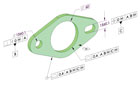
Dimensions and tolerances can be embedded in the CAD model, producing drawings such as this. Source: Tec-Ease Inc.


What geometric dimensioning and tolerancing (GD&T) is depends on one’s discipline. To the designer it is a way to describe the design intent of individual parts. To someone in production it is the language of modern print reading. To someone working in metrology it is a guide to the inspection of parts. To management it is a concurrent engineering tool that provides clear communication across the enterprise.

GD&T has been developing during the past 80 to 100 years. It really started to be applied during World War II when the military realized the importance of defining parts with a document that had only one meaning to ensure interchangeability and part functionality. For many years companies, countries and the military published their own version of GD&T. This caused much confusion for suppliers trying to produce parts for multiple customers.

Today most companies, from those that produce aircraft carriers to those that produce cell phones, satellites or sump pumps, have committed to following either the ASME Y14.5M-1994 standard or the collection of ISO standards on GD&T. The ASME Y14.5 standard has emerged as the preferred standard in the United States and several foreign countries, mainly because of its stability, emphasis on design intent, mathematical definition and translation to several languages.

In addition, there is now the ASME Y14.41-2003 standard, which sets forth the rules to applying the Y14.5 dimensioning and tolerancing concepts to digital data such as solid models. Dimensions and tolerances can now be embedded in the CAD model. Embedding tolerances in the solid (digital) model opens the door to reduced dimension drawings and automated analysis, which can include the expected variation which is bound to occur in production. GD&T enables this change in technology. According to ASME Y14.100 the word drawing now refers to the paper document or digital data.
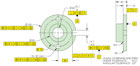


Figure 1. The size dimensions are Ø30, Ø100, Ø50, Ø12 and 14.1/14.0. Source: Tec-Ease Inc.

Directly Toleranced Dimensions

Dimensions may be directly or indirectly toleranced. Directly toleranced dimensions are those that are not basic. Directly toleranced dimensions may have a tolerance written next to the dimension, be limit dimensions or make use of a general title block tolerance. The drawing in Figure 1 illustrates common tolerancing methods. In addition to the tolerancing shown, tolerances may be unequal bilateral, or applied by using limits and fits tolerance symbols, or by referencing implied tolerances found in standards such as ISO 2768.

Limit dimensioning: 14.1 14.0

Plus and minus tolerancing:
    Unilateral: 30 +0.1/0
    Equal Bilateral: Ø12±0.1

Title block tolerance:
    Linear tolerance: ±0.2
    Applies to Ø100, Ø50, 30, 10 and two R3s
    Angular tolerance: ±2°
    Applies to the implied 90° angles


Basic Dimensions

Basic dimensions do not have a direct tolerance. The basic dimensions in Figure 1 are Ø76 and 40. By making these dimensions basic, the general tolerances no longer apply. Their tolerance is indirect. The tolerance is applied to the features on the part, not the dimensions. The basic dimension may be thought of as the goal and the geometric tolerance is the amount the feature may deviate from the goal.

Geometric Tolerances

Where geometric tolerances are used, they are applied to the feature rather than the dimension. The geometric tolerances are found in the feature control frames. In Figure 1 they are Ø0, 0, 0.1, 0.2 and three Ø0.3.

Even though there are 0s in some of the feature control frames, it does not mean that production must make perfect parts. The 0 tolerance applies only at one limit of size known as the maximum material condition (MMC) or the least material condition (LMC). Using 0 tolerancing actually provides production with more tolerance because it allows the acceptance of the best parts. This was not possible without GD&T.


Size Dimensions

The size dimensions in Figure 1 are Ø30, Ø100, Ø50, Ø12 and 14.1/14.0. The 10 and 30 dimensions use the dimension origin symbol in place of an arrowhead to indicate which surface functions as a “local datum feature” for inspection.


There are 14 geometric tolerances. This table shows the tolerance symbols, describes what they control and whether or not they can reference datums. Source: Tec-Ease Inc.

Originally only direct tolerancing was used on drawings even though there never was a standard that could provide one clear meaning. Some of the problems with direct tolerancing include:

  • Multiple interpretations.
  • Tolerancing of points in space that cannot be verified, such as the center of a radius.
  • Tolerance accumulation.
  • Wedge-shaped tolerance zones where angles are toleranced in degrees.
Not all directly toleranced dimensions have these problems. GD&T was developed to eliminate these problems where they exist.

There are four categories of geometric tolerance characteristics: location, orientation, size (handled with direct tolerancing not shown in chart) and form. There is a hierarchy to these geometric characteristics. Location tolerances also control the orientation of features. Size also controls form.
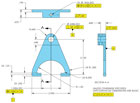
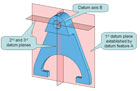
Figure 2A. Source: Tec-Ease Inc.

Datum features are labeled using a letter in a box at one end of a line and a triangle at the other. The triangle is associated with the feature that will serve as a datum feature to establish origins of measurement. Figure 2 illustrates a drawing where this approach has been applied. The old general titleblock tolerance has been replaced by a note making the dimensions that do not have a tolerance specified basic and a general profile of a surface tolerance that applies to the entire part unless it is overridden by a tolerance that appears on the field of the drawing. All measurements should be made from the datum reference frame established by datum features A, B and C. This part is totally defined with one clear meaning to anyone who knows how to read today’s prints.

Figure 2B. All measurements should be made from the datum reference frame established by datum features A, B and C. Source: Tec-Ease Inc.

GD&T has been evolving for decades and an understanding of it is essential for anyone who reads today’s drawings. There is no other standard for defining parts. GD&T is enabling the new technology in CAD, CNC software and automated inspection such as CMMs and 3-D scanners. Becoming educated in GD&T is an essential requirement for those who wish to compete on a global level.

Share This Story

Looking for a reprint of this article?
From high-res PDFs to custom plaques, order your copy today!

Don Day is president of Tec-Ease Inc. (Cherry Creek, NY), a mechanical engineer, professor emeritus and a standards developer. For more information, e-mail [email protected], call Tec-Ease Inc. at (888) TEC-EASE or visit www.tec-ease.com.


Recommended Content

JOIN TODAY
to unlock your recommendations.

Already have an account? Sign In

  • 2024 Quality Rookie of the Year Justin Wise 1440x750px banner with "Quality Rookie of the Year" logo inset

    Meet the 2024 Quality Rookie of the Year: Justin Wise

    Justin Wise is an exceptional individual who has been...
    Aerospace
    By: Michelle Bangert
  • Man with umbrella and coat stands outside while it rains at night looking at a building.

    Nondestructive Testing: Is there an ethics problem?

    I was a whistleblower who exposed fraudulent activities...
    NDT
    By: Dale Norwood
  • Unraveling Deflategate: Football stadium with closeup of football on field

    Unraveling the Tom Brady Deflategate

    The Deflategate scandal erupted following the 2014 AFC...
    Measurement
    By: Greg Cenker and Henry Zumbrun
Manage My Account
  • eMagazine Subscriptions
  • Newsletters
  • Online Registration
  • Subscription Customer Service
  • Manage My Preferences

More Videos

Sponsored Content

Sponsored Content is a special paid section where industry companies provide high quality, objective, non-commercial content around topics of interest to the Quality audience. All Sponsored Content is supplied by the advertising company and any opinions expressed in this article are those of the author and not necessarily reflect the views of Quality or its parent company, BNP Media. Interested in participating in our Sponsored Content section? Contact your local rep!

close
  • This image shows a person seated next to a Bobcat T66 compact track loader.
    Sponsored byPolyWorks by InnovMetric

    Supercharging Digital Gauging at Bobcat North America

  • Dorsey Calibration Lab photo by Tom LaBarbera Picture this Studios
    Sponsored byDorsey Metrology International

    Ensuring Product Quality in a Competitive Manufacturing Landscape

  • This image displays a Eddyfi Technologies Cypher portable inspection instrument alongside a scanner for non-destructive testing (NDT).
    Sponsored byEddyfi Technologies

    A Safer, Smarter Approach to Weld Inspection: Why Advanced Ultrasonic Testing Is Redefining Industry Standards

Popular Stories

MicroRidge MobileCollect wireless measurement system

Before AI Can Help, the Data Has to Be Ready

a titanium diaphragm speaker driver

The One Thing Elon Gets Right Is Designed to Scare You

This image shows a person seated next to a Bobcat T66 compact track loader.

Supercharging Digital Gauging at Bobcat North America

2026 Quality Professional of the Year!

Events

June 4, 2026

Scaling Manufacturing Quality with Automation for Greater ROI

If you need to do more with the same resources or build a new tech foundation, this session shows where to start and how to create a more efficient, scalable, cost-conscious quality process.

June 9, 2026

Future-Proof your Quality Processes with Advanced 3D Optical CMM Technology

Discover how to effortlessly capture complex data, leverage true multi-sensor automation, and ensure continuous operation without creating inspection delays.

View All Submit An Event

Products

Lean Manufacturing and Service Fundamentals, Applications, and Case Studies

Lean Manufacturing and Service Fundamentals, Applications, and Case Studies

See More Products
Quality Podcast Channel Custom Content

Related Articles

  • Quality 101: Making GD&T Work

    See More
  • GD&T Workshop: The Perfect Imaginary World of GD&T

    See More
  • GD&T Workshop: The Fundamentals of GD&T

    See More

Related Products

See More Products
  • Quality Improvement Through Planned Experimentation 3/E

  • Juran Institute's Six Sigma Breakthrough and Beyond Quality Performance Breakthrough Methods

See More Products

Related Directories

  • Tec-Ease Inc.

    Tec-Ease provides high quality training and reference materials in the areas of Geometric Dimensioning and Tolerancing (GD&T) and ASME Y14.5 Standard. We are known for our GD&T knowledge and the use of humor in our training. We provided training with a live instructor on-site or as a webinar. Self-Paced Online Training is available for most of our classes.
  • Symphony Technologies

    Symphony Technologies: Software for Product and Process Quality Improvement: Simple, user-friendly and powerful software that helps you to design better products and improve your process performance. Software for FMEA, SPC, MSA, Process Capability, Pre-Control & Web-based GD&T Training.
×

Stay in the know with Quality’s comprehensive coverage of
the manufacturing and metrology industries.

Newsletters | Website | eMagazine

JOIN TODAY!
  • RESOURCES
    • Advertise
    • Contact Us
    • Directories
    • Manufacturing Division
    • Store
    • Want More
  • SIGN UP TODAY
    • Create Account
    • eMagazine
    • Newsletters
    • Customer Service
    • Manage Preferences
  • SERVICES
    • Marketing Services
    • Market Research
    • Reprints
    • List Rental
    • Survey/Respondent Access
  • STAY CONNECTED
    • LinkedIn
    • Facebook
    • YouTube
    • X (Twitter)
  • PRIVACY
    • PRIVACY POLICY
    • TERMS & CONDITIONS
    • DO NOT SELL MY PERSONAL INFORMATION
    • PRIVACY REQUEST
    • ACCESSIBILITY

Copyright ©2026. All Rights Reserved BNP Media, Inc. and BNP Media II, LLC.

Design, CMS, Hosting & Web Development :: ePublishing