Helium Leak Detection for Plastic Containers Adds Value
Cost efficiency through modern helium leak detection without vacuum chambers.
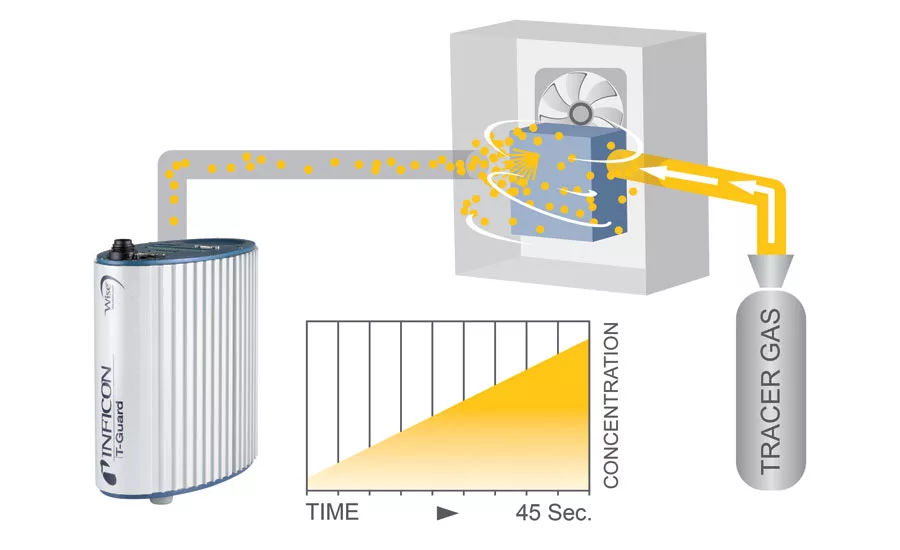
An economical method to test for leaks outside of a vacuum chamber is by using helium or hydrogen in an accumulation chamber at normal pressure. Source: INFICON
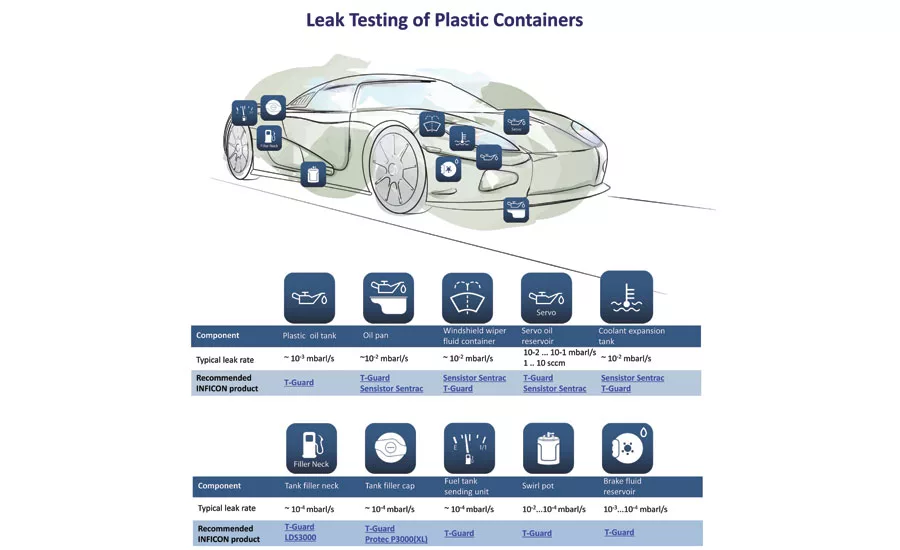
This chart illustrates the many vehicle systems that use plastic containers. Source: INFICON
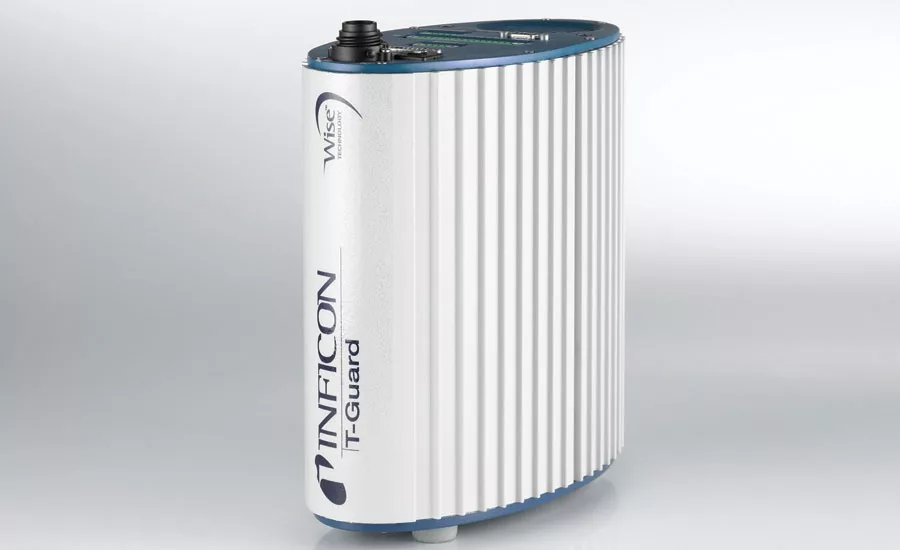
Using helium tracer gas with a patented quartz membrane sensor, this piece of testing equipment can be used on plastic and non-ferrous metal components. It delivers fast, precise results and eliminates the need for a vacuum chamber. Source: INFICON
Quality, safety and weight are chief drivers in the design and manufacture of most automotive components. An advance in any one of these areas can’t come at the expense of another. And of course, cost is a critical factor as well.
Components such as lightweight, but sturdy plastic containers and housings can be processed easily, procured at reasonable prices and have great appeal.
Due to the demands for weight reduction and technology to optimize complex forms in less space, more and more components are being manufactured from plastics. All of these smaller components must be checked for leaks—and the requirements continue to increase.
But when it comes to quality, manufacturers and their suppliers are faced with a dilemma. Product specifications often include low-cost plastic components that cannot be safely and cost-effectively tested for leaks using conventional testing methods such as an underwater bubble test, the pressure-drop method or vacuum leak detection.
Accumulation helium-leak detection with a quartz-membrane sensor eliminates the need for a vacuum chamber, while still delivering fast, precise results.
Automotive manufacturers annually produce about 90 million vehicles globally. According to Thomas Parker, North American automotive sales manager for INFICON, car makers and their suppliers conduct as many as 600 million leak tests per year on plastic vehicle components, including fuel, brake, steering and cooling system parts.
Areas at risk for leaks include plastic containers for lubricants, coolants, brake fluid, hydraulic fluids, and windshield wiper fluid, as well as plastic fuel lines, plastic filters, surge tanks, filter housings, pumps or batteries, gas tank caps and tank fillers.
It once was considered routine for a driver to occasionally top off fluids in a vehicle. Today’s standards are much different and a part is considered defective or of sub-par quality if a car owner has to perform this type of vehicle maintenance—maintenance that could have a negative effect on brand image.
Charge air coolers, often made from metal as well, are currently tested against leak rate limits of 10-2 mbar l/s, servo oil containers, tank fillers, gas tank caps and lines already are at 10-4 mbar l/s. Yet the latter are already impermeable to liquids at a value of 10-2 mbar l/s. Why the stricter leak-rate limit? These components must contain evaporation vapors almost completely. Besides quality demands, stricter emission regulations also are driving industry standards upwards. Leak detection methods are becoming more precise, but must be affordable as well.
Are obsolete methods used for modern materials?
For a long time, most plastic containers were tested for leaks in a water bath or with a pressure- drop method. Both methods are relatively low-cost but can be used only up to a certain detection limit.
Smaller leaks cannot be measured with a bubble test because bubble formation will not occur due to the high surface tension of water. Because bubble tests require visual inspection, test results also depend entirely on the skills and attentiveness of the person performing the test. In addition, test parts after a water bath test must be dried before they can be used in other production or assembly operations—a process that is both energy-intensive and time-consuming.
During pressure-drop testing (also referred to as a pressure-decay test) the test part is filled with air at a specific pressure. If there is a leak, the pressure will drop and the difference can be measured. But test pressures can vary considerably depending on the volume of the test sample and its temperature.
When plastic parts are filled with air there is a “creepage” effect during the test period when pressure in the test parts declines as the volume of the parts increases. As a result, reliable measurements are virtually impossible. Duplicating measurement results is critical, but difficult to guarantee, especially with smaller leak rates or larger-volume components. The pressure-drop method therefore is no longer precise enough for many industrial requirements.
Cost increases in a vacuum
At the other end of the scale, there are test methods that detect leaks with helium as a test gas using a mass spectrometer. Although very small amounts of helium and the smallest leaks rated can be detected as a result (10-11 mbar l/s), detecting helium gas with a mass spectrometer requires a high vacuum. Air-tight vacuum chambers and high-performance pumps capable of producing this type of vacuum are expensive to manufacture and operate.
Vacuum-testing use makes sense, however, if very fast, very small leaks need to be detected. This type of testing lasts only a few seconds, and the equipment is so highly developed that even with a steadily increasing helium concentration it can deliver optimal results over several test cycles.
Vacuum-chamber methods could be used for testing plastic containers, however, detection is too sensitive by a factor of one thousand or more, and plastic containers can collapse or split in a vacuum. Even the smallest differences of 100 mbar between the internal pressure of the container and the pressure in the test chamber are sufficient to deform a plastic container.
Gaps in leak detection – integral helium leak detection without a vacuum
Leak testing with air also has reached its limits, and vacuum testing in most cases is too expensive. However, there is a gap between the two (in a range from 10-2 to 10-5 mbar l/s) which is being filled by newer automated high-performance test methods. Leak detection with helium or hydrogen in an accumulation chamber under normal pressure (accumulation method) can now fill the gap in an economical way. Hydrogen can be used as well as helium and is priced even lower as a test gas, although it does not provide the same sensitivity.
Because a mass spectrometer cannot be used under normal pressure, a highly-sensitive sensor operating at atmospheric pressure is required. Sensors based on patented Wise technology, for example, can measure an increasing helium concentration in a test chamber at atmospheric pressure. In the chamber, the test part is filled with helium through a test-gas connection so that the gas can escape through any leaks into the accumulation chamber. Internal fans ensure an even distribution of the helium in the chamber, so regardless of the position of the leak, precise measurement values are guaranteed. The sensor determines the amount of gas content in the chamber.
Leak-detector sensors with Wise technology consist of an evacuated glass cell with a quartz membrane that is permeable to helium. The membrane is like a sponge interspersed with small capillaries through which only helium at a molecular level can penetrate.
Under laboratory conditions, leaks in a range of 10-6 mbar l/s can be reliably detected. During production operations with a free volume—the volume of the chamber minus the volume of the test sample—of five liters in the test chamber, leak rates of 1*10-4 mbar l/s can be detected in less than 30 seconds.
For a free volume of one liter the same leak rates can be detected in just 11 seconds. Including setup time, the time per test sample is about 16 seconds, which yields 225 test samples per hour. In addition to speed, the accumulation method is especially suited for testing plastic components because the expansion component becomes irrelevant.
To check the system, measurements are done against test leaks. By positioning the test leak at different places in the test chamber one can also test to see if an even helium concentration in the test chamber has actually been achieved.
Accumulation leak-detection cost benefits
Sensitivity is a crucial element in this type of a measurement system. But to meet the installation and low-cost maintenance requirements of most manufacturing plants, a test system also must be compact, easy to set up, connected to hydraulic and electronic components and offer a wide range of test modes for flexible use. Here the accumulation method offers significant advantages. For example, since the normal atmosphere does not have to be evacuated, no costly turbo-molecular pumps or air-tight vacuum chambers are needed.
The need for a sensitive mass spectrometer also can be eliminated. The measuring system is relatively easy to set up. Acquisition and maintenance costs are low and manageable, as well. Successful tests with reliable, reproducible measurement results are even possible with the simplest of household plastic boxes. Nevertheless, the measurement values with this variant of the integral helium leak detection are highly reliable and reproducible, even with large, hot or moist test samples. Furthermore, long cooling or drying phases before tests are no longer necessary.
Helium leak detection without a vacuum is ideally suited for plastic components during automotive production, where rapid automated testing on production lines is essential for economic reasons. A system that uses a highly sensitive helium sensor and an accumulating chamber meets today’s need for a reliable, yet relatively low-cost, high-speed leak detection system.
Tests that work with a simple chamber under atmospheric pressure do not require complex high-vacuum chambers and pumps, and measurements are not affected by temperature or humidity. Plastics, as well as ferrous and non-ferrous metals, can be tested with this system, which also can be 100 times more sensitive than pressure-drop and water-bath systems.
Looking for a reprint of this article?
From high-res PDFs to custom plaques, order your copy today!