Quality Magazine logo
search
cart
facebook twitter linkedin youtube
  • Sign In
  • Create Account
  • Sign Out
  • My Account
Quality Magazine logo
  • NEWS
  • PRODUCTS
    • FEATURED PRODUCTS
    • SUBMIT YOUR PRODUCT
  • CHANNELS
    • AUTOMATION
    • MANAGEMENT
    • MEASUREMENT
    • NDT
    • QUALITY 101
    • SOFTWARE
    • TEST & INSPECTION
    • VISION & SENSORS
  • MARKETS
    • AEROSPACE
    • AUTOMOTIVE
    • ENERGY
    • GREEN MANUFACTURING
    • MEDICAL
  • MEDIA
    • A WORD ON QUALITY PUZZLE
    • EBOOK
    • PODCASTS
    • VIDEOS
    • WEBINARS
  • EVENTS
    • EVENT CALENDAR
    • IMTS
  • DIRECTORIES
    • BUYERS GUIDE >
      • Supplier Insights
    • NDT SOURCEBOOK
    • VISION & SENSORS
    • TAKE A TOUR
  • INFOCENTERS
    • Digital Quality Management Systems
    • NEXT GENERATION SPC & QUALITY ANALYTICS
  • AWARDS
    • ROOKIE OF THE YEAR
    • PLANT OF THE YEAR
    • PROFESSIONAL OF THE YEAR
  • MORE
    • Expert Columns
    • NEWSLETTERS
    • QUALITY STORE
    • INDUSTRY LINKS
    • SPONSOR INSIGHTS
  • EMAG
    • eMAGAZINE
    • ARCHIVES
    • CONTACT
    • ADVERTISE
  • SIGN UP!
Software

Gage Repeatability and Reliability: Ensuring Accurate Test Results for Measurement Systems

When designing a GR&R study it is important to select a range of materials that is representative of what the system will be used for.

By Elayne Gordonov, Morgan Galaznik
gage repeatability and reliability

Figure 1: Sources of Error

gage repeatability and reliability

Figure 2: Example of One GR&R Study Trial
gage repeatability and reliability

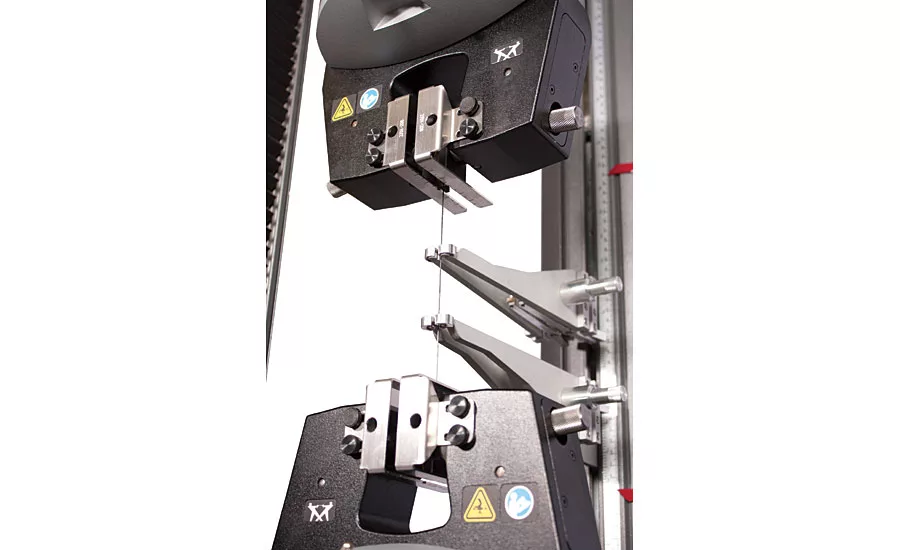
Utilizing pneumatic grips with specimen alignment devices and an automatic extensometer helps reduce machine setup error for passing a GR&R. Source: Instron

gage repeatability and reliability
November 1, 2016

One of the questions our applications team is most commonly asked is “Why aren’t my systems producing the exact same results?” Over years of applications consulting, we have found that optimizing the test configuration by instructing labs to use the same method files, implement standard operating procedures (SOPs) and use equivalent test setups is the best way to minimize test result differences. However, application engineers can only do so much as differences do exist in the real world. For example, every mechanical testing system is different, laboratories have different operators using their systems, different samples are actually being tested, and each specimen being tested is prepared with slight differences. There are many sources and reasons that may cause these differences and the sum of the differences may produce an overall error in the test results. Sources of error specific to materials testing are summarized in Figure 1.

While most users of materials testing equipment can understand these sources of error and do their best to minimize testing errors, eliminating error altogether is not possible. As companies grow, it is even more difficult to reduce sources of error between multiple test systems, multiple laboratories, and multiple geographic locations. Since error can never be eliminated, the next best option quality professionals have is to understand and quantify the error. One approach to both quantify and understand sources of error is to perform a gage repeatability and reliability (GR&R) study on a measurement system.

Tech Tips

  • A GR&R study may help to understand why variation in testing results exists.
  • GR&R identifies whether it is the measurement device itself or the operator that is causing variation.
  • As organizations grow, there is an increased need to understand variations that can occur with different systems in different labs in different geographies.

To adopt GR&R to materials testing, the gage is a test result (i.e. modulus), and repeatability and reliability relate to using the measurement system to obtain that gage. According to ASTM E177-14, Standard Practice for Use of the Terms Precision and Bias in ASTM Test Methods, the definitions of repeatability and reproducibility are as follows:

Repeatability: conditions where independent test results are obtained with the same method on identical test items in the same laboratory by the same operator using the same equipment within short intervals of time.

Reproducibility: conditions where test results are obtained with the same method on identical test items in different laboratories with different operators using different equipment.

The goal of repeatability is to determine how accurate the materials testing system is at measuring the gage. The goal of reproducibility is to measure operator variation.

GR&R is a common statistical tool. The purpose of a GR&R study is to uncover the cause of variation from a measurement device (or gage) and classify the source of this variation as either from the device itself or the operator of the device. As a lab’s capabilities expand, either by adding additional equipment or opening a new facility, it is important to first conduct a controlled experiment, such as a GR&R, to ensure repeatability can be achieved and the expected variance between systems can be quantified.

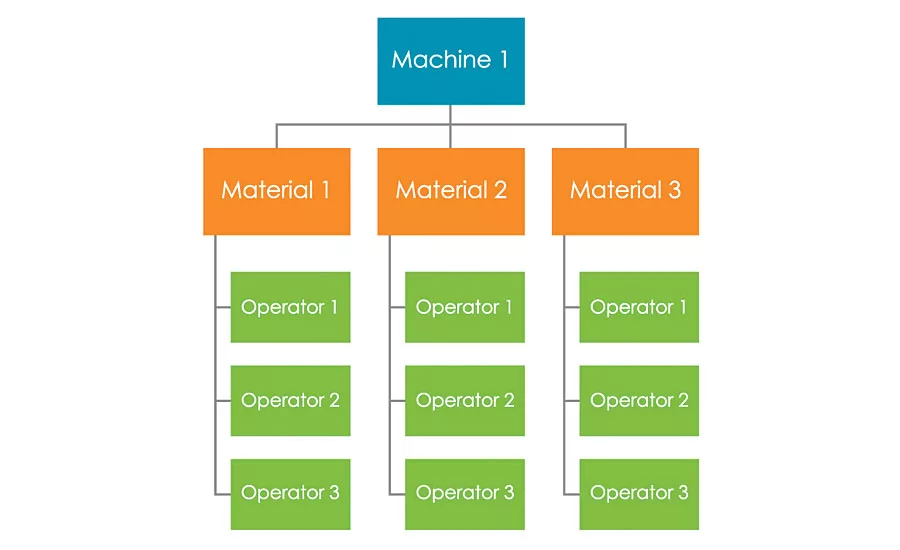
When designing a GR&R study it is important to select a range of materials that is representative of what the system will be used for. While more materials and more specimens can lead to a better output from the experiment, the number of tests required increases very quickly. In the example Figure 2 illustrates, three operators and three materials were used for each frame. This image represents one trial. Often at least eight to ten trials are used, although this number can vary depending on the design of the experiment. In this example, this would mean ninety tests per machine.

There are several commercially available tools that can help to design and analyze the results of a GR&R study.

Other tools

While GR&R has proven to be a useful tool for materials testing professionals to understand their sources of error, our systems for destructive materials testing are considered very complex compared to other gages that GR&R was originally intended to measure. For instance, materials testing systems have many parts: the frame, load cell, extensometer, grips and fixtures, software, and operator. Before performing a GR&R it is imperative that all these individual measurement systems are verified and calibrated. Our service team has the ability to calibrate and verify to international standards such as ASTM F74 and ISO 376 for calibrations and ASTM E4 and ISO 7500-1 for verification. Important verifications include: alignment, displacement, speed, temperature, and strain verifications. Force and creep calibration are also important.

Although equipment model, product generation, and software build often have little impact on error, the medical industry takes all possible sources of error seriously. The FDA 21 CFR 820.72 establishes practices for installation qualification (IQ) and operational qualification (OQ). IQ is an installation qualification process designed to establish that the measurement system is installed correctly. This process often documents installation conditions, operation of the machine and safety features, organization of system manuals and certifications, environment conditions, and preventative maintenance. IQ focuses on both the system and the software. OQ is designed to verify the proper operation of the testing system, and that the system is able to produce valid results. Within the OQ process, functionality of the software is checked and validation of any specific calculations would occur. For many medical device companies, IQ/OQ is performed, calibrations and verifications are completed, and then a procedural or process qualification (PQ) is conducted. PQ takes into account different operators and in some cases is a full GR&R study.

Conclusion

While there can be many reasons why different or even the same system are not producing consistent results, a GR&R study may help to understand why variation in testing results exists. GR&R identifies whether it is the measurement device itself or the operator that is causing variation. For some industries, like biomedical, there may be additional verification and calibration requirements that would prevent the likelihood of error. As organizations grow, there is an increased need to understand variations that can occur with different systems in different labs in different geographies, and a GR&R study is a way to ensure testing results are consistent and measurement is repeatable and reproducible.

KEYWORDS: calibration Gage R&R GR&R

Share This Story

Looking for a reprint of this article?
From high-res PDFs to custom plaques, order your copy today!

Elayne Gordonov, software product manager, Instron. For more information, call (800) 877-6674, email [email protected] or visit www.instron.com.

Morgan Galaznik is the electromechanical applications manager at Instron. For more information, call (800) 877-6674, email [email protected] or visit www.instron.com.

Recommended Content

JOIN TODAY
to unlock your recommendations.

Already have an account? Sign In

  • 2024 Quality Rookie of the Year Justin Wise 1440x750px banner with "Quality Rookie of the Year" logo inset

    Meet the 2024 Quality Rookie of the Year: Justin Wise

    Justin Wise is an exceptional individual who has been...
    Aerospace
    By: Michelle Bangert
  • Man with umbrella and coat stands outside while it rains at night looking at a building.

    Nondestructive Testing: Is there an ethics problem?

    I was a whistleblower who exposed fraudulent activities...
    NDT
    By: Dale Norwood
  • Unraveling Deflategate: Football stadium with closeup of football on field

    Unraveling the Tom Brady Deflategate

    The Deflategate scandal erupted following the 2014 AFC...
    Measurement
    By: Greg Cenker and Henry Zumbrun
Manage My Account
  • eMagazine Subscriptions
  • Newsletters
  • Online Registration
  • Subscription Customer Service
  • Manage My Preferences

More Videos

Sponsored Content

Sponsored Content is a special paid section where industry companies provide high quality, objective, non-commercial content around topics of interest to the Quality audience. All Sponsored Content is supplied by the advertising company and any opinions expressed in this article are those of the author and not necessarily reflect the views of Quality or its parent company, BNP Media. Interested in participating in our Sponsored Content section? Contact your local rep!

close
  • Key Takeaways for Quality Leaders
    Sponsored byComplianceQuest

    Key Takeaways for Quality Leaders from the 2026 Gartner Magic Quadrant™ for QMS

  • This image shows a person seated next to a Bobcat T66 compact track loader.
    Sponsored byPolyWorks by InnovMetric

    Supercharging Digital Gauging at Bobcat North America

  • Dorsey Calibration Lab photo by Tom LaBarbera Picture this Studios
    Sponsored byDorsey Metrology International

    Ensuring Product Quality in a Competitive Manufacturing Landscape

Popular Stories

a titanium diaphragm speaker driver

The One Thing Elon Gets Right Is Designed to Scare You

This image shows a person seated next to a Bobcat T66 compact track loader.

Supercharging Digital Gauging at Bobcat North America

Dorsey Calibration Lab photo by Tom LaBarbera Picture this Studios

Ensuring Product Quality in a Competitive Manufacturing Landscape

2026 Quality Professional of the Year!

Events

June 9, 2026

Future-Proof your Quality Processes with Advanced 3D Optical CMM Technology

Discover how to effortlessly capture complex data, leverage true multi-sensor automation, and ensure continuous operation without creating inspection delays.

June 22, 2026

Automate 2026

Automate is North America's largest robotics and automation event — and the best place to take your ideas from insight to impact.
 
Our show floor features the world’s leading automation solutions, from AI and robotics to motion control, vision systems, and more. Plus, our educational conference is second to none, led by the brightest minds in automation today.
 
Ready to transform the way you work? Take the next step at Automate.
View All Submit An Event

Products

Lean Manufacturing and Service Fundamentals, Applications, and Case Studies

Lean Manufacturing and Service Fundamentals, Applications, and Case Studies

See More Products
Quality Podcast Channel Custom Content

Related Articles

  • GR&R for Destructive Measurement Systems

    See More
  • ASTM Offers Guide for Measurement Systems Analysis

    See More
  • API

    API, MLT Cooperate for 3D Measurement Systems in Finland, Norway

    See More

Related Products

See More Products
  • Measurement and Gaging DVD

  • Creating a Kaizen Culture: Align the Organization, Achieve Breakthrough Results, and Sustain the Gains

  • Six Sigma for Sustainability

See More Products

Related Directories

  • Starrett-Bytewise Measurement Systems

    Starrett-Bytewise provides in line, continuous, dimensional profile measurement technology. Applications include tires, rubber extrusion, plastic extrusion, roll forming, pipe & tube, and wire & cable.
×

Stay in the know with Quality’s comprehensive coverage of
the manufacturing and metrology industries.

Newsletters | Website | eMagazine

JOIN TODAY!
  • RESOURCES
    • Advertise
    • Contact Us
    • Directories
    • Manufacturing Division
    • Store
    • Want More
  • SIGN UP TODAY
    • Create Account
    • eMagazine
    • Newsletters
    • Customer Service
    • Manage Preferences
  • SERVICES
    • Marketing Services
    • Market Research
    • Reprints
    • List Rental
    • Survey/Respondent Access
  • STAY CONNECTED
    • LinkedIn
    • Facebook
    • YouTube
    • X (Twitter)
  • PRIVACY
    • PRIVACY POLICY
    • TERMS & CONDITIONS
    • DO NOT SELL MY PERSONAL INFORMATION
    • PRIVACY REQUEST
    • ACCESSIBILITY

Copyright ©2026. All Rights Reserved BNP Media, Inc. and BNP Media II, LLC.

Design, CMS, Hosting & Web Development :: ePublishing