The Opportunities and Challenges of the Industrial Internet of Things
It's all about connecting smart sensors to the internet and using the information they capture to make better business decisions.
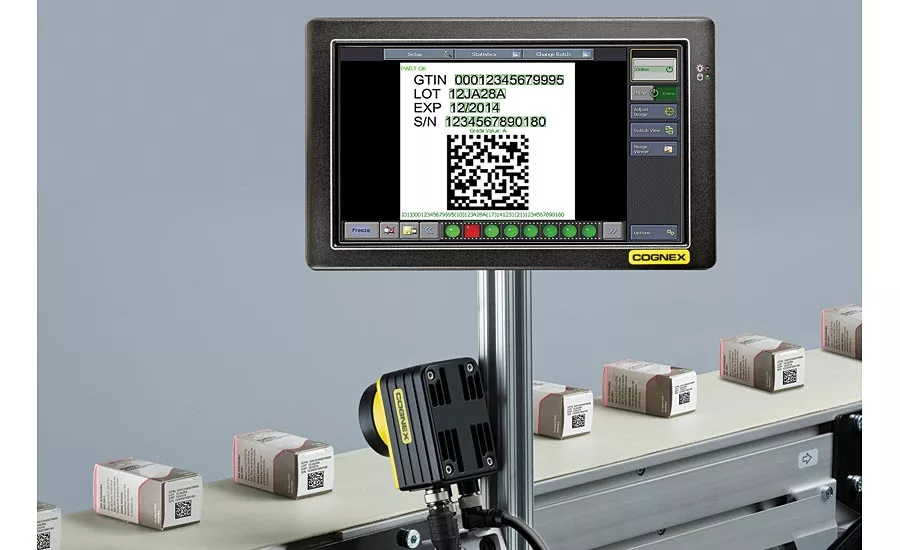
Machine vision systems provide a higher level of label verification of product traceability to the supply chain. Source: Cognex
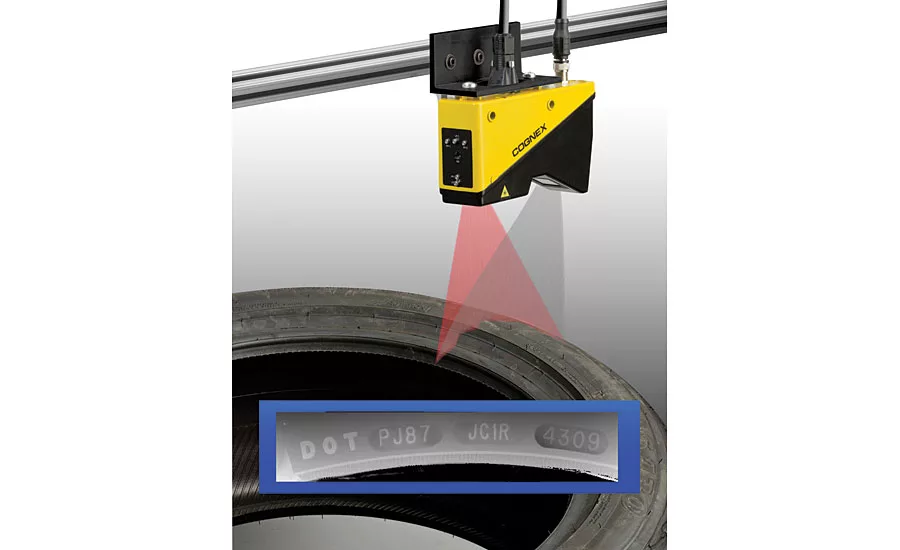
3D vision system reading the Department of Transportation (DOT) cords on the sidewalls of a tire. Source: Cognex
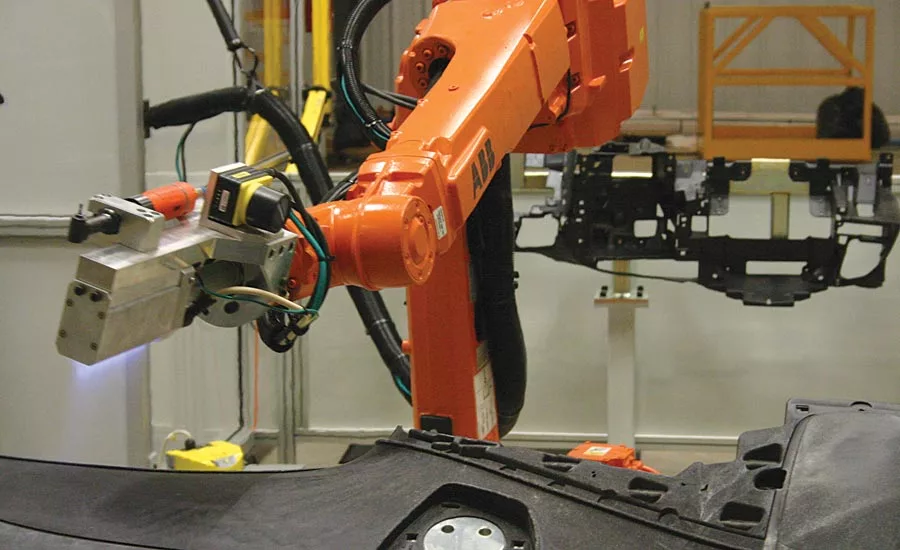
A vision-enabled robot applies heat treatment to automotive interior components. Source: Cognex
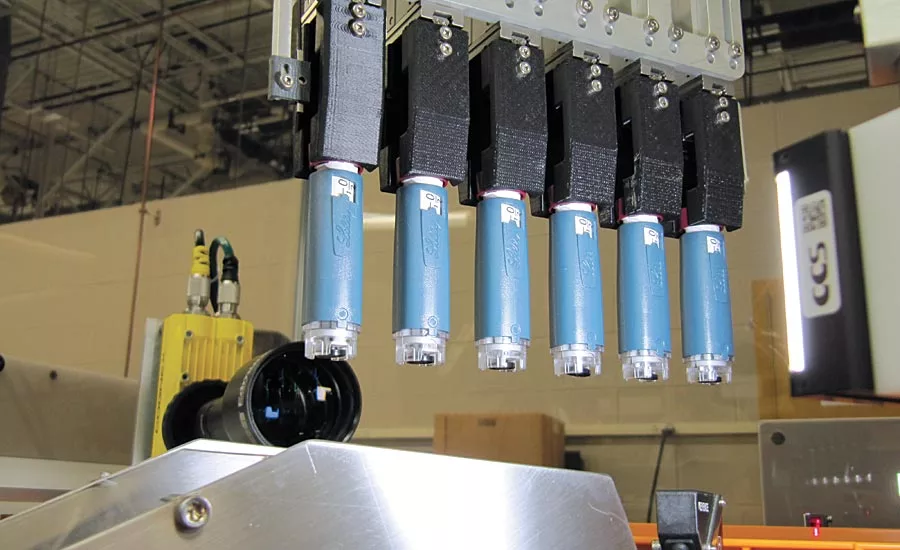
A machine vision system inspects subassemblies for medical devices. Source: Cognex
The Internet of Things (IoT) describes the growing trend in which a wide range of objects—sensors, switches, video cameras, tools, thermostats, lights, microphones, speakers, etc.—are given unique identifiers and the ability to communicate with each other over a network without requiring human intervention. The IoT enables these objects to upload data that they have sensed to a central processing facility which in turn can make decisions based on this data and command the objects to take actions to implement these decisions. The IoT creates the potential for a world in which physical objects can in effect respond intelligently to changes in the environment and become active participants in business processes. There are currently more than 12 billion devices connected to the Internet and Cisco estimates that 50 billion devices will be connected by 2020.
What is the Industrial Internet of Things?
The Industrial Internet of Things (IIoT), sometimes called Industry 4.0, is the subset of the IoT that involves manufacturing and distribution. The IIoT is all about connecting smart sensors to the Internet and using the information they capture to make better business decisions. The IIoT is growing at least as fast as the IoT as smart sensors and devices proliferate up and down the manufacturing supply chain. A major difference between the IoT and the IIoT is that the IIoT is designed to be a relatively closed environment focused on communicating within a company and its partners while being closed to intrusions from the outside. It has been estimated that manufacturing companies worldwide will spend $500 billion a year by 2020 on IIoT technology and that the value generated by the IIoT will reach $15 trillion per year by 2030.
What is big data?
Big data is a term that involves the capture and analysis of very large data sets in order to gain insights that lead to better decisions. Big data typically comes from disparate sources so it can often be challenging to connect and correlate relationships, hierarchies and linkages in the data so that it can be reliably used to make decisions. Big data is expected to play a critical role in the IIoT in that IIoT-connected sensors offer a practical and inexpensive way to capture large volumes of data. The data captured by machine vision systems as well as many other types of sensors in the manufacturing and distribution process can be processed to identify patterns and relationships that can be used to improve manufacturing and business processes. In some cases, these improvements can be implemented instantaneously by taking advantage of the IIoT’s ability to control the operation of productive assets.
What potential advantages does the Industrial Internet of Things offer for manufacturers?
The IIoT offers the potential for substantial improvements in manufacturing productivity and quality by providing voluminous information on every aspect of productive assets while at the same time enabling people and programs to make adjustments to the operation of these assets in order to optimize their performance. Deutsche Bank estimates that higher levels of automation and more flexible production methods enabled by the IIoT will enable manufacturers to increase their productivity by 30%. Beyond improving manufacturing and distribution efficiency, the IIoT also offers the potential for manufacturing equipment suppliers to introduce new products and services that are tied to the IIoT.
What is the difference between machine vision and computer vision?
Computer vision refers in general terms to the acquisition and analysis of image data regardless of the purpose or application. The ultimate goal of computer vision is to model, replicate, and eventually exceed human vision using computer hardware, software and image sensors. Over the last several decades, computer vision has been used in a wide range of applications such as blood cell analysis, remote sensing by satellite, automatic screening of chest X-rays, guidance of autonomous vehicles, traffic monitoring, and target acquisition and range finding. Machine vision is a subset of computer vision that involves practical applications in the fields of industrial automation such as automated inspection, industrial robot guidance and process control. Machine vision technology is experiencing rapid growth with total sales in the industry expected to reach $2.5 billion in 2015, an increase of about 10% over 2014.
What is the role of machine vision in the Industrial Internet of Things?
Machine vision already plays a major role and has the potential to play a much bigger role in the IIoT because it is potentially the most powerful sensor of all. Machine vision has already demonstrated the ability to accurately and reliably inspect a wide range of products, to dramatically improve the capabilities of industrial robots to perform more difficult tasks than were possible in the past, and to bring a much higher level of traceability to the supply chain. All of these capabilities are continually being improved through innovations such as 3D vision and multimodel pattern matching. The IIoT offers the potential to increase the value and utilization of the data produced by machine vision. For example, images from manufacturing operations across a factory or around the globe could be compared to look for changes in product quality and to understand why such changes are taking place.
How does machine vision relate to big data?
The ability of big data technology to process high volumes of data in real time opens the potential for many powerful new machine vision applications. As the number of different production and distribution applications that are subjected to machine vision increase, the potential for correlating the data captured from these images to get a better understanding of the interactions and interrelationships of these operations also increases. Smart cameras can potentially capture a wide range of images at every stage of the production process. This information can then be combined with data from many thousands of other sensors that capture data from production equipment as well as other information to gain a far better understanding than is possible today of the impact of each of the many thousands of variables involved in producing and distributing a product on how the end-user experiences that product.
What challenges do manufacturers face in implementing the Industrial Internet of Things?
The IIoT is designed to control critical machinery that is subject to failure if timing of control signals is off by as little as a few thousands of a second so network performance parameters such as latency—the amount of time required for a message to traverse the network—are a critical concern. It doesn’t do much good to shut down a machine in response to a safety issue detected by a sensor if the instruction to shut down comes a few seconds too late. For global companies, utilizing the full potential of the IIoT requires communicating with devices located thousands of miles apart. Both the devices themselves and the networks used to communicate with them need to be secured in order to avoid putting the company’s operations at risk. Finally, the IIoT will need to be expanded and upgraded over the coming decades so it needs to be built on open, flexible hardware, software and networking platforms that are capable of evolving and adapting to meet the requirements of the future.
How will the Industrial Internet of Things increase the effectiveness of current machine vision applications?
Machine vision is currently used primarily as a reactive tool to identify defects that have occurred in the production process so that parts with defects can be pulled off the production line. Its impact is for the most part limited to the specific operations where it is used to inspect parts or guide robots. The IIoT has the potential to greatly expand the impact of machine vision by making information generated by many smart cameras along with other sensors immediately available to understand correlations and trends and trace complex interactions across the supply china. This information can then be used by the global supply chain to make improvements to production processes and better decisions. In potentially the most powerful case, machine vision trends can be used to instantly adjust the operating parameters of production machinery.
The implementation and expansion of the IIoT will create challenges for machine vision suppliers. The greater value that can be obtained from the information generated by machine vision systems can be expected to accelerate their proliferation in a wide range of new applications up and down the supply chain. Manufacturers want to avoid increasing the size of their engineering teams responsible for machine vision implementation, so they will be looking for systems that are simple to implement, easily adaptable to new applications and require the least amount of maintenance.
Looking for a reprint of this article?
From high-res PDFs to custom plaques, order your copy today!