Fixturing 101: The Sky is the Limit
Fixturing tubular parts in aerospace duct fabrication with traditional vs. modular systems.
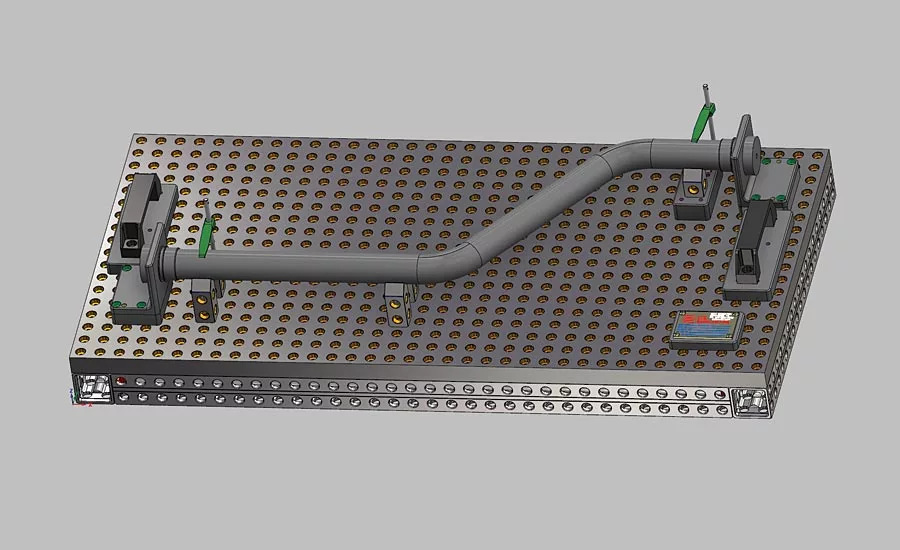
The fixture is constructed, certified and then used for the specified part or parts and either stored for future use or broken down for re-configuration on the next project. Courtesy of C2 Gauge & Fixture
“Since the beginning, humans have searched for superior more practical methods to fulfill holding and clamping needs.” I said this a long time ago about modular tooling and the beat goes on.
Until recently, the concept of “fixturing” or work holding for most manufactured parts, especially cylindrical parts like ducts, in aerospace has incorporated antiquated methods. Still emerging, modular fixture technology referred to as “adaptable, modular, re-usable, reclaimable” brings countless features and benefits to the modern workplace. Modular fixturing technology enables benefits such as shorter design and build time, faster setup times, higher accuracy, cleaner workplace, less manufacturing waste and reduced processes. My top talking points are still the three E’s: economically, ergonomically and ecologically. More than ever these are the buzzwords we focus on today.
Many “in house” tooling departments continue to struggle with old technology ultimately outsourcing many processes to eliminate cost centers. The change in technology is proven. Many have implemented modular fixturing technology and are quickly recognizing the features, benefits and ROI. Technology that is sustainable, profitable and meets the demands of today’s schedules in our fast paced and competitive manufacturing world is real.
In the late ‘90s, Boeing Rocketdyne needed to “catch up” on a project and they looked to modular tooling for their ducts for the RS68 Rocket Engines for assembly, orbital welding, work holding, inspection and test. It was a success. In 2001, a Mantech Defense Achievement Award was granted to the Composites Affordability Initiative (CAI) with the U.S. Navy, Boeing and Lockheed Martin. The team implemented modular tooling technology for a bonding tool for aerospace ducts of composite fiber materials. It was better than a success. The team won this award utilizing innovative technology and when the project was complete they disassembled the tool and returned the modular components. They leased the tool vs. purchasing and accounting was delighted.
The Scenario: traditionally, the tooling supervisor walks into the fixture department in need of a fixture yesterday! The expectation is to relay the fixturing problem to the tooling staff and move on to another issue; leaving the fixture problem with someone who isn’t sure how to resolve the requirement in the time allocated. Now what? There are a couple of options and the timesaving for modular vs. traditional fixture manufacturing is incredible.
Option 1. With traditional fixture manufacturing processes a designer would first need the data for the part to be inspected so he or she could eliminate any margins for error in making the tool to hold the part with proper access for the CMM. The concept is then sketched or designed in CAD utilizing the part data files. The designer then releases the design for the production process and this team gets to work on a BOM (bill of materials) including clamps, pins, net locators and the raw materials (i.e. steel, aluminum) for the basic structure. This is determined according to a specification with tolerances. Machinists, welders and toolmakers are all coordinating with a delivery constraint. Obstacles: The welder quits in the middle of the job, the machinist just destroyed the tool holder in his CNC mill and the toolmaker is on hold waiting for the welder and machinist to resume work. Days later, the tool is near completion and oops...here comes the CMM operator to check on the delivery that is now overdue and in its fifth week of manufacturing. Even worse he has a new part data release and it has changed significantly. Now the tool is scrap that needs a revised design and new build order. Time to design, build and scrap: six weeks on average.
Option 2. With a modular, or flexible, fixture system the manufacturing process allows the designer to make changes to the CAD data and re-designs the tool for concept approval much the same as a traditional tool build process. Often the modular design is conceived with future changes in mind (i.e. multiple parts, one tool with interchangeable holding features). It should allow plenty of clearance for the CMM to position for measurements with movable or re-movable net locators. The CMM operator or the fixture department is now ready for reconfiguration of the system. The list of re-usable components will be relocated and fastened on the surface plate or base of the fixture. The components are selected based on the design and are often within a kit that can be used over and over. The fixture is constructed, certified and then used for the specified part or parts and either stored for future use or broken down for re-configuration on the next project.
Time to design, build and re-use: six days or less! Fast forward, it’s 2019 and the task is still the same and the decisions remain a challenge. When Dave Padden of Padden Design Engineering (Stuart, FL) reviewed the options it was a no brainer for his next opportunity to offer both methods:
“It’s efficient and time saving, compact for universal use and storage. Our recent traditional method fixture for multiple helicopter bleed ducts consisting of high temp materials would be a perfect next option for modular tooling. We designed and fabricated a traditional fixture to align individual tubular components and fittings for precise installation of the ducts. The ducts were constructed of unique titanium alloys vs. steel for significant weight reduction. The task included insulating the components to protect adjacent composite fuselage. The modular design and fab will provide rapid delivery, on schedule timing and meet the technical specs for design utilizing common components for building multiple ducts on one universal tool for the family of parts. We look forward to offering this on our next challenge that meets or exceeds on time delivery and affords catch up on critical late start programs. This is a lessons learned opportunity.”
The concept is simple. The process is easy. The future is here. Technology has enabled manufacturers to excel by introducing modular systems. The features and benefits are endless. “I’m learning it opens doors for many decisions that you must make. You can do more with less. It just opens all kinds of doors with flexibility more accurately, more quickly than past processes.” The common complaint with traditional tool manufacturers is that it eliminates jobs but it really changes the way people do business. When we went from typewriters to word processors we utilized the same workforce. The same goes for fixture building in most cases. With proper education and re-training a new generation of toolmakers, welders and machinists the modular approach improves profits, environments and benefits for all, especially those pesky accounting people upstairs. “Be creative…think modular” and join the millennials that want to get involved in manufacturing for the next generation. Q
Looking for a reprint of this article?
From high-res PDFs to custom plaques, order your copy today!