Measurement
Certified 3D Scanners in a Maintenance System
3D scanners enable the accurate mapping of three-dimensional shapes and geometries of objects, which makes them an extremely useful tool in reverse engineering.
Reverse engineering process. Image Source: SMARTTECH3D
Maintenance of mechanical machinery plays a key role in keeping production processes going smoothly and minimizing downtime. In order for mechanical machinery to function efficiently and effectively, regular maintenance and monitoring is essential.
With even the most strict maintenance strategies, it is impossible to completely eliminate the risk of failure. In such situations, effective problem diagnosis and rapid intervention to resolve the problem plays a key role. There is a risk that, at the time of failure, the availability of the required spare parts in stock will be limited and their delivery date may be significantly delayed. In such situations, the use of reverse engineering including 3D scanners may be necessary to restore smooth functioning of the machine.
What is a 3D scanner?
A 3D scanner is a metrological device that measures a surface in a contactless way which results in obtaining a digital twin of the object – its full geometry representation in CAD software. The measurement process conducted with a 3D scanner is automated. The device projects a set of images on the measurement object, photos of images are taken and based on those, software calculates a cloud of points which represent the measured surface. Usually the process is repeated to obtain full geometry from different directions by using rotary stage which allows to merge directional clouds of points into one full model of object. 3D scanners are described technically and chosen by the user taking into consideration:
- Scanning accuracy – the allowed error of positioning single detected point given in mm (mm)
- Resolution of the cloud of points – described often as probing in contact metrology and given in number of point for square mm (pts/mm2)
Measurement volume – working volume of 3D scanner in which whole object can be measured described as a box of certain dimensions (Xmm x Ymm x Zmm). - Most scanners can measure also bigger object partially and merge the scanning data into one final 3d model. This is a compromise between work load during scanning process and accuracy – the bigger the measurement volume the smaller scanning accuracy (mathematical relationship) in contrary to work load that is reduced when full object can be scanned at once.
- Measurement time – time of detection cloud of point from single direction given in seconds (s)
Noncontact measuring devices have existed on the industrial market for over two decades and are a standard solution for example in automotive and on the rise in different industries. Compared to CMMs, 3D scanners stand out for their ease of use and measurement efficiency. Negative arguments criticizing 3D scanners in the past included the issue of the lack of standards to verify the accuracy of these devices. Nowadays, it is good practice for each scanner to be checked in accordance with the VDI/VDE 2634 guidelines or ISOISO/DIS 10360-8 standard immediately after manufacture. In addition, the accuracy of the system can be certified by accredited measurement laboratories, thereby achieving a reference ability equal to that of a standard CMM.
3D scanners enable the accurate mapping of three-dimensional shapes and geometries of objects, which makes them an extremely useful tool in reverse engineering. They allow detailed examination of each product component and analysis of their structure. 3D scanning is also very helpful when a damaged or worn-out part needs to be replaced and the original model is not available - the missing part is scanned and can then be printed on a 3D printer. It is also possible to make modifications or design new parts to fit existing components. 3D scanning also allows different design variations to be tested and verified to match the original model. This is helpful when trying to change the shape, size or materials of a product.
Reverse engineering process


Reverse engineering is usually chosen because of its ability to capture the necessary data to develop a counterpart. The use of rapid prototyping with a 3D optical scanner enables detailed documentation of an existing object to be created from a 3D scan without the need to model it manually in dedicated engineering software (CAD), which significantly reduces the time to create a replacement. Assistance of specialized software, integrated with the scanners, makes it possible to generate data in commonly used formats, which greatly facilitates further design operations.
In addition, when confronting a damaged part for which no documentation is available, it is possible to model the part and obtain a fully functional model using a 3D printer, as described in the following.
In the first step, the part has been scanned using an automated setup consisting of a 3D scanner with structured lighting and a tilt-rotary stage. A high scanning resolution of 2x6 MP and an accuracy of 0.03mm produced a precise 3D scan that can be used in any CAD software.

A single scan resulted in a cloud of points, with each point described by X, Y, Z coordinates. A total of 36 measurements were taken - 12 from each direction. Further data processing was carried out in the specialist 3D scanner management software and the point clouds were merged into one continuous triangle mesh surface.

The second step of reverse engineering is the transformation of the data from the 3D scanner into CAD models, which can then be edited and used in design, analysis or manufacturing. When analyzing the model, the software extracts regions from the model, i.e. areas in the mesh that represent surface fragments such as planes, cylinders, cones, spheres, rotating surfaces, torus, free surfaces. The regions are intended to facilitate the subsequent modelling process and are also used for orientation in the coordinate system.

This is followed by a hybrid modelling process that uses both free surfaces and parametric surfaces. This method allows for a flexible approach to the design process, enabling different techniques to be used simultaneously to achieve optimal results.
With hybrid modelling, designers can use traditional parametric tools to create geometric shapes such as straight lines, curves, solids or functions. At the same time, they have the option of using free surfaces to create shapes in a more organic and customized way.

Hybrid modelling makes it possible to recreate an object even when full information about its shape is missing. Often only a small part of is needed to enable the reconstruction of damaged parts.
During surface matching, the program enables an analysis of the modelling accuracy, i.e. a check of the divergence of the surface model from the mesh displayed as a color deviation map.

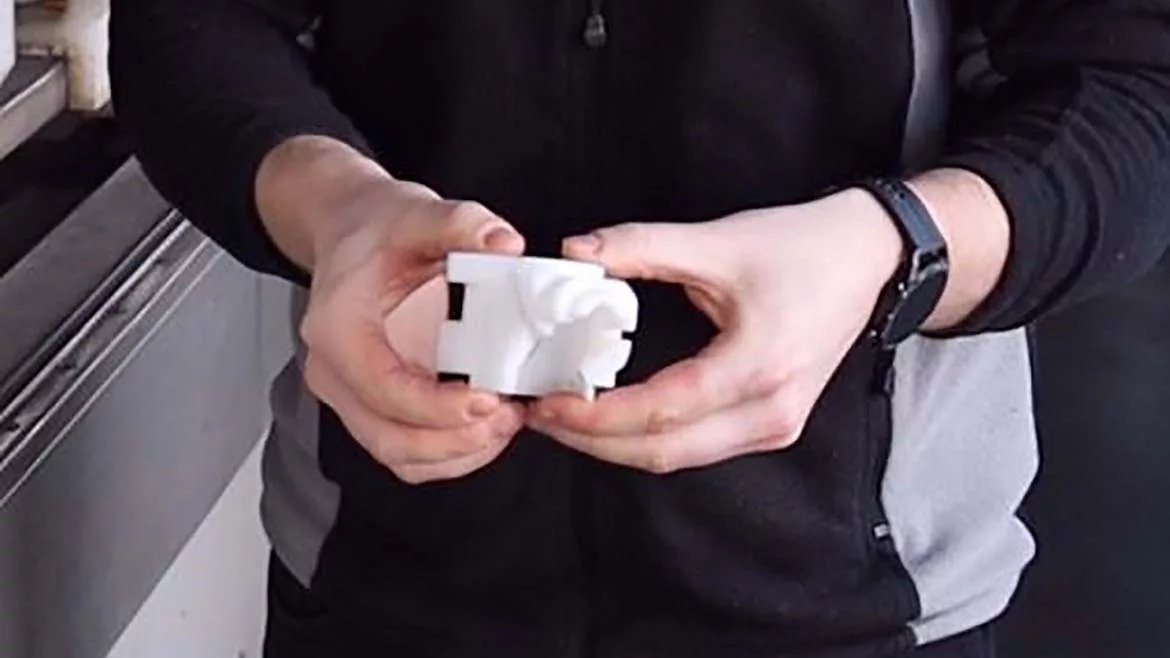
The final step is to produce the real object using 3D printing technology.

The use of 3D scanning, reverse engineering and 3D printing provides a number of benefits to various industries and design processes. One advantage is outstanding speed and precision - 3D scanning, which takes 10 minutes, enables an accurate digital model of the actual object to be obtained, thus reducing the time needed for design preparation, and also contributes to optimization of geometry, reduction of material waste or increased production automation. The next step after scanning is point cloud processing, which takes just five minutes, followed by twenty minutes of CAD modelling, after which you can proceed to 3D printing, which takes 1.5 hour.

During the reverse engineering process, the model can be refined with all the nuances and details included. Furthermore, this method enables designers to modify existing models more easily - adapting them to design requirements or customer needs. Creating personalized solutions increases the attractiveness of the offering and improves the user experience. Today, the design process has become even more flexible as 3D printing allows for rapid verification and prototyping of changes - designing from real objects enables experimentation with forms and materials, and with 3D printing (additive production methods) it is possible to create geometrically complex objects or structures that would be difficult to achieve with traditional loss production methods.
3D scanning of damaged machine parts facilitates the diagnosis and problem identification, as well as the implementation of modifications. The precise data obtained can then be compared with the CAD model, allowing any differences to be accurately assessed and any deviations from specifications to be detected, thereby helping to maintain high production quality. Reverse engineering allows damaged parts to be reproduced according to original specifications. These solutions increase productivity by minimizing downtime, improve quality, and reduce production costs.
Looking for a reprint of this article?
From high-res PDFs to custom plaques, order your copy today!