Cobots
Cobots Drive Flexibility and Precision in Automotive Manufacturing
The rise of collaborative robots reflects a larger shift in automotive manufacturing.
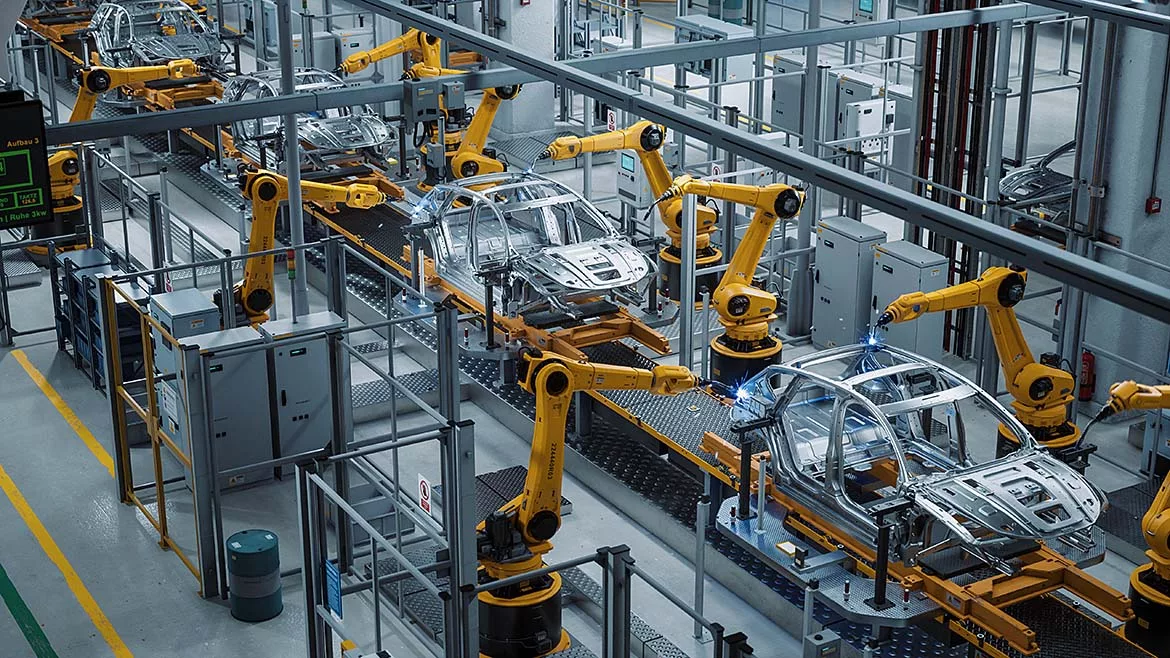
Automotive production is at an inflection point. For decades, automakers relied on traditional industrial robots to deliver the speed, durability and throughput required for mass production. Those large, stationary machines defined efficiency, but often at the expense of flexibility.
Today, with design cycles shrinking, consumer demand diversifying and sustainability goals rising, manufacturers face a new challenge: how to maintain precision and consistency while building more adaptable production systems. Increasingly, companies are turning to collaborative robots to help strike that balance.
Unlike conventional robots, collaborative robots are designed to work safely alongside humans. Their compact footprints, intuitive programming and ability to operate in tight spaces make them especially valuable on the automotive plant floor, where space is constrained and production needs can shift quickly. Their impact is already visible in sensitive applications such as dispensing and welding, where accuracy and repeatability are critical to quality outcomes.
The Push for Flexible Automation
Automotive manufacturing has long been optimized for volume output. Large production lines are capital-intensive to build but highly efficient once set. The downside is rigidity. Adding new vehicle variants or accommodating electric vehicle architectures can require significant retooling, extending downtime and raising costs.
Cobots offer a way forward. With up to seven axes of movement, some models can reach around obstacles and work with complex geometries that standard six-axis robots cannot. This improved dexterity allows automakers to automate areas of assembly plants where traditional robotics were impractical or cost prohibitive.
One example is adhesive dispensing for vehicle body sealing. Consistent bead placement is essential to ensure performance in noise reduction, structural integrity and water resistance. A cobot equipped with force and torque sensitivity can apply sealant evenly along changing body contours, adjusting to design updates without requiring extensive reprogramming.
Welding and Dispensing in Action
Welding remains a backbone of automotive operations, and cobots are finding niches here as well. Rather than replacing the high-volume industrial robots used on body lines, cobots are increasingly used for smaller subassemblies, prototype builds and short production runs.
Because cobots are easier to reposition and teach than traditional automation, a technician can guide the arm through a weld path and have it replicate those motions consistently. This minimizes cycle-to-cycle variation and reduces fatigue-related errors, while also enabling high-mix, low-volume welding operations where reconfiguring fixed automation would be prohibitive.
Dispensing applications follow a similar logic. In sealing or gasketing tasks, inconsistent application can lead to rework or failure. Cobots provide the repeatability necessary for every bead, curve and joint, while freeing human operators for inspection and quality verification. In practice, the cobot and worker collaborate while one handles precision, the other judgment.
Manufacturers are already deploying seven-axis cobots in welding and dispensing. The additional range of movement gives operators flexibility not possible with other systems, an advantage in crowded, space-constrained assembly lines. Beyond these core areas, cobots are also being adapted for assembly tasks such as screwing, as well as finishing processes like polishing and painting, showing how their versatility extends across a wide spectrum of automotive workflows.
Modular Approaches to Automotive Assembly
Collaborative robots deliver value not only as standalone tools but also as part of a broader shift toward modular, adaptable production environments.
Traditional automotive plants are laid out as linear lines with fixed equipment. Increasingly, carmakers are exploring more flexible production cells integrated with conveyors, mobile systems and advanced controls. Collaborative robots are central to these layouts, providing both precise task execution and the adaptability needed when volumes or product mixes change.
This shift is supported by technologies that connect cobots with conveyors and digital control systems, enabling manufacturers to build scalable lines that can be expanded or reconfigured on demand. Such flexibility reduces downtime, accelerates changeovers and helps automakers introduce new platforms without wholesale line overhauls.
This flexibility has workforce ripple effects as well. Rather than being pinned to a single repetitive task, operators can manage multiple cobot-assisted processes. That shift improves ergonomics and safety while also helping address persistent labor shortages in manufacturing.
Safety and Collaboration in Practice
One of the defining features of collaborative robots is embedded safety. Force and speed monitoring allow them to operate near humans without the heavy guarding required by traditional robots. If they encounter unexpected resistance, they can slow or stop.
That functionality does not eliminate the need for risk assessments, training or proper safeguarding, but it does enable new models of human-robot collaboration. Picture a worker loading a component into a fixture, while a cobot lays down a precise bead of adhesive before handing it back for inspection. In such cases, throughput increases without sacrificing quality or operator well-being.
The key is not substitution but partnership. Cobots take on repetitive, ergonomically difficult motions while people provide quality oversight, decision-making and adaptability. The result is higher consistency and safer work environments.
Looking Ahead: Electrification, Energy Efficiency and Digital Integration
As electric vehicle production ramps up, new assembly processes are reshaping automotive manufacturing. From battery pack integration to handling lightweight materials, EV production introduces tasks that differ from traditional drivetrains. Here, the flexibility of collaborative robots offers particular advantages.
Battery modules, for instance, require careful handling and precise assembly. These robotic systems, equipped with sensitive feedback, can place delicate components safely and repeatably. As designs evolve, operators can adapt programs without lengthy downtime, making them ideal for fast-moving EV initiatives.
Sustainability considerations are also influencing manufacturing decisions. Automakers face pressure to reduce waste, cut scrap and use energy more efficiently. This technology contributes by minimizing overdosing in dispensing applications, lowering rework through consistent welds and saving valuable floor space by enabling compact, shared workcells.
Finally, digital integration is expanding how collaborative robots are applied in inspection and testing. Combined with vision systems, digital twins and predictive maintenance, these tools can link physical production with quality analytics in real time, helping manufacturers prevent defects rather than react to them.
Challenges and Considerations
Collaborative robots are not a universal solution. Not every application is suitable: high-speed, heavy-payload processes remain the domain of traditional industrial robots. Successful deployment requires upfront evaluation criteria, including payload, reach, cycle time and compatibility with existing systems.
Workforce integration is another critical factor. Operators need training and confidence in the safety features of these machines. Building cultural acceptance, where the technology is viewed as a partner rather than a replacement, is as important as selecting the right hardware.
Equally important, implementation must align with strategic production goals. This form of automation delivers the most value when integrated thoughtfully into broader ecosystems, not when deployed as one-off standalones.
Conclusion
The rise of collaborative robots reflects a larger shift in automotive manufacturing. Flexibility, precision and adaptability are no longer optional; they are core requirements of success in a rapidly evolving industry.
From welding and dispensing to EV assembly and modular workcells, this technology is helping automakers bridge the gap between traditional automation and the future of production. Its contribution is not just technical but cultural, fostering collaboration between people and machines on the factory floor.
As electrification, customization and sustainability reshape the industry, collaborative robots will play an increasingly central role in building the agile, efficient plants of tomorrow. They are not replacing people or industrial robots. Instead, they complement both by filling flexibility gaps, enhancing safety and driving the next wave of productivity gains in automotive manufacturing.
Looking for a reprint of this article?
From high-res PDFs to custom plaques, order your copy today!