


Manufacturing Automation That Pays for Itself
Overcoming the productivity paradox of partial automation.
A New Look at Automation’s Progress
Manufacturers everywhere are accelerating their investments in smart manufacturing technologies. But how much progress have they really made, and where are they seeing measurable results?
To find out, Lifecycle Insights surveyed more than 300 manufacturers across industries and regions to assess the state of automation, cloud adoption, and AI in modern production environments. The findings paint a mixed picture. About 85 percent of manufacturers now operate with some level of automation, yet only a fraction have achieved the seamless connectivity and visibility needed to unlock full performance gains.
Partial automation has brought clear benefits, including labor savings and improved consistency, but its greatest value appears when machines, data, and decision systems work together. This article explores where automation delivers the strongest returns, based on data from the Smart Manufacturing Study, and how manufacturers can align technology, processes, and people to make those gains sustainable.
Production and Data: The Foundation for Performance
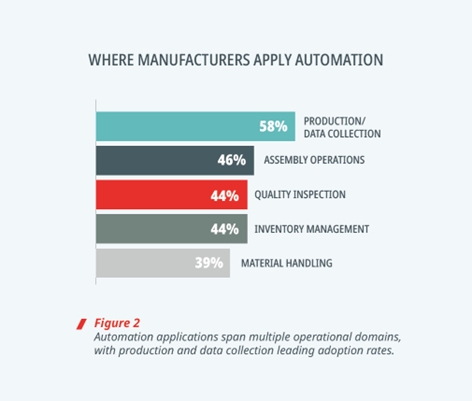
The survey found that 58 percent of manufacturers have automated at least part of their production and data collection processes. That makes it the most automated function on the factory floor. These systems, including programmable logic controllers, drives, and human-machine interfaces, are the core engines that collect process data, feed quality checks, and execute repetitive tasks with precision.
Respondents described the benefits in straightforward terms: higher consistency, fewer errors, and faster cycle times. Yet the real value lies in visibility. Automated production lines generate continuous, accurate data streams that improve scheduling, traceability, and material flow decisions.
When this data connects to an enterprise resource planning (ERP) system, the impact multiplies. Instead of reviewing performance after the fact, teams can see live metrics such as equipment uptime or deviations flagged in real time. For many manufacturers, that single capability justifies the initial investment.
One participant summarized the shift well: “Using AI for our production data has enabled us to streamline many routine functions that used to be done manually.” That simple change freed skilled staff for higher-value work and built trust in the information guiding daily decisions.
Assembly, Quality, and Inventory: From Precision to Predictability
Beyond core production, automation is gaining traction in assembly, quality inspection, and inventory management. The survey found that 46 percent of manufacturers have automated parts of their assembly lines, while 44 percent reported automation in both quality and inventory control.
Each area rewards precision. Automated torque tools, vision-based quality checks, and barcode-driven inventory systems reduce human error and maintain throughput even during labor shortages.
Quality automation has evolved especially quickly. Inline inspection systems now capture images, vibration readings, and temperature data during every production run. This information not only identifies defects early but also supports root-cause analysis, shifting quality assurance from a reactive process to a proactive one.
Inventory automation closes the loop by linking warehouse movements to production signals. The result is shorter order-to-ship times, steadier material flow, and reduced work-in-progress. One manufacturer described the outcome this way: “We use AI and ML to detect patterns, predict equipment failures, and optimize production processes. It has reduced downtime and improved overall efficiency.” Their experience reflects how combining automation with analytics transforms quality from hindsight to foresight.
Drivers and Barriers: Why Progress Remains Uneven
If automation offers such clear advantages, why isn’t every plant fully automated? The study points to three familiar constraints: workforce shortages, integration complexity, and limited capital budgets.
Skilled labor shortages, intensified by retirements and recruitment challenges, are pushing manufacturers to automate simply to maintain output. Many are not replacing people but ensuring continuity when hiring cannot keep pace.
Legacy systems and incompatible software also limit progress. Integrating robotics, programmable controllers, and manufacturing execution systems into an existing ERP environment often requires incremental upgrades rather than complete overhauls.
Finally, capital decisions still hinge on measurable return on investment. Even when automation promises faster output, companies prioritize projects that address known bottlenecks or quality risks. This explains the prevalence of partial automation. Manufacturers are selective, focusing first on the areas with the fastest payback and lowest disruption risk.
Interestingly, several respondents said that even small steps produced unexpected insight. A single automated test station or data-capture process often revealed inefficiencies that later guided broader rollouts. In this sense, automation becomes both a productivity lever and a diagnostic tool.
Data as the Hidden Dividend
While labor savings and throughput gains often headline the automation business case, many respondents emphasized another benefit: data.
Automated systems generate continuous performance records that fuel predictive maintenance, AI, and analytics initiatives. These same datasets support smarter scheduling, energy optimization, and scrap reduction. Manufacturers in the study called automation “a critical competitive differentiator” because it created reliable data streams that could be analyzed and acted upon.
Once data moves seamlessly from sensors to software, higher-level tools such as dashboards, digital twins, and machine learning models can deliver real-time insight. The study found that 88 percent of manufacturers streaming data to the cloud now use AI or ML to analyze it, often to improve efficiency or decision-making.
When production data integrates directly into ERP systems, automation evolves from a local improvement to a strategic capability. Decision-makers across the organization can base choices on a shared source of truth, linking plant performance to financial results.
Where Automation Truly Pays
The research shows that automation delivers the best results when three conditions align:
- Standardized data: Sensors and controllers report information consistently across lines and sites.
- Integrated systems: Production, quality, and inventory data flow directly into planning and costing tools.
- Responsive analytics: Insights are acted upon within the same workflow that generated them.
When these elements come together, efficiency gains multiply. A two-percent improvement in uptime can cascade through scheduling, delivery reliability, and overall margin. Even a one-percent reduction in scrap contributes directly to profitability.
Many companies discover that they do not need brand-new equipment to achieve measurable returns. Simply connecting existing automated assets through ERP and analytics platforms produces visible improvement.
Automation alone does not guarantee competitiveness, but connected automation, where data moves freely from machine to management, builds resilience against volatility, labor shortages, and supply chain uncertainty. Manufacturers that achieve this integration report not only higher throughput but faster decision cycles and greater executive confidence.
Automation as the Bridge, Not the Finish Line
Automation continues to advance steadily rather than suddenly. Most manufacturers now operate in that 85 percent middle ground: beyond manual but not yet fully autonomous.
The study suggests that progress yields the best results when each step strengthens visibility and control instead of simply adding machines. In that sense, automation is not the final destination of smart manufacturing but the bridge to it.
By generating accurate, continuous data, automation builds the foundation for analytics, AI, and continuous improvement. The real return on automation lies not only in efficiency gains but in the confidence it gives manufacturers to make faster, better-informed decisions.
Looking for a reprint of this article?
From high-res PDFs to custom plaques, order your copy today!


