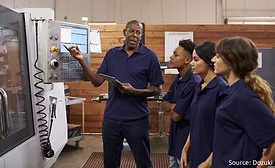
America Makes, the National Additive Manufacturing Innovation Institute, welcomes Edward D. Herderick, Ph.D., as its new Director of Education and Workforce Development (EWD).
A recent Idera report reveals that many industries view artificial intelligence positively. Judy Bossi, Vice President of Product Management at Idera, discusses AI's potential in quality assurance (QA), the challenges to adoption, and steps to effectively implement the technology.
Autonomous systems, collaborative robots, AI-driven robotics applications and sustainable robotics are shaping a new era of automation and human-robot interaction.
Robotics is rapidly advancing from science fiction to practical uses across industries like manufacturing, logistics, and healthcare. Key trends include autonomous systems operating independently, robots collaborating with humans for improved productivity and safety, and AI integration that allows robots to learn and adapt. This technology enables both large enterprises and SMEs to optimize processes and meet growing demands.
Orders of manufacturing technology, measured by the U.S. Manufacturing Technology Orders (USMTO) report published by AMT – The Association For Manufacturing Technology, totaled $450.6 million in September 2024.
Leak testing of EV battery cells and modules is vital for safety and defect prevention in North America's growing mobility industry. Early detection of leaks, especially during module assembly, saves time and money while ensuring quality control.
Ultimately, standardized software and modular platforms don’t just improve inspection—they help manufacturers thrive in the face of industry-wide challenges.
The manufacturing sector faces challenges like labor shortages and supply chain issues. Adopting standardized modular inspection systems can boost efficiency, improve communication, and reduce costs. These tools also facilitate advanced technologies, helping manufacturers thrive in a competitive landscape.
Generative AI Searches are transforming how professionals access technical data in fields like inspection and gages. While these tools deliver quick results, reliance on their outputs can lead to inaccuracies, as shown by discrepancies in thread specifications. Understanding the strengths and limitations of Generative AI is essential for ensuring the accuracy and relevance of information used in gage calibration and metrology.
By leveraging billions of historical data points and real-time insights, manufacturers can empower new operators to meet stringent quality standards while maintaining throughput goals.
The manufacturing sector struggles with declining workforce experience as seasoned veterans retire and new operators lack the necessary skills. To address this, integrating predictive quality technologies and AI-driven recommendations can empower less experienced workers to achieve the quality and performance levels needed.