Software
New Operator Productivity: Using Predictive Quality to Solve Workforce Challenges
By leveraging billions of historical data points and real-time insights, manufacturers can empower new operators to meet stringent quality standards while maintaining throughput goals.
.webp?t=1731730848)
Image Source: ndoeljindoel / AdobeStock
Consistently, the number one challenge facing manufacturers is recruiting, training, and retaining their workforce. Seasoned veterans who have spent decades perfecting their craft are retiring, and being replaced by a new wave of operators. These new staff lack the deep experience the manufacturing sector traditionally depended on to simultaneously maintain quality and performance. With the average tenure of operators declining from 20 years in 2019 to just three years today—with an average retention rate hovering around 50% after three months—the industry faces a critical challenge. The question now is: how can manufacturers ensure consistent quality and throughput while ensuring new, less experienced workers have what they need to increase performance?
One of the most promising solutions is the integration of predictive quality technologies and AI-driven prescriptive recommendations. These technologies can help bridge the experience gap, enabling new operators to perform at levels comparable to their veteran counterparts. By leveraging billions of historical data points and real-time insights, manufacturers can empower new operators to meet stringent quality standards while maintaining throughput goals.
The Shift in the Manufacturing Workforce
Moving forward, the manufacturing workforce has no choice but to lean on newer operators, rather than relying on experienced ones. This change presents significant challenges in maintaining consistent quality output. Historically, experienced operators have played a crucial role in ensuring product quality by relying on their accumulated knowledge and intuition. However, new operators, who lack this depth of experience, are more likely to second guess—and therefore underperform—due to the very real risk of not meeting quality specifications. Their hesitation often results in lower throughput because they tend to prioritize avoiding mistakes over optimizing performance. And it takes approximately two or more years for a new operator to become fully productive.
This shift is problematic because most manufacturing firms are small and operators are primarily measured on their ability to maintain product quality. In industries where even minor deviations from quality specifications can lead to significant costs, delays, or product failures, it is vital that new operators are quickly brought up to speed on how to maintain consistent quality output. The traditional approach to quality control, which relied on in-line quality measurements, has limitations. While in-line quality provides insights into what is currently happening, it does not offer the foresight needed to anticipate potential issues before they arise.
The Power of Predictive Quality
Predictive quality transforms quality measurement from a reactive function into a proactive one. Rather than responding to issues after they occur, predictive quality uses billions of historical data points, existing quality test results, and real-time data to forecast (and correct) potential quality issues before they happen. This is a critical distinction from both in-line and off-line quality control, which only measures what is currently happening, either in real time (in-line) or historically (off-line). These quality tests do not look forward, so the operator is forced to guess and hope that their changes to the line won’t result in catastrophic loss of quality, rather than have the confidence that predictive quality provides.
By analyzing patterns from past production runs and combining them with real-time cleansed and contextualized data, predictive quality systems can identify subtle trends and deviations that may not be immediately visible to an operator. These insights allow operators to confidently make proactive adjustments to the production process that ensure quality specifications are consistently met. This not only improves product quality but also reduces downtime, scrap, and rework—ultimately increasing overall operational efficiency.
Delivering Data Where It Matters: Directly to the Operator
For predictive quality to be effective, the insights generated must be easily accessible to operators on the plant floor. The days of engineers manually pulling data, analyzing it, and then communicating their findings to supervisors or operators are no longer feasible in today’s fast-paced manufacturing environment. Operators need real-time, actionable insights delivered directly to them at the point of use. This ensures they can make informed decisions quickly, without having to rely on time-consuming, or worse, outdated feedback loops.
The introduction of AI-driven recommendations further enhances the effectiveness of predictive quality systems. By pairing predictive insights with prescriptive actions, operators are not only alerted to potential quality issues, but are also given specific guidance on how to address them. This combination of prediction and prescription empowers new operators to make decisions with the confidence of seasoned veterans. They can optimize both quality and throughput without having to compromise one for the other.
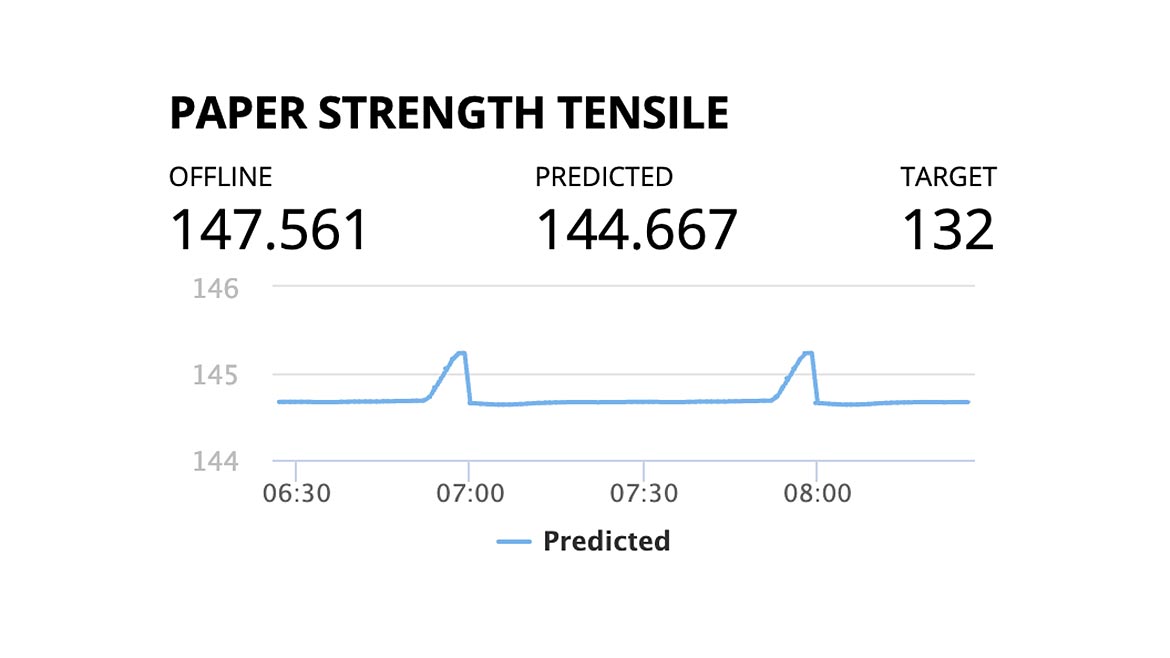
Case Study: Predictive Models in Action
We have developed predictive models that achieve 95+% accuracy within four weeks of deployment. These models predict quality outcomes that enable manufacturers to make proactive adjustments in real time instead of taking an internal build approach, which can take months to develop.
Our predictive quality models are then used with process recommendations to empower front-line operators to optimize their process. This is done by using technology to close the feedback loop. Quality information is provided live so that immediate decisions can be made on the plant floor. Once quality stability is achieved, manufacturers can increase line speed or reduce costs, depending on their specific goals.
For example, in paper production, getting tensile strength or ring crush quality tests to the desired levels is often the first step before pushing for higher throughput. By leveraging predictive quality systems, manufacturers can ensure these critical quality tests remain within the desired specifications, reducing the need for costly rework or scrapped materials. Once quality is stabilized, the focus can shift to optimizing other aspects of the production process. Throughout this optimization, quality is continuously predicted and monitored to ensure quality standards are met.
The Efficacy of Immediate Feedback Loops
One of the key advantages of predictive quality systems is the ability to reduce the length of feedback loops. In traditional manufacturing environments, quality issues are often identified through offline testing, which can take hours or even days to complete. And there are often communication breakdowns that prevent (or hinder) the flow of that feedback. During this time, the production line may continue to operate sub-optimally, leading to wasted materials, time, and money.
Predictive quality systems, on the other hand, provide real-time insights that allow operators to make adjustments before quality issues arise. This eliminates the need for lengthy feedback cycles and ensures that production lines are operating at peak efficiency at all times. By catching potential issues early, manufacturers can avoid the costly disruptions associated with offline quality testing and maintain consistent product quality throughout the entire production process.
Conclusion: Empowering the Next Generation of Operators
The manufacturing workforce may be changing, but the tools and technologies available to support operators are evolving as well. By integrating predictive quality systems with AI-driven prescriptive recommendations, manufacturers can empower new operators to perform like experienced veterans, maintaining quality standards while also meeting throughput goals.
As the workforce continues to advance, the importance of predictive quality will only grow. Deloitte and The Manufacturing Institute assert that more than 3.5 million manufacturing jobs will be needed by 2034. Manufacturers who embrace these technologies will be well-positioned to navigate the challenges of the modern workforce and drive continued success in an increasingly competitive market.
By surfacing predictive insights directly on the plant floor and providing operators with the tools they need to make informed decisions in real-time, manufacturers can ensure that their workforce—regardless of experience level—delivers consistent, high-quality results. In doing so, they not only protect their bottom line but also set the stage for future growth and innovation in the manufacturing sector.
Looking for a reprint of this article?
From high-res PDFs to custom plaques, order your copy today!