Quality Innovations: Today's Comparator
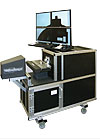
Unlike traditional optical comparators, the VisionGauge Digital Optical Comparator is a portable system that can be wheeled around to another station. Source: VISIONx
It may be time for operators to embrace optical comparator technology that was developed more recently than the 1940s.
The VisionGauge Digital Optical Comparator developed and manufactured by VISIONx (Pointe-Claire, Quebec, Canada) brings comparators into the digital age. As with so many products, the digital optical comparator came about by customer request.
“We had a lot of customers that were unhappy with traditional optical comparators,” says Patrick Beauchemin, president of VISIONx. “Traditional optical comparators do provide value, but customers were asking for a fully digital way to compare parts to their CAD [computer-aided design] data.
“Once you go fully digital, you’re not just allowing an operator to compare a part to its CAD data-you’re allowing the operator to overcome many limitations,” Beauchemin says. “This machine allows companies to eliminate the inaccuracies, cost and effort of using transparencies, also known as overlays. Once you’re digital, you bypass all those headaches.”
Going digital allows for completely automatic results, enabling automatic pass/fail. If done electronically, operators are able to save a very high resolution image of the part. Auto pass/fail provides a very high resolution digital picture that operators can work from, and once they open that door, more benefits follow.
The final product was in development for about two years, and the VisionGauge Digital Optical Comparator has been well received since its release late last year. Early adopters include the medical industry as well as automotive and aerospace. Though at first glance these applications may not seem connected, the underlying demands are the same.
“The product is doing well where tolerances are tight and 100% inspection is required,” Beauchemin says, “and where it’s beneficial to eliminate operator subjectivity.”
When someone is producing medical implants, the manufacturer does not just check the first and the last one, he points out. “You need to inspect that they’re all good,” Beauchemin says, and the same applies for aerospace components.
Applications with complex geometries and profiles where operators must determine if parts are within specification are good fits for the product, he says.
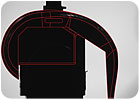
The product does well where tolerances are tight and 100% inspection is required, such as this knee implant application. Source: VISIONx
Today's Comparator
Traditional comparators were developed in the 1940s and are still widely used today. Though they have not changed dramatically since that time, there have been some improvements.Today for example, some systems can project CAD data to the optical comparator; however, they are relatively inaccurate and as with a typical comparator, they are still prone to operator subjectivity. They also do not feature electronic documentation, which is critical for many applications.
“Any other system out there is still built on traditional comparators, and some are with projections,” Beauchemin says. “However, our product changes the field quite a bit. It’s a completely new approach.”
The digital optical comparator has multiple patent applications, and is the result of more than one innovation.
Customers decide to switch to this new technology for many different reasons-Beauchemin says there could be 20 to 30 factors involved-but three come to the forefront.
First, it is much more accurate than traditional comparators, something not to be taken lightly when considering the necessity of having parts within tolerance for orthopedic implants or aerospace, automotive, power generation components and other critical applications.
Automatic pass/fail is a second key advantage, as it removes operator subjectivity from the equation.
Finally, the full electronic documentation is a big draw. Traceability is important in many different industries, especially if there is a problem with a product in the field.
Secondary benefits include not having to use overlays, and also the ability to have data work electronically on the shop floor. This allows for a paperless shop floor where measurements can go directly into an Excel spreadsheet.
Unlike traditional optical comparators, the VisionGauge Digital Optical Comparator is a portable system that can be wheeled around to another station. This smaller footprint alone has attracted customers.
One customer saw that it was less than half the size of a traditional optical comparator, Beauchemin says. This customer was thinking about expanding his shop floor but optical comparators were eating up a lot of valuable space.
While VisionGauge is similar to a video coordinate measuring machine (CMM), it is still generally used for comparator-type applications.
If you’re looking to compare a part to a CAD file, you are likely using an optical comparator, Beauchemin says.
And unlike CMMs, this system requires almost no programming. Operators can get up to speed very quickly, usually less than 1.5 hours.
“If you know how to use a traditional optical comparator, then you know how to use this,” Beauchemin says.
In addition, Beauchemin says customers report twice the throughput with this machine than a traditional comparator, as they are able to measure with the click of a button instead of setting up an overlay.
The “extensive tire kicking” that went on during beta testing aided product development. Because so much customer feedback went into the product, new customers have been pleased when they see the product for the first time, Beauchemin says. VisionGauge Digital Optical Comparators are priced similarly to traditional optical comparators.
VisionGauge Digital Optical Comparators are marketed, demonstrated and exclusively sold, distributed and supported throughout North America by Methods Machine Tools Inc.
VISIONx
274 Lakeshore
Pointe-Claire, Quebec
Canada H9S 4K9
(514) 694-9290
[email protected]
www.visionxinc.com
Methods Machine Tools Inc.
65 Union Ave
Sudbury, MA
(978) 443-5388
www.methodsmachine.com
Specifications
Looking for a reprint of this article?
From high-res PDFs to custom plaques, order your copy today!


