The Fundamentals of Data Collection

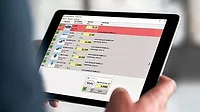
Data collection software can reduce human error in data reporting. Source: Starrett
Having the best, most accurate data is critical for making decisions on the plant floor, and the right data collection software can help streamline operations. Instead of scratching out notes on paper, savvy manufacturers let their machines collect data and send it directly to a software program. This important inspection data should be treated accordingly.
“The decision that you make on the data is only as good as the data provided,” says Rusty Eckstrom, data collection software product manager at ASI DataMyte (Plymouth, MN). “Across the board, data drives the rest of everything that we do, the decisions we make, how we decide to react and change.”
Thus, high-caliber data collection software should be a priority for any manufacturer looking to make well-informed decisions.

The software allows operators to insert pictures and layout screens to make data
collection more intuitive. Source: DataNet Quality Systems
Do It Right
When buying data collection software, be sure to get the most out of it, says Bruce A. Brigham, president of Prolink Software Inc. (Glastonbury, CT). It does not make sense to spend money on software and then not learn how to use it, but that is exactly what many companies do when they cut budgets. By taking time for training, staff may locate previously undiscovered features.“If you want to get the most out of it, you really need to send people to training,” Brigham emphasizes. “If you’re going to do this, do it.”
While the same information could be found by reading the manual cover to cover, no one takes the time to do this, Brigham says, and by putting people into a classroom, they are more likely to learn.
In working with analysis software, Brigham says the hardest part is getting the data. When running the software, Prolink’s goal is to eliminate all questions for human operators. Brigham says their software is easy to use because, in the traditional sense, no one is using it. If a problem occurs, the software e-mails automatic reports.
Jeff Wilkinson, general manager of The L.S. Starrett Co.’s (Athol, MA) advanced technology division, encourages operators to use a wireless data collection system to significantly reduce human error in data recording.
To make the data collection process as painless as possible, Brigham also recommends electronic, wireless gages that get data into a computer without any buttons except send. This will reduce the amount of time spent on frivolous reporting and allow engineers to think about other problems. While he acknowledges some people have their act together, Brigham says many operators will spend two hours trying to report data that was collected in 10 minutes of automated inspection.
“It’s epidemic,” Brigham says. “More time is wasted in this industry today making reports than anything else. Our goal is to reduce that time to zero seconds.”
Prolink offers software that is intended to generate reports, automatically get graphs and put the data into Excel.
“In the end, the vast majority want the report container to be Excel,” Brigham says. “Excel is perceived to be free and easy to use, both of which are false, but it doesn’t matter.
“What matters is that everyone thinks all of the data is best suited to land in Excel, and that’s what we are addressing,” Brigham adds.

Software can help manage the endless flow of data. Source: Starrett
Features
So what should people look for in a new system? Rick Sloop, senior application engineer at Infinity QS International (Chantilly, VA), suggests looking for a system that is flexible enough to collect data from almost any source and one that is easy to use, set up and manage.Infinity QS collects data from checkweighers, coordinate measuring machines (CMMs) and other devices. “Our main strength is that we collect data from almost any source,” Sloop says.
Collecting data from a variety of sources is definitely a priority for software providers.
“We collect data for the charting automatically, from shop-floor sources such as serial devices, text files, machines, gages, databases and other manufacturing systems,” says Beena Anand, a Six Sigma Black Belt quality engineer at DataNet Quality Systems (Southfield, MI). “It is possible to directly hook those to computers and pick up data directly.”
Anand says companies want to gather data and manage it, and then trace it.
“Almost every manufacturer wants to trace things, whether you are making tires for cars or medicine for people,” Anand says.
The data collected can be fed to enterprise systems, and it allows manufacturers to look at product recalls and the cost of quality. The DataNet software works with a company’s financial software and is done in real time. Because many of their customers use SAP or Oracle systems, the software can work with these systems.
Many software programs can work with other systems and make the transition as smooth as possible.
“We don’t require people to have certain equipment,” Eckstrom says. “We are unobtrusive in their environment and work with existing equipment and tools.”
No matter what type of tools a plant already has in place, data collection software may offer something different for everyone. With all of the software features available, Brigham says that Prolink customers probably use only 20% to 30% of the software’s capabilities. “The unique thing is that everyone’s using a different percent,” Brigham says.
Manufacturers should be cautious with the siren song of endless, easy-to-use features, as ease of use may cause manufacturers to try to collect too much data.
Sloop reminds operators to remember the basic principles of data collection.
“It’s so easy to collect the data that we tend to want everything,” Sloop says, “which sometimes doesn’t make for good control charts.”
A common mistake on automated systems is the sampling itself, Sloop says, and operators should know when to collect sample data and what rational sampling is.
“It’s what you do with it that makes the difference,” Anand says.

Data collection software should be a priority for any manufacturer looking to make well-informed decisions. Source: Infinity QS International
The Future
In the 20 years Sloop has been in the field, he has seen a lot change in the market. Early on, the focus was connecting to a multiplexer, caliper or scale. “If software could do that, it was in the market,” Sloop says. From there came interest in pulling in data from CMMs and flat file data. In the past two years, Sloop says PLCs have been strong as customers are looking for ways to bring data from PLCs for analysis. Customers are looking for anything to make data collection easier.It is difficult to predict the future of data collection, particularly when the present is so varied, but some general trends are visible.
“Everything is going toward automation,” Sloop says. “Manufacturers are moving away from keyboard entry, which saves time and increases accuracy. One of the biggest gains is accuracy, and time is right there with it.”
The trend is going to streaming data and a live connection, Sloop says.
Some of these forms of data collection, such as tapping into streaming data, offer a new type of data collection system. The data management system ties together all of the data collection in one service, comes with the computer and is ready to collect data 24/7.
“This is a taste of the future,” Sloop says. More and more software will match PLC information with calipers, and be able to tie everything together for analysis.
Some of these technologies are very new, says Sloop, including the ability to set sampling frequencies on streaming data.
On the instrumentation level, Eckstrom says the future of this software will depend on what inspection equipment is used and how it generates data.
“It will be interesting through the years as we continue and the use of the Web expands,” Eckstrom says.
Eckstrom has run across a gamut of technology adopters-some pushing forward, while others still have one foot in the past.
But no matter what technology is used, it all boils down to the basics.
“The critical aspect on all of this is that data collection really drives the decision process,” Eckstrom says, “And the quality of those decisions is directly related to the quality of data you’re collecting.” Q
For more information on the companies mentioned in this article, visit their Web sites:
- ASI DataMyte, www.asidatamyte.com
DataNet Quality Systems, www.winspc.com
Infinity QS, www.infinityqs.com
Prolink Software, www.prolinksoftware.com
The L.S. Starrett Co., www.starrett.com
Tech Tips
Quality Online
For more information on data collection software, visit www.qualitymag.com to read the following:- Quick and Accurate Data Collection
- Wireless Data Collection Technology Explained
- Quality 101: Data Collection Serves as a Management Tool
Looking for a reprint of this article?
From high-res PDFs to custom plaques, order your copy today!