Quality Test & Inspection: Noncontact Inspection: From Shadowgraph to Multisensor
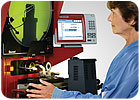
This system with microelectronic-based, software-driven readout systems, precise lighting and edge detection with automatic point entry is more accurate than the shadowgraphs and overlays of the past. Source: Starrett
The oldest of the noncontact inspection systems commonly used today is the optical comparator-commonly called a shadowgraph a couple of generations back. For many years, a comparator with a part-specific overlay was the only method available for profile inspection of parts such as cutting tools.
Shadowgraphs and overlays are still used, but they have largely been superseded. At best, overlay chart inspection provides only a basic go/no-go result-recording trends and degree of variation is not possible with overlays. Other problems include traceability, storage and calibration of Mylar overlays, and mistakes made by inexperienced or fatigued operators. Many tolerances today are tighter than the operator-to-operator variability and subjectivity of overlays.
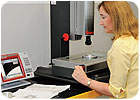
Vision applications can range from simple, manual measurements on small machines to highly complex, CNC programmed routines on large motorized systems. Source: Starrett
Advances in Optical Comparators
Today’s optical measuring system is not your grandfather’s shadowgraph. The transition to modern optical systems began about 25 years ago with the introduction of digital measuring systems (DROs), greatly reducing measurement error. During the past decade, increasingly powerful microelectronic-based and software-driven readout systems replaced the basic DROs to become the backbone of the modern optical measuring system.Large screens and overlays have been replaced by much smaller screens and programmed routines. Measuring tasks are faster, easier, more varied and complex, and measurement data can now be collected.
Now, sophisticated optical systems feature edge detection with automatic point entry. For example, edge detection can automatically determine the diameter of a circle by finding just three points on its circumference. Edge detection allows the measurement of circles, angles and work with skewed objects.
Some high-end optical systems have computer numerical control (CNC) and precise, motorized axis movement. Combined with edge detection, they allow complex programmed routines, and even software interfaces with computer-aided design (CAD) systems, to jumpstart the programming process. User-friendly visual and audio cues guide the operator through programmed sequences, simplifying setup for complex measuring routines. The result is exponentially higher throughput, accuracy, reliability and repeatability.
This mature method of noncontact measurement that some had thought would be left by the wayside has been adapted with new technologies. Optical comparators work well in production environments and quality control to ensure accuracy of radius, angle and location of specific features, and similar tasks.
One significant benefit of optical systems is their flexibility-an investment in optical equipment has a short and certain payoff because it can be readily adapted to new applications.
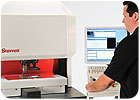
This
large video measurement system is running a multisensor program that could use
noncontact video and laser sensors along with a contact touch probe to a
perform a highly complex inspection in a single setup. Source:
Starrett
Vision Systems
Where optical comparators work predominantly with the optical shadow of a work piece, vision systems use precise lighting, controlled optics and a video camera to count pixels. This information provides a data stream that control systems translate into meaningful dimensional data.There are two broad classes of video-based measurement and inspection vision technology used in manufacturing. The first, commonly called machine vision, determines the dimensions or attributes of a single feature or small group of features of parts that are moving on some variation of an assembly line.
The second type involves a combination of a coordinate measuring platform with video or “vision” capability. Here, the part in question is brought to or loaded on the video-based measurement system for simple or detailed dimensional analysis.
Benchtop video-based measurement systems work well for a range of applications from walk-up measuring of a limited number of features of a few parts to high-volume production applications. They are versatile inspection tools that can be easily reconfigured for a range of applications.
They are available in a range sizes. A vision product line could include X-Y-Z work cubes from 6 inches by 4 inches by 6 inches (200 millimeters by 100 millimeters by 200 millimeters) to 50 inches by 36 inches by 8 inches (1,270 millimeters by 915 millimeters by 200 millimeters) in a benchtop or floor standing configuration, as appropriate. Configuration and features cover a wide range as well. Some examples include:
- Manual or motorized positioning. Stepper or servo motors.
- A choice of optics configuration, lenses, auxiliary lenses and zoom optics ranging from 10X to 240X.
- Lighting including surface illumination, transmitted or backlight, coaxial illumination, dark field quadrant and a variety of specialized combinations in either fiberoptic or LED.
- S-Video camera, digital video camera.
- A range of control systems and software, from simple to highly complex.
- Physical configuration and multisensor adaptability.
Noncontact laser measurement. Inspection lasers work by emitting and detecting light: direct, reflected or scattered. They are particularly useful for measuring 3-D features such as surface contours and for precise definition of very small areas.
Noncontact multisensor systems. The best approach to some inspection applications involves a combination of noncontact techniques, or in some cases, a combination of noncontact and contact measurement. Today, multisensor systems are developed to provide a complex inspection routine with a single setup.
Combining optical and simple video. One comparator product offers dual-optical lenses. A special video zoom lens can be substituted for one of the lenses to add video capability. The result is basic video capability at an economical price. Depending on the features of the host optical system, a range of applications combining optical and video measurement are possible.
System equipped with an attached laser sensor. Some video-based systems have a column built with the room and rigidity to accommodate a laser attachment. Uses range from simple to complex depending on the system complexity and application requirements. However, unlike the optical/video systems, video/laser systems almost always require CNC control.
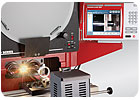
This
optical comparator is fitted with a special video zoom lens that can be
substituted for the lens, and along with the control system, adds basic video
capability to the system. Source: Starrett
The Right Choice for the Application
Over the years, both the number of noncontact technologies available and the complexity of noncontact inspection applications have increased. These factors are interrelated-new technologies allow more complex routines and more demanding application requirements require more powerful inspection tools.However, the availability of more sophisticated tools is only relevant where they are needed. The wise old rule of keep it simple is a good guide. The single factor that should guide a choice of technologies and systems is the application. Q
Tech tips
- An investment in optical equipment has a short and certain payoff because it can be readily adapted to new applications.
- Where optical comparators work predominantly with the optical shadow of a work piece, vision systems use precise lighting, controlled optics and a video camera to count pixels.
- Multisensor systems are developed to provide a complex inspection routine with a single setup.
Looking for a reprint of this article?
From high-res PDFs to custom plaques, order your copy today!