Small Companies See the Money

Six Sigma has been defined as a tool kit or a set of techniques, based on statistical process control (SPC), that can help companies make major improvements in product quality. The Six Sigma goal of 3.4 defects per million, the standard +1.5 sigma shift, techniques for calculating the sigma value and definitions for Six Sigma Black Belts have been well documented.
Six Sigma programs are typically structured around a Black Belt working full-time on difficult business problems in a large organization. The management representative, or Six Sigma Champion, helps the Black Belt get the needed resources—for example, formal Six Sigma training, part-time Green Belts and cross-functional team support—and breaks down barriers to complete the project in three to six months. This formal Six Sigma structure can provide significant financial results in large organizations, but typically exceeds the resources available to smaller companies. Six Sigma, however, can be an effective tool for smaller organizations and play a major role in continual improvement based on the ISO 9001: 2000 requirements. This nontraditional technique still requires the use of the entire Six Sigma tool kit, formal training and the DMAIC (Define, Measure, Analyze, Improve, Control) principle.
To review this nontraditional continual improvement technique, consider a hypothetical manufacturing company, Expanders Limited (EL), which employs less than 100 people. EL manufactures limited quantities of custom-designed components and equipment for a specialized international market. Standard methods of SPC typically do not apply to this type of manufacturing effort. Defect-free performance of the engineering, manufacturing and service functions is required, however, to stay competitive in EL’s volatile market.
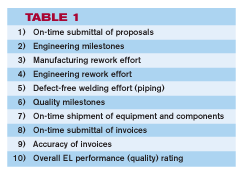
EL started by identifying all of the major processes (see Table 1) that define their quality management system as required by Section 4.1.a and 4.1.f of ISO 9001: 2000. Using Six Sigma techniques, these major processes will be monitored, measured and analyzed, as required by Section 4.1.e of ISO 9001: 2000. EL also generated a detailed listing for each process that defines formal criteria for determining defects. For example, the defect-free welding effort is defined as the number of defect-free welds divided by the total number of radiographed welds—typically 5% of all piping welds are radiographed. All welds rejected during this nondestructive examination are considered defects.
Sigma ratings are calculated using the Microsoft Excel function =normsinv((total opportunities – defects)/total opportunities) + 1.5 (standard sigma shift). For example, two rejected piping welds out of 593 radiographed welds would result in a sigma rating of 4.21 (i.e., =normsinv((593-2)/593)+1.5).
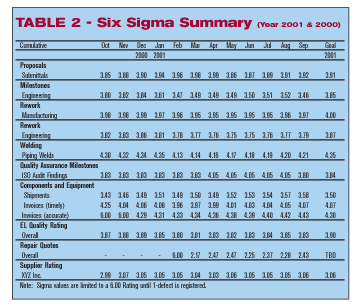
Defect-free performance is measured and the resulting sigma ratings are calculated for all of the major processes, such as engineering milestones, rework effort and on-time shipments. The sigma ratings are calculated monthly using cumulative data from the previous 24 months; EL started gathering data with a pilot program prior to the December 2000 formal approval of the new ISO 9001 standard. EL also added an overall Sigma Rating for the entire company. This rating is used to ensure that EL stays focused on continual improvement as a balanced team in addition to individual effort and special cross-
functional teams.
Top management at EL establish goals for each process, as required by Section 5.4.1 of ISO 9001 “Quality Objectives,” on a yearly basis and also monitor the sigma ratings for continual improvement on a monthly basis (see Table 2). If negative trends become a serious problem or if breakthrough improvement is required, then the trends can be analyzed to find the root cause of the problem by using performance improvement methods including the Six Sigma tool kit. Breakthrough improvement has been defined by the Breakthrough Management Group (Longmont, CO) as the key to dominance in any industry and for improving faster than the competition.
Internal requests
This nontraditional Six Sigma technique for ISO 9001: 2000 continual improvement resulted in an unexpected benefit. EL associates started making requests to expand the Six Sigma program into additional areas. These areas required a special cross-functional team approach to identify and solve the root cause of the problem, which represents the power of Six Sigma.
The first request to unleash the real power of Six Sigma was based on price and delivery quotations for equipment returned to EL for repairs. Repair quotations took approximately 30 days to complete after the equipment arrived at the EL factory; the customer expected a response in less than two weeks. The DMAIC process for quoting repairs included the use of Six Sigma tools such as brainstorming, cause-and-effect diagrams, identification of primary and secondary metrics, and a capability analysis. EL found that measuring the process provides actual data to make business decisions and typically removes most of the speculation and emotion from the problem. The decision on how to improve the process was based on an analysis of the data, such as timely release of inspection prints from engineering, processing the equipment correctly after receipt, disassembly and inspection of the equipment, dispositioning parts for the repair status, quoting the repair price and delivery cycle. The repair quoting process was added to the monthly update to monitor for negative trends.
The second request was based on improving the reliability of components provided by a supplier. Customer expectations of shorter and shorter delivery cycles for EL’s equipment required that components arrive on time and in compliance with purchase order requirements. EL developed a measuring system for all items listed on purchase orders from supplier XYZ Inc.; supplier XYZ Inc. is an authorized distributor for several manufacturing companies. Components are tracked for compliance based on the purchase order and delivery date at the EL factory. Most of the discrepancies resulted from drop shipments directly to the EL factory that were not verified by the distributor and some of the discrepancies were internal problems at the EL factory.
EL also discovered that limiting Six Sigma training to the Green Belt level, during the continual improvement pilot program, still provided the resources required to attack and solve their business problems. As the continual improvement program matured, then advanced Six Sigma training, such as Black Belt, DFSS - Design for Six Sigma, was considered. The advanced training is especially important for improvement between 4.0 and 6.0 sigma (see Figure 1).
It has been suggested that Six Sigma’s long-term viability will depend on an honest recognition of the limitations of Six Sigma as a tool. The real strength of Six Sigma, however, has already been proven as a disciplined problem-solving technique that can be expanded beyond traditional applications in the quest for continual improvement.
Sidebar: Tech Tips
1. Six Sigma can be an effective tool for smaller organizations and play a major role in continual improvement based on the ISO 9001: 2000 requirements.
2. Adding an overall Sigma Rating for the entire company ensures the company stays focused on continual improvement as a balanced team in additional to individual effort and special cross-functional teams.
3. Measuring the process provides actual data to make business decisions and typically removes most of the speculation and emotion from the problem.
Looking for a reprint of this article?
From high-res PDFs to custom plaques, order your copy today!


