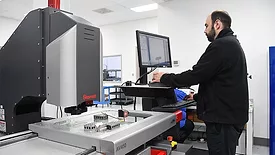
CMM touch probing surely has its place, however it is not always an optimal solution for certain part geometries and applications. Roush Yates Engines (RYE) and its manufacturing division, Roush Yates Manufacturing Solutions (RYMS), recognized there were better options.
Recent advancements in sensor and optics manufacturing technologies for UV and IR wavelengths have made imaging systems for these wavelength ranges more accessible.
As of recent years, the demand for machine vision systems that capture information in the ultraviolet (UV) and infrared (IR) spectral ranges has increased as more integrators and end users venture into new application spaces.
Until the CoaXPress v2.1 standard was released in 2021, the only physical medium between cameras, PCs, and frame grabbers for the CoaXPress (CXP) interface had been 75Ω coaxial cable. For most vision applications, the CXP 2.1 interface perfectly suited high-throughput inspection systems, quality control and factory automation needs. So, who would want to change that winning formula?
In a domain where microns and millimeters matter, efficient quality inspection and metrology processes can make the difference between consistent, successful production runs and labor-intensive failures.
As a technology, automated inspection has transformed the manufacturing industry, In addition, automated inspection is used in life sciences and pharmaceuticals, where its applications can range from reducing the probability of cross-contamination to identifying abnormalities in cells.
Lighting represents a crucial consideration when designing and specifying a system, as it is fundamental to image quality. Understanding how lighting impacts the rest of the system lays the foundation for system success.
Camera sensors and new machine vision applications tend to drive parallel advances in optics, and optics suppliers must continually evolve as machine vision technologies progress.
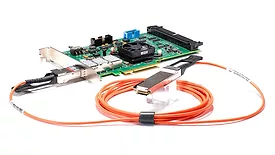
CLHS specification 1.2 recently introduced the 25 Gbps speed along with the QSFP28, SFP28, and MPO connectors. The committee has proof of concept to achieve 50 Gbps using the same IP core, ensuring an easy transition to future speeds.
 RSS
RSS