Case Study: VW Scans Clay Models with Lasers
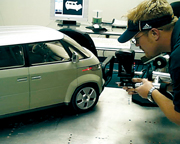
Switching from manual digitizer to laser scanning is helping the Volkswagen & Audi Design Center (Simi Valley, CA) make more realistic physical models of new vehicle design concepts, speeding the decision-making process within the company.
The manual digitizer used in the past could only generate a limited number of points from clay models, which limited the amount of detail in the resulting computer aided design (CAD) model. The design center switched to a laser scanning system that acquires millions of X, Y, Z coordinates, making it easy to digitally create a highly detailed surface model that can be used to accurately reproduce the part with a CNC (computer numerical control) milling machine.
"Now, we can much more accurately duplicate the basic body contour and create models of details such as grilles and rear view mirrors that were more difficult for the digitizer to handle," says Hans Lapine, chief modeler for Volkswagen & Audi Design Center. "This makes it possible to create a more realistic model that makes it easier to envision the final product that we are proposing. The end result is better and faster decisions that are helping to keep Volkswagen at the leading edge of automotive design."
As one of the largest producers of passenger cars in the world and Europe's perennial sales leader, the Volkswagen Group operates manufacturing facilities in countries across the world. Brands in the Volkswagen Group include Volkswagen, Audi, SEAT, Skoda, Volkswagen Commercial Vehicles, Rolls Royce, Bentley, Lamborghini and Bugatti. The Volkswagen and Audi Design Center in Simi Valley was opened in 1991 as the company's first design center in southern California. Listed among its accomplishments is the design of Volkswagen's popular New Beetle concept car, which was introduced to the market in 1998. Staff members at the California Design Center also created the Audi TT and 2005 Microbus and influenced the 2003 Volkswagen Jetta and the 2003 Audi A8.
From clay to CAD
While the role of the computer in automotive design is continually increasing, nearly every new model is still originally created in clay because many skilled modelers still produce a more visually attractive surface with their hands. However, after a clay model is created, it needs to be digitized into a CAD model so that certain areas can be made mathematically more precise. The CAD model is also used to generate as many copies of the clay model as are needed during the review process.
Originally, the company used a digitizer to probe the model's surface to generate points that were used to create a surface with CAD software. A problem with this approach is that the operator had to move the digitizer to generate each individual point, which made it difficult to generate enough points to define complex contoured areas. Another problem was that the accuracy of each point depended on the operator's ability to position the probe so that it was in contact with the clay model while the measurement was made. The operator also had to avoid applying excessive pressure that might damage the model. Duplicating the basic body contour was so difficult that there was rarely enough time to scan details such as grilles, rear view mirrors, mufflers and lights.
"We were looking for a way to speed up the scanning process so that there would be more time to add details that would allow us to produce more realistic models," Lapine says. "We considered a number of alternatives but it soon became clear that the technology of laser scanning had some advantages." Laser scanning systems work by projecting laser light onto surfaces while cameras continuously triangulate the changing distance and profile of the laser as it sweeps along, enabling the object to be accurately replicated. Laser scanners are able to quickly measure large parts while generating far greater numbers of data points than manual digitizers without the need for templates or fixtures. Because a laser scanner does not use a probe that must physically touch the object, the problems of depressing soft objects and measuring small cavities are eliminated. Lapine looked at several different types of scanners and selected the ModelMaker from NVision (Coppell, TX) because of its ease of use and the number of data points it could collect. The ModelMaker's sensor is a single viewpoint laser stripe sensor incorporating the illumination and sensing means to capture 3-D data. Laser stripe sensors capture up to 10,000 data points per second. The result is a denser cloud of 3-D data, which can accurately describe the surface of the object.
Laser scanning process
Since getting the scanner, the company's experience level has helped find optimum ways to scan the models. For instance, "While a laser scanner works under nearly any lighting conditions, we have found that it's easier with very low light so we scan models in a darkened room," Lapine says.
Engineers begin the process by calibrating the laser. A fixed cube is scanned to establish the coordinate system. Then, the model is scanned by moving the scanner around it. Engineers can scan a quarter-scale clay model in about two to two and a half days. "That is about the same amount of time that we used to spend scanning with a manual digitizer, but with a laser scanner we are able to acquire many times the number of points," Lapine says. "For example, we now have time to scan details such as rocker areas, wheel arches, mirrors, door handles, grilles and other areas that would have taken too much time or would have been impossible to reach with a digitizer."
The calibration process establishes where the points generated by each individual stroke of the scanner lie in relation to one another so that when done, the points are automatically assembled into a single point cloud in a process known as merging. The CAD software that runs with ModelMaker does minor cleanup such as filling in holes and eliminating stray points. The file is exported in the stereolithography format which moves cleanly to Alias, a modeling software. Then modelers working in Alias spend additional time using the software's tools to perform cleanup, such as ensuring that the body is symmetrical.
"The much larger point cloud that is created by laser scanning can be turned into a surface model in far less time and with a much higher level of accuracy," Lapine says. "We used to spend days in Alias to create surfaces and finalize the model but now only a fraction of that time is needed to produce a surface model that is ready to generate a tool path for a CNC mill.
"The end result is a physical model that, rather than simply presenting the lines of the body, actually looks like a car," Lapine adds. "Making the model more realistic is important because many of those involved in the design and review process don't work in design on a day-to-day basis. Their day job may be in finance or manufacturing. With laser scanning, we can produce a much more detailed model for their review and that makes it easier to visualize the product and helps them make better decisions."
Other VW studios in the corporation, with whom the Simi Valley engineers regularly cooperate and compete with, have come to see the scanner's potential and are using it at their design centers.
"Laser scanning," Lapine says, "can provide substantial improvements in the automotive design process by providing a more detailed and more accurate transformation from clay to CAD, generating additional information that helps everyone involved in the process to make the decisions."
NVision Inc.
(972) 745-8444
Looking for a reprint of this article?
From high-res PDFs to custom plaques, order your copy today!