Quality Software & Analysis: Collect Less Data for Better SPC
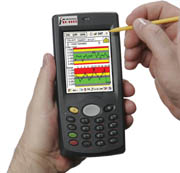
For manufacturers using statistical process control (SPC), there are myriad software programs available to assist in its implementation. Many of them have similar capabilities and the program chosen is less important than how it is used. Some guidelines will make these tools more effective.
Implement SPC for the right reasons
Why do SPC? If the only answer is "because my customer requires it," chances are that employees see SPC as nothing but an additional burden and an obstacle to productivity. There also is a good chance that they are correct, which means that in these plants SPC is more of a hindrance than a help. If an SPC program is not viewed as essential to improving quality, productivity and reduction of scrap, then it has minimal usefulness.
For example, a large machine shop was working on a multimillion dollar project for an automobile manufacturer. The machine shop designed custom test fixtures for each machining station and collected data on dozens of characteristics at each station. Unfortunately, it became obvious that the company had no intension of using the technology to improve their processes. SPC was simply an additional requirement-the cost of doing business. They could have viewed it as an opportunity to improve productivity but they did not.
Several years later, the entire contract was pulled and sent to Mexico. They may not have saved the contract if they had changed their culture and fully embraced SPC when they had a chance, but it might have helped. After all, the most common reason for sending manufacturing outside of the United States is cost.
A manufacturer can only go so far in reducing cost by cutting fixed overhead. Eventually productivity needs to increase in order to reduce the cost per piece.
The goal of SPC software is to monitor processes and detect trends before they interrupt production. This requires that everyone from management to the machine operator be empowered to act on SPC trend alerts as soon as they are detected.
Some companies use SPC software solely to collect part data to prove that a particular lot of parts were manufactured within specification. This is not where the power of SPC lies. The true power of SPC software is in identifying processes that are about to produce bad parts, and to adjust them before they do.
Dr. W. Edwards Deming, widely considered the father of SPC, talked about developing profound knowledge about a process that would lead to improvement. Since Deming's theories on process improvement were first introduced, there have been great advances in the power of computing technology and software tools to aid in the implementation of SPC. By using this software, data is analyzed faster than ever before.
Monitor the process, not the part
Consider the term statistical process control. Concerned with manufacturing process and quality control, manufacturers constantly have to remind themselves that the p stands for process and not for part. Sometimes manufacturers become so intent on measuring the part that they lose sight of the fact that the part is just a window into the process that produced it.
The first step to successful SPC is determining the capability of the process. SPC alerts are only as good as the capability limits that have been selected. Before SPC can be used to control a process, it must be verified that the process is capable of making parts within specification. If the process is not capable, then 100% inspection is required to sort the bad parts from the good; the antithesis of SPC.
Collect less data
Why would someone advise a manufacturer to collect less data? Because if the correct data is not collected, a company will not benefit from SPC and therefore abandon the strategy.
Continual process improvement must apply not only to the manufacturing process, but also to the process that monitors it. Dr. Demming advocated continual cycles of improving the knowledge of a process. He proposed that one should strive to "improve constantly and forever" in a never-ending quest to reduce process variation.
As a technician gains more experience with a process, he will find characteristics that have a high correlation to each other, and eliminate redundancy. Identify these key characteristics by using SPC software. Most packages have an X/Y or scatter chart that can give a correlation coefficient for any pair of characteristics. More sophisticated software will supply more complex multivariate analysis that can factor a matrix of characteristics, thereby identifying key characteristics.
In some cases, processes are controlled by monitoring a single characteristic. In fact, a technician may find a process variable that directly correlates to part quality, eliminating the need to inspect any parts. By simply monitoring the process variable, the process can be controlled.
Take, for example, an unstable injection molding process. A sensor was inserted on the side of the mold that measured the mold deflection-the separation of the two mold halves-very precisely. By comparing the maximum deflection against the parts critical characteristics, it was noticed that "perfect parts" always produced the same amount of deflection. In this case, the manufacturer went one step further and closed the loop. The process was controlled in real time, reacting to the ideal mold deflection on every cycle. Always look for opportunities to correlate to a process variable, and close the loop.
Less data can be collected by adjusting the sampling frequency to match the historical stability of the process. This technique is readily used in acceptance sampling, but is rarely seen in in-process SPC. When a process produces good results over a period of time, it should be promoted so that it is sampled less often.
By collecting less data, SPC implementation is simplified by making it less burdensome and therefore better accepted and more effective.
Use technology
It seems that the technology available for quality infrastructure is always just slightly behind the current state of the art. Part of the problem may be that technology is advancing so fast, it is difficult to keep making capital investments in hardware and software every three to five years.
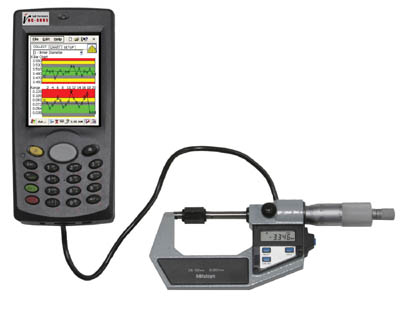
Two new technologies have emerged in the past few years that are essential to easing the burden of implementing plant wide SPC. The first is wireless networking. A second technology-small portable industrial computers-is required to take advantage of these wireless networks. These devices are becoming very affordable and most come standard with built-in wireless networking, barcode scanners and gage interfaces.
By using these technologies, additional longevity is added to a capital investment. Consider devices that can be easily upgraded by installing new software, or that can be shared for additional applications on the shop floor.
A handheld computer running a standard operating system, such as Windows CE or Palm OS, can run shop-floor SPC software applications. This same device also can run familiar standard software such as a browser to access the corporate intranet to retrieve work instructions or operating procedures. Because these devices run standard operating software, they are easily upgradeable and used for multiple purposes.
Do less with less
Does this sound familiar? "Jim, we are cutting your staff. You are just going to have to do more with less." How more can be done with less is a mystery, but less can be done with less.
Use SPC software to analyze data that has been collected, and continually improve the knowledge of one's processes. Use that knowledge to refine SPC data collection procedures to improve control by collecting less data. Use shop-floor SPC software to alert operators when trends occur, and empower them to make adjustments before bad parts are produced. Use innovative and flexible technology to protect an investment in SPC infrastructure. Q
Bill Caterisano is lead developer for I&R Partners LLC (White House, TN). He can be reached at [email protected] or (585) 330-8836. For more information, visit www.spcmadeeasy.com.
Quality Tech tips
• The power of SPC software is in identifying processes that are about to produce bad parts, and to adjust them before they do.
• The first step to successful SPC is determining the capability of the process.
• Less data can be collected by adjusting the sampling frequency to match the historical stability of the process.
• If the correct data is not collected, a company will not benefit from SPC.
Looking for a reprint of this article?
From high-res PDFs to custom plaques, order your copy today!


