Quality Magazine logo
search
cart
facebook twitter linkedin youtube
  • Sign In
  • Create Account
  • Sign Out
  • My Account
Quality Magazine logo
  • NEWS
  • PRODUCTS
    • FEATURED PRODUCTS
    • SUBMIT YOUR PRODUCT
  • CHANNELS
    • AUTOMATION
    • MANAGEMENT
    • MEASUREMENT
    • NDT
    • QUALITY 101
    • SOFTWARE
    • TEST & INSPECTION
    • VISION & SENSORS
  • MARKETS
    • AEROSPACE
    • AUTOMOTIVE
    • ENERGY
    • GREEN MANUFACTURING
    • MEDICAL
  • MEDIA
    • A WORD ON QUALITY PUZZLE
    • EBOOK
    • PODCASTS
    • VIDEOS
    • WEBINARS
  • EVENTS
    • EVENT CALENDAR
    • IMTS
  • DIRECTORIES
    • BUYERS GUIDE >
      • Supplier Insights
    • NDT SOURCEBOOK
    • VISION & SENSORS
    • TAKE A TOUR
  • INFOCENTERS
    • Digital Quality Management Systems
    • NEXT GENERATION SPC & QUALITY ANALYTICS
  • AWARDS
    • ROOKIE OF THE YEAR
    • PLANT OF THE YEAR
    • PROFESSIONAL OF THE YEAR
  • MORE
    • Expert Columns
    • NEWSLETTERS
    • QUALITY STORE
    • INDUSTRY LINKS
    • SPONSOR INSIGHTS
  • EMAG
    • eMAGAZINE
    • ARCHIVES
    • CONTACT
    • ADVERTISE
  • SIGN UP!

QUALITY SOFTWARE & ANALYSIS: Synchronized Measurement Reduces Calibration Time
September 1, 2006

The conventional process for measuring computer numeric control (CNC) displacement errors is static -the machine stops at every measurement increment, dwells for a few seconds, settles and then collects the positioning data. For small measurement increments or machines with long travels, this can add up to a substantial amount of machine downtime. The same measurements take only a few minutes with nonstop synchronized data collection. In fact, nonstop measurement and data collection allows many more measurement points, which provides more detail and still cuts run time. For example, an increment of 25 millimeters with a 5-second dwell time, 1,250-millimeter axis length and five bidirectional runs requires more than 50 minutes.


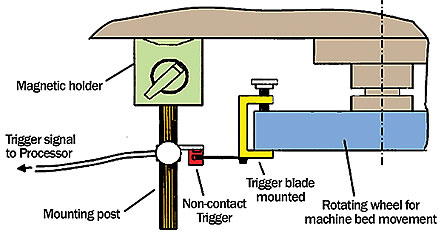
This portrays schematics of the external trigger setup for nonstop synchronized data collection for a CNC machine tool. Source: Optodyne Inc.

Additionally, the measured static positioning error, usually caused by machine geometry, guide way and structure rigidity, does not measure dynamic positioning errors caused by servo parameters, resonance frequency, and acceleration or deceleration. In other words, because the machine stops before collecting data, it misses servo or dynamic errors. In theory, contouring accuracy should improve by using the dynamic displacement error table, instead of the static displacement error table. This is particularly important for moldmakers, who must ensure mold cavities conform to complex geometric shapes created by multiple blended surfaces.


Displacement Measurement Instruments

In 1881, Albert Abraham Michelson, winner of the 1907 Nobel Prize for Physics, invented an interferometer. The Michelson interferometer used a white light source with fixed and movable mirrors. Michelson interferometers have been used to measure distances or compare distances by counting interference fringes. With the invention of lasers, a single-frequency helium-neon laser replaced the white light source and two corner-cubes replaced the mirrors.

A single frequency helium-neon laser beam is directed at a beam splitter. Half of the beam passes through to a movable corner-cube and the other half is reflected to a fixed corner-cube. The reflected beams return and combine at the beam splitter. When all the optics are exactly aligned and motionless, these two combined beams will interfere with each other to generate an interference fringe pattern. A small area photo detector counts the fringes. Each cycle of intensity change represents a half-wavelength of travel of the movable corner-cube. If the laser wavelength is known, the travel of the movable corner-cube can be accurately determined. The single frequency interferometer works well but is sensitive to noise. So, electrical noise and gain drift cannot be distinguished from motion.

A two-frequency interferometer uses a two-frequency helium-neon laser and mixes its two beams of two different frequencies to generate a carrier frequency. Therefore, the distance information is carried on AC waveforms, not DC. The two-frequency interferometer works well, however, it requires heavy permanent magnets and precision optical components to stabilize the laser, preserving polarization and minimizing the scattered light returning to the laser resonator. Because the system is bulky and has a large number of optical components, the cover must be removed from most machine tools to set up.


Laser Doppler Calibration System

The laser doppler calibration system uses a laser doppler displacement meter (LDDM), which is based on microwave radar technology, the Doppler Effect and optical heterodyning technology. The LDDM uses electro-optics, optical heterodyne techniques and phase-demodulators to obtain the position information of a movable corner-cube.

The LDDM measures displacement based on illuminating a retroreflector with a helium-neon laser beam. The laser beam reflected by the retroreflector is frequency shifted as the retroreflector moves. Because the phase of the reflected laser beam is proportional to the position of the retroreflector, the change in position can be measured.

Polarization and stray light are non-issues, precision and special optics are not required. Windows can be inserted in the beam path and simple mirrors can be used to reflect the laser beam to any angle.
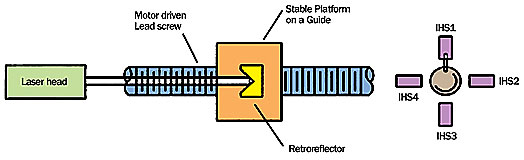


Schematics of automatic lead screw calibration setup with four-trigger pulses per revolution are illustrated. Source: Optodyne Inc.

How It Works

For lead/ball screw calibration, a blade mounted on the axis motor-driven lead/ball screw triggers the position sensors. For example, four position sensors can be used to collect four data per revolution. The position sensor sends a TTL pulse to a PCMCIA card, triggering data collection. The key to nonstop data collection is the external trigger and data collection synchronized with the TTL trigger pulses, allowing the data to be collected at the same time.

With typical measured pitch errors with four position sensors, the lead screw pitch is 0.2 inch per revolution. This allows 20 data points per inch over 20 inches. In this example, the thermal expansion error is much smaller than the pitch error.

To calibrate an axis on a CNC machine, the laser head is mounted on the machine bed and the retroreflector, or target, is mounted on the spindle. The laser beam is aligned to be parallel with the axes in the same way as with conventional static laser calibration. Instead of programming the spindle beginning at the start position to stop at every increment with a 5-second dwell time until reaching the end position, the spindle is programmed to move continuously from the start position to the end position without any stops in between.

The position sensor can be mounted on the lead screw or the rotary wheel of the lead screw. The noncontact trigger is mounted on a magnetic holder with a post. The trigger blade is mounted on the rotating wheel of the lead/ball screw. For every revolution of the wheel, a trigger signal is sent to the PCMCIA card, which collects the data. For some machines, the trigger signal may come from the machine controller or encoder output.
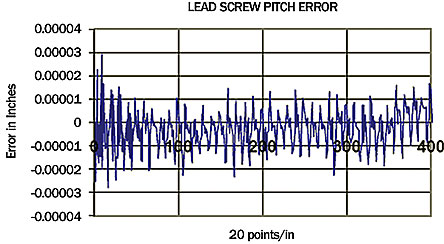


Measured lead screw pitch errors at an increment of 0.05 inch over 19-inch travel are shown. Source: Optodyne Inc.

Test Case

Using a LDDM-based laser calibration system with a high data rate PCMCIA interface card and an external trigger option, the data is collected nonstop and synchronous up to 10,000 data per second. A barometric pressure sensor, an air temperature sensor and a material temperature sensor for automatic compensation the speed-of-light change and material thermal expansion is standard with the laser system. The LDDM laser head was mounted on the table and the retroreflector was mounted on the spindle of a vertical machining center. A noncontact trigger was mounted on the post of a magnetic holder and a trigger blade was mounted on the rotating wheel.

A notebook PC with high speed PCMCIA card was used for data collection. A special cable connected the LDDM Processor box output to the PCMCIA card and the trigger signal was connected to the LDDM processor box. In the LDDM software main menu, the 2-D time base button is clicked for data collection setup. The data rate, time duration and external trigger were selected. The maximum speed is up to 5 meters per second, and the maximum data rate is up to 10,000 data per second. The data age, time between the trigger pulse and latched displacement reading, was less than 100 nanoseconds.

In the test, two LDDM laser heads were separated by 4.25 inches and aligned in the Y-axis direction. The displacement data were collected with conventional static data collection at an increment of 2 inches over an 18-inch travel. The maximum error is 0.020 inch and the backlash is 0.005 inch.

In the same setup, the displacement data were collected using the nonstop synchronized external triggers. Data were collected over five bidirectional runs with an increment of 0.2 inch over 19 inches.

The two sets of LDDM displacement data were collected nonstop synchronously and simultaneously. The angular errors can be calculated by the difference of the two displacement errors divided by the separation. The maximum angular error is 8.5 arcsec. The maximum straightness error is 0.00012 inch.

Compared to statically collected data, nonstop data collection indicates the result is similar but it has more detailed features. Using the displacement data to compensate the machine errors, the final parts accuracy may be better using the nonstop synchronized data than conventional static data. Furthermore, time is saved when using the nonstop synchronous data collection for small measurement increments and large machines. Q


Quality Tech Tips

• Nonstop measurement and data collection allows many more measurement points, which provides substantially more detail and still cuts the amount of run time.

• By using the dynamic displacement error table, instead of the static displacement error table, contouring accuracy in theory can be improved.

• The Windows-based metrology software supplied with the LDDM based system supports automatic and nonstop synchronous data collection, which reduces measurement time by up to 50% or more.

Share This Story

Looking for a reprint of this article?
From high-res PDFs to custom plaques, order your copy today!

Recommended Content

JOIN TODAY
to unlock your recommendations.

Already have an account? Sign In

  • 2024 Quality Rookie of the Year Justin Wise 1440x750px banner with "Quality Rookie of the Year" logo inset

    Meet the 2024 Quality Rookie of the Year: Justin Wise

    Justin Wise is an exceptional individual who has been...
    Aerospace
    By: Michelle Bangert
  • Man with umbrella and coat stands outside while it rains at night looking at a building.

    Nondestructive Testing: Is there an ethics problem?

    I was a whistleblower who exposed fraudulent activities...
    NDT
    By: Dale Norwood
  • Unraveling Deflategate: Football stadium with closeup of football on field

    Unraveling the Tom Brady Deflategate

    The Deflategate scandal erupted following the 2014 AFC...
    Measurement
    By: Greg Cenker and Henry Zumbrun
Manage My Account
  • eMagazine Subscriptions
  • Newsletters
  • Online Registration
  • Subscription Customer Service
  • Manage My Preferences

More Videos

Sponsored Content

Sponsored Content is a special paid section where industry companies provide high quality, objective, non-commercial content around topics of interest to the Quality audience. All Sponsored Content is supplied by the advertising company and any opinions expressed in this article are those of the author and not necessarily reflect the views of Quality or its parent company, BNP Media. Interested in participating in our Sponsored Content section? Contact your local rep!

close
  • Key Takeaways for Quality Leaders
    Sponsored byComplianceQuest

    Key Takeaways for Quality Leaders from the 2026 Gartner Magic Quadrant™ for QMS

  • This image shows a person seated next to a Bobcat T66 compact track loader.
    Sponsored byPolyWorks by InnovMetric

    Supercharging Digital Gauging at Bobcat North America

  • Dorsey Calibration Lab photo by Tom LaBarbera Picture this Studios
    Sponsored byDorsey Metrology International

    Ensuring Product Quality in a Competitive Manufacturing Landscape

Popular Stories

a titanium diaphragm speaker driver

The One Thing Elon Gets Right Is Designed to Scare You

This image shows a person seated next to a Bobcat T66 compact track loader.

Supercharging Digital Gauging at Bobcat North America

Dorsey Calibration Lab photo by Tom LaBarbera Picture this Studios

Ensuring Product Quality in a Competitive Manufacturing Landscape

2026 Quality Professional of the Year!

Events

June 9, 2026

Future-Proof your Quality Processes with Advanced 3D Optical CMM Technology

Discover how to effortlessly capture complex data, leverage true multi-sensor automation, and ensure continuous operation without creating inspection delays.

June 22, 2026

Automate 2026

Automate is North America's largest robotics and automation event — and the best place to take your ideas from insight to impact.
 
Our show floor features the world’s leading automation solutions, from AI and robotics to motion control, vision systems, and more. Plus, our educational conference is second to none, led by the brightest minds in automation today.
 
Ready to transform the way you work? Take the next step at Automate.
View All Submit An Event

Products

Lean Manufacturing and Service Fundamentals, Applications, and Case Studies

Lean Manufacturing and Service Fundamentals, Applications, and Case Studies

See More Products
Quality Podcast Channel Custom Content

Related Articles

  • Quality Software & Analysis: Calibration Software Evolves to Total Lab Management

    See More
  • QUALITY SOFTWARE & ANALYSIS: Size Up Gage Calibration Software

    See More
  • QUALITY SOFTWARE & ANALYSIS: Harnessing Real-Time SPC

    See More

Related Products

See More Products
  • certified.jpg

    The Certified Software Quality Engineer Handbook, Second Edition

  • The Quality Calibration Handbook

See More Products

Related Directories

  • QT9 Software

    QT9 QMS is a cloud-based, pre-validated quality management system that simplifies compliance with ISO, IATF and FDA standards. Automate document control, corrective actions, training, gage calibration and quality alerts while integrating seamlessly with your ERP. Eliminate spreadsheets, reduce risk and save time—so your team can focus on quality.
  • GAGEtrak Calibration Management Software

    GAGEtrak continues to be the world standard for calibration management software, not only for its versatility, longevity and countless auditor recommendations, but also for remaining on the cutting edge of technology. Don't compromise on your calibration management software; contact us today to see the difference true quality can make.
  • Quality Calibration Service Inc.

    QCS is an ISO/IEC 17025 - A2LA accredited full-service metrology lab providing gage calibration (all types and brands), CMM dimensional inspection, electronic test & measurement instrumentation calibration & repair, hand tool repair services and on-site calibration of major metrology & inspection gages / instruments. New gage & equipment sales.
×

Stay in the know with Quality’s comprehensive coverage of
the manufacturing and metrology industries.

Newsletters | Website | eMagazine

JOIN TODAY!
  • RESOURCES
    • Advertise
    • Contact Us
    • Directories
    • Manufacturing Division
    • Store
    • Want More
  • SIGN UP TODAY
    • Create Account
    • eMagazine
    • Newsletters
    • Customer Service
    • Manage Preferences
  • SERVICES
    • Marketing Services
    • Market Research
    • Reprints
    • List Rental
    • Survey/Respondent Access
  • STAY CONNECTED
    • LinkedIn
    • Facebook
    • YouTube
    • X (Twitter)
  • PRIVACY
    • PRIVACY POLICY
    • TERMS & CONDITIONS
    • DO NOT SELL MY PERSONAL INFORMATION
    • PRIVACY REQUEST
    • ACCESSIBILITY

Copyright ©2026. All Rights Reserved BNP Media, Inc. and BNP Media II, LLC.

Design, CMS, Hosting & Web Development :: ePublishing