Case Studies: Increasing Throughput with Lean Concepts
After attending a Lean 101 class, Joe Oakley, powdercoat team leader for Edmond, OK-based Pelco Products Inc., manufacturer of traffic signal hardware, structural poles, decorative lighting and utility hardware, knew he wanted to use lean in his department.
Joe Oakley, powdercoat team leader for Edmond, OK-based Pelco Products Inc., manufacturer of traffic signal hardware, structural poles, decorative lighting and utility hardware, knew he wanted to use lean in his department. After attending a Lean 101 class, Oakley returned to work and saw other departments and work cells implementing lean concepts all over the manufacturing floor at Pelco. The problem was he did not know where or how to start.
Oakley approached Pelco’s lean consultants from Argent Global Services (Oklahoma City, OK) and asked what he could do. “I wanted so badly to do something, because our department was viewed as the biggest bottleneck in the plant.” The lean team explained to Oakley that there was a plan in place to implement lean company-wide. Powdercoat was not at the top of the implementation list, and Oakley was told, “Use what you have learned. Don’t wait for a lean project to be facilitated for you.”
The results were impressive. Oakley’s team saw their daily totals go from painting less than 800 parts per day, with an occasional “great day” being around 1,000 pieces, to producing an average of 1,016 pieces per day. “We thought we had really done something great by using visual aids to create inbound and outbound lanes labeled with due dates on signs for each lane. Our throughput increased by more than 32%, and we eliminated more than 2.5 man-hours per day of searching for orders that needed to be painted,” says Oakley.

That day came in April 2007. Unfortunately, the timing was not in Oakley’s favor. A lean project led by Trevor Mann, senior engineer at Argent, started while Oakley was out on leave. When he returned a week later he did not recognize his powdercoat area. “The team had totally changed the way we were operating-the way we hung parts, the way we packaged some parts, even the way we were applying powder had changed. I was extremely frustrated. But Trevor stayed by my side and worked with me. He didn’t force things on me. He asked me questions and made me discover the answers for myself. Even my team worked with me to make sure I understood all the changes they had made in my absence,” explains Oakley.
“Every day it got a little easier. And then we thought we had it made. Our throughput numbers leveled out in the 1,500 to 1,700 parts per day range.” The improvements resulted in an average throughput increase of more than 52%. Supermarkets for the higher volume parts made it easier to hang and paint larger jobs at one time.
The results were a welcome relief to Oakley and his team. But there were still days when they had both the warehouse, which fed them parts, and the assembly cells pointing fingers directly at powdercoat. And there appeared to be a pattern forming. “We would get caught up, refill our supermarkets and clear the inbound lanes,” says Oakley. “And then, all of a sudden, we would be swamped, several days behind and not have a clue what had gone wrong. The frustration was returning and I didn’t know how to solve the problem.”
A meeting in July 2007 between Oakley, his team, the warehouse team leader, assembly team leader and the production manager, Kevin Shook, brought the issue to light. Shook explains, “I, along with our assembly and warehouse team leaders, had been trying to change powdercoat’s rules. In our desire to satisfy our customers and get orders out the door, we were demanding things of Oakley and his team that in hindsight didn’t really make sense.”
A 15-minute meeting and a little point kaizen went a long way in addressing powdercoating’s issues. The inbound lanes were changed. One lane for each of the three major paint colors was established. A fourth lane was added for “all other colors,” and a “hot lane” for late orders caused by parts shortages was set up next to the parts hanging station.
Each of the four color lanes is now worked one hour at a time. “Hot orders” are worked into the mix for that color at the beginning of each lane. Oakley also has the freedom to rearrange which lane is worked and in what order. The goal is to use the lean concept of EPE (the every part every interval) to run every color at least once each morning and once each afternoon during every 10-hour day.
The results have been dramatic. On the first day after the changes were made in July, the powdercoat cell produced 3,114 parts, a 91.6% increase over the previous daily average of 1,625 parts. On the second day after the change, the cell produced 4,712 parts. The cell began to settle down on the third day because the entire backlog had been eliminated. All these results were accomplished by the same seven-person team that had been struggling for several years.
But this is not the end of the story. Lean never ends and Oakley and his team know this. The team is already focused on taking it to the next level. “Our entire team wants to hit 5,000 parts in a day. We now have the knowledge and processes to do that. All we are waiting for is an increase in sales. Until then, we will keep our supermarkets full, the customer happy and wait for the increase that will result in a lower Takt Time and the signal to set another record. And it goes without saying that we will always look for a more efficient way to do our job.”
Point Kaizen. Improvements made at an individual process step, usually completed in less than one day.
EPE. Refers to the every-part-every interval, which is a measure of process size and length. For example, if a computer system is able to change over and produce all required checks, regardless of type (for example, accounts payable, payroll), during a three-week cycle, then the batch size for each individual check type is three weeks. Thus this process is covering every part every (EPE) three weeks.
Takt Time. The rate or time in which a completed product must be finished to meet customer demand.
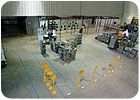
Through the implementation of lean concepts, Pelco’s powdercoat department raised its throughput from an average of less than 800 parts per day to an average of 3,429 parts per day.
Once considered the bottleneck of the company, the powdercoat department is now able to process parts arriving from the warehouse quickly, eliminating backlog.
When there are no orders waiting to be processed, the powdercoat team cleans and organizes the area.
What was once an area so full of pallets, totes and parts that it took a team member up to three hours per day to find orders is now an organized, visually controlled lean work cell. Source: Argent Global Services Inc.
Joe Oakley, powdercoat team leader for Edmond, OK-based Pelco Products Inc., manufacturer of traffic signal hardware, structural poles, decorative lighting and utility hardware, knew he wanted to use lean in his department. After attending a Lean 101 class, Oakley returned to work and saw other departments and work cells implementing lean concepts all over the manufacturing floor at Pelco. The problem was he did not know where or how to start.
Oakley approached Pelco’s lean consultants from Argent Global Services (Oklahoma City, OK) and asked what he could do. “I wanted so badly to do something, because our department was viewed as the biggest bottleneck in the plant.” The lean team explained to Oakley that there was a plan in place to implement lean company-wide. Powdercoat was not at the top of the implementation list, and Oakley was told, “Use what you have learned. Don’t wait for a lean project to be facilitated for you.”
The results were impressive. Oakley’s team saw their daily totals go from painting less than 800 parts per day, with an occasional “great day” being around 1,000 pieces, to producing an average of 1,016 pieces per day. “We thought we had really done something great by using visual aids to create inbound and outbound lanes labeled with due dates on signs for each lane. Our throughput increased by more than 32%, and we eliminated more than 2.5 man-hours per day of searching for orders that needed to be painted,” says Oakley.
Not Good Enough
“What we thought initially was going to be big, actually just increased our frustration,” says Oakley of the first lean attempt. “We were still being called the bottleneck. We didn’t know what to do. But we stuck to the plan and hoped a lean facilitator would soon come to lead us in a project.”That day came in April 2007. Unfortunately, the timing was not in Oakley’s favor. A lean project led by Trevor Mann, senior engineer at Argent, started while Oakley was out on leave. When he returned a week later he did not recognize his powdercoat area. “The team had totally changed the way we were operating-the way we hung parts, the way we packaged some parts, even the way we were applying powder had changed. I was extremely frustrated. But Trevor stayed by my side and worked with me. He didn’t force things on me. He asked me questions and made me discover the answers for myself. Even my team worked with me to make sure I understood all the changes they had made in my absence,” explains Oakley.
“Every day it got a little easier. And then we thought we had it made. Our throughput numbers leveled out in the 1,500 to 1,700 parts per day range.” The improvements resulted in an average throughput increase of more than 52%. Supermarkets for the higher volume parts made it easier to hang and paint larger jobs at one time.
The results were a welcome relief to Oakley and his team. But there were still days when they had both the warehouse, which fed them parts, and the assembly cells pointing fingers directly at powdercoat. And there appeared to be a pattern forming. “We would get caught up, refill our supermarkets and clear the inbound lanes,” says Oakley. “And then, all of a sudden, we would be swamped, several days behind and not have a clue what had gone wrong. The frustration was returning and I didn’t know how to solve the problem.”
A meeting in July 2007 between Oakley, his team, the warehouse team leader, assembly team leader and the production manager, Kevin Shook, brought the issue to light. Shook explains, “I, along with our assembly and warehouse team leaders, had been trying to change powdercoat’s rules. In our desire to satisfy our customers and get orders out the door, we were demanding things of Oakley and his team that in hindsight didn’t really make sense.”
A 15-minute meeting and a little point kaizen went a long way in addressing powdercoating’s issues. The inbound lanes were changed. One lane for each of the three major paint colors was established. A fourth lane was added for “all other colors,” and a “hot lane” for late orders caused by parts shortages was set up next to the parts hanging station.
Each of the four color lanes is now worked one hour at a time. “Hot orders” are worked into the mix for that color at the beginning of each lane. Oakley also has the freedom to rearrange which lane is worked and in what order. The goal is to use the lean concept of EPE (the every part every interval) to run every color at least once each morning and once each afternoon during every 10-hour day.
The results have been dramatic. On the first day after the changes were made in July, the powdercoat cell produced 3,114 parts, a 91.6% increase over the previous daily average of 1,625 parts. On the second day after the change, the cell produced 4,712 parts. The cell began to settle down on the third day because the entire backlog had been eliminated. All these results were accomplished by the same seven-person team that had been struggling for several years.
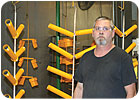
Joe Oakley of Pelco Products in front of some of the redesigned parts trees on the powdercoat line. Source: Argent Global Services Inc.
The Optimized Process
As of November 15, 2007, the powdercoat cell is averaging 3,429 parts painted per day. There is no backlog, and the warehouse is worried that because the lanes are not full they are not doing their job correctly. Oakley points out, “We are constantly reminding the order fillers in the warehouse that if we are doing our job correctly and they are balancing their order pulling to our speed, they won’t ever fill up the lanes. As long as we have some work sitting in a lane, we’re happy. And if there is no order sitting to be painted we immediately begin 5S activities (sorting, simplifying, sweeping, standardizing and sustaining) to clean up and organize the area and start talking to assembly, warehouse and sales about what the schedule looks like for the future. If things are slowing down over all, then it gives us the opportunity to shut down the ovens early, save some money as a company and possibly even do some maintenance work on the oven and track system, or do another lean event.”But this is not the end of the story. Lean never ends and Oakley and his team know this. The team is already focused on taking it to the next level. “Our entire team wants to hit 5,000 parts in a day. We now have the knowledge and processes to do that. All we are waiting for is an increase in sales. Until then, we will keep our supermarkets full, the customer happy and wait for the increase that will result in a lower Takt Time and the signal to set another record. And it goes without saying that we will always look for a more efficient way to do our job.”
- Argent Global Services Inc.
(800) 731-6388
www.argentglobal.com
Reply 12
Definitions
Supermarket. A controlled inventory that is used to supply a process with the next unit of work or parts for the next unit of work. Supermarkets usually have replenishment signals associated with them to signal automatic replenishment.Point Kaizen. Improvements made at an individual process step, usually completed in less than one day.
EPE. Refers to the every-part-every interval, which is a measure of process size and length. For example, if a computer system is able to change over and produce all required checks, regardless of type (for example, accounts payable, payroll), during a three-week cycle, then the batch size for each individual check type is three weeks. Thus this process is covering every part every (EPE) three weeks.
Takt Time. The rate or time in which a completed product must be finished to meet customer demand.
Benefits
Looking for a reprint of this article?
From high-res PDFs to custom plaques, order your copy today!