Quality Magazine logo
search
cart
facebook twitter linkedin youtube
  • Sign In
  • Create Account
  • Sign Out
  • My Account
Quality Magazine logo
  • NEWS
  • PRODUCTS
    • FEATURED PRODUCTS
    • SUBMIT YOUR PRODUCT
  • CHANNELS
    • AUTOMATION
    • MANAGEMENT
    • MEASUREMENT
    • NDT
    • QUALITY 101
    • SOFTWARE
    • TEST & INSPECTION
    • VISION & SENSORS
  • MARKETS
    • AEROSPACE
    • AUTOMOTIVE
    • ENERGY
    • GREEN MANUFACTURING
    • MEDICAL
  • MEDIA
    • A WORD ON QUALITY PUZZLE
    • EBOOK
    • PODCASTS
    • VIDEOS
    • WEBINARS
  • EVENTS
    • EVENT CALENDAR
    • IMTS
  • DIRECTORIES
    • BUYERS GUIDE >
      • Supplier Insights
    • NDT SOURCEBOOK
    • VISION & SENSORS
    • TAKE A TOUR
  • INFOCENTERS
    • Digital Quality Management Systems
    • NEXT GENERATION SPC & QUALITY ANALYTICS
  • AWARDS
    • ROOKIE OF THE YEAR
    • PLANT OF THE YEAR
    • PROFESSIONAL OF THE YEAR
  • MORE
    • Expert Columns
    • NEWSLETTERS
    • QUALITY STORE
    • INDUSTRY LINKS
    • SPONSOR INSIGHTS
  • EMAG
    • eMAGAZINE
    • ARCHIVES
    • CONTACT
    • ADVERTISE
  • SIGN UP!

Selecting Statistical Software for Six Sigma

By BNP Media Staff
December 30, 2008
This chart shows the contours of response surface for rocket propellant burn rate as a function of fuel, oxidizer and binder. This is from a mixture experiment described by Myers and Montgomery in “Response Surface Methodology: Process and Product Optimization Using Designed Experiments, 2nd edition,” Wiley, 2002. Source: StatPoint Technologies Inc.


Anyone who has been exposed to the fundamental concepts of Six Sigma knows the importance of the role statistical methods play in quantifying improvements in process quality. Inherent to the name is the concept that quality is related to variability, because the Greek letter sigma is the standard statistical notation used to represent the standard deviation of a probability distribution. Whether the variable of interest is the strength of a manufactured item or the waiting time at an ATM, quantification of variability is fundamental to the assessment of system quality. That job is usually delegated to a statistical package, of which there are many.

There are some important criteria that should be considered when selecting a statistical software package to use in Six Sigma programs. Choosing the right software package has a lot to do with the eventual success or failure of the Six Sigma initiative. If the wrong choice is made, operators will put the software aside after their training is finished and go back to business as usual.

Criterion 1: Background of Targeted Operators

Statistical software packages vary greatly in their assumptions about the operator’s background in mathematics and statistics. With some programs, operators without several courses in basic and advanced statistical methods will find it difficult to: (a) select the proper procedures for their particular data, and (b) interpret the statistical results after they have been calculated. Other programs provide tools to guide operators in selecting the proper methods, often through some type of wizard. Online statistical “advisors” then interpret the numerical results in simple language that does not assume the operator remembers everything they may have learned in their statistics classes.

When selecting a statistical package, be sure to ask:
  • Does the typical operator have a strong background in statistics?

  • Does the typical operator apply statistical methods frequently, or is analyzing data just one of many tasks he is asked to perform?

  • Are there enough statisticians and Master Black Belts available to help operators select the correct methods and interpret the results after the data have been analyzed? Or is a program needed that provides that help as part of the software?


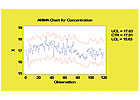
  • An ARIMA control chart is designed for monitoring data with a high sampling frequency. Such data violate the assumption of independence that is necessary when using a standard Shewhart chart. Source: StatPoint Technologies Inc.

    Criterion 2: Type of Data Commonly Analyzed

    Each statistical package tends to have a specific emphasis. Some are oriented toward engineering and manufacturing applications. Others put a heavy emphasis on uses in basic research and development. Still others are geared toward applications in the service industries. Because the type of data collected varies from one area to another, software packages tend to emphasize procedures for the type of data that the operators most frequently encounter.

    As an example, engineers tend to deal with two types of data: measurement data, such as tensile strength, and count data, such as numbers of defects. Operators in the service industries often deal with survey data. In research and development, there is a heavy emphasis on designed experiments. Amongst those in the financial and business communities, time series analysis and forecasting are frequently used.

    The software’s ability to deal with unusual data features that are expected to be encountered should also be evaluated. While all statistical packages include routines to handle data that is normally and independently distributed, packages vary quite a bit in their capabilities to handle data that do not meet the standard assumptions. Ask whether there are procedures to fit regression models when the data are discrete counts rather than continuous measurements. Are there procedures to handle censored data that might result from a measurement system with a lower limit of detection? Can the control charts handle data with a high sampling frequency, making the assumption of independence between successive data values invalid? If a manufacturer expects to encounter very small or very large datasets, for example, the program must have procedures to handle such applications.

    When selecting a statistical package, be sure to ask:

  • What types of data are operators most likely to encounter?

  • Is the package geared toward the type of applications seen most often?

  • What tools does the software have for dealing with data that do not follow the standard assumptions of normality and independence?

  • Can the software deal with very small or very large samples?


  • Criterion 3: Exploratory Data Analysis or Repetitive Data Processing

    John Tukey, a famous statistician, wrote a textbook many years ago titled “Exploratory Data Analysis.” Tukey presented many techniques he had developed that were designed to help individuals explore their data. With the advent of the PC, statistical packages were developed with similar goals of enabling an analyst sitting at a keyboard to try many different ways of examining his data in an effort to extract whatever information it held.

    This was in sharp contrast to traditional programs, which assumed that operators would develop a set of analyses that would later be repeated on many different datasets. Whereas programs developed for exploratory data analysis tend to function through dialog boxes and windows that are hot-linked to the data in other windows and instantly update if that data change, the more traditional packages rely on having a language in which programs can be developed, saved and later executed.

    With the advent of Web services, more analyses are being dynamically linked to data sources. Time series forecasts, capability indices, Pareto charts and the like can be placed on a Web page and made to change whenever new data become available.

    When selecting a statistical software package, be sure to ask:

  • If data are mined for information, how easily can multiple approaches with multiple options be tried? Is the software designed to help get answers while the operator sits at the PC, or will they end up writing programs to submit for execution?

  • If there are standard analyses that are run over and over again on different datasets, how easy is it to create and run a fixed set of procedures?

  • Can the analyses be structured so that they update automatically whenever the data change?


  • The ability to view information on a mobile device, such as this stability regression curve viewed using a Web browser, can be of great benefit to manufacturers. Source: StatPoint Technologies Inc.

    Criterion 4: Accessibility of Statistical Results

    After statistical analyses have been completed, the results need to be shared. Unless licenses will be purchased for everyone in the organization, this means that output needs to be transferred to other formats, such as PDF files, PowerPoint slides and Web pages that can be accessed from any Web browser. If companies frequently deal with colleagues in other countries, a package that makes it easy to translate the statistical results into other languages is a good option.

    When selecting a statistical package, be sure to ask:

  • How easy is it to create a report or presentation that can be shared with other colleagues?

  • Can the output be placed on a Web page so that anyone can view it using only a Web browser? Or does everyone need to purchase a license for the software?

  • Can operators access the results from anywhere using a mobile device?

  • How easily can the same analyses be created in other languages to share with colleagues in other countries?

    There are a large number of programs that can be used to perform the statistical calculations required in Six Sigma. However, not all programs are designed to support operators who do not do statistics every day. The type of guidance and advice built into packages that are designed for practitioners rather than statisticians and the ease of sharing those results can be the difference between a Six Sigma program that achieves real success and one that falls short. Q


  • Quality Online

    For more information on Six Sigma Software, visit www.qualitymag.com to read these articles:
    • “Accelerating Six Sigma Rollout”
    • “Digital Solutions Achieve Six Sigma”
    • “Six Sigma Software Generates Improvements”


    Tech Tips

    When selecting a statistical software package for use in a Six Sigma initiative, be sure to ask:

  • How strong a background in statistics does the typical operator have?

  • What types of data are operators most likely to encounter?

  • If data are mined for information, how easily can multiple approaches with multiple options be tried?

  • How easy is it to create a report or presentation that can be shared with other colleagues?
  • Share This Story

    Looking for a reprint of this article?
    From high-res PDFs to custom plaques, order your copy today!

    Recommended Content

    JOIN TODAY
    to unlock your recommendations.

    Already have an account? Sign In

    • 2024 Quality Rookie of the Year Justin Wise 1440x750px banner with "Quality Rookie of the Year" logo inset

      Meet the 2024 Quality Rookie of the Year: Justin Wise

      Justin Wise is an exceptional individual who has been...
      Aerospace
      By: Michelle Bangert
    • Man with umbrella and coat stands outside while it rains at night looking at a building.

      Nondestructive Testing: Is there an ethics problem?

      I was a whistleblower who exposed fraudulent activities...
      NDT
      By: Dale Norwood
    • Unraveling Deflategate: Football stadium with closeup of football on field

      Unraveling the Tom Brady Deflategate

      The Deflategate scandal erupted following the 2014 AFC...
      Measurement
      By: Greg Cenker and Henry Zumbrun
    Manage My Account
    • eMagazine Subscriptions
    • Newsletters
    • Online Registration
    • Subscription Customer Service
    • Manage My Preferences

    More Videos

    Sponsored Content

    Sponsored Content is a special paid section where industry companies provide high quality, objective, non-commercial content around topics of interest to the Quality audience. All Sponsored Content is supplied by the advertising company and any opinions expressed in this article are those of the author and not necessarily reflect the views of Quality or its parent company, BNP Media. Interested in participating in our Sponsored Content section? Contact your local rep!

    close
    • This image shows a person seated next to a Bobcat T66 compact track loader.
      Sponsored byPolyWorks by InnovMetric

      Supercharging Digital Gauging at Bobcat North America

    • Dorsey Calibration Lab photo by Tom LaBarbera Picture this Studios
      Sponsored byDorsey Metrology International

      Ensuring Product Quality in a Competitive Manufacturing Landscape

    • This image displays a Eddyfi Technologies Cypher portable inspection instrument alongside a scanner for non-destructive testing (NDT).
      Sponsored byEddyfi Technologies

      A Safer, Smarter Approach to Weld Inspection: Why Advanced Ultrasonic Testing Is Redefining Industry Standards

    Popular Stories

    MicroRidge MobileCollect wireless measurement system

    Before AI Can Help, the Data Has to Be Ready

    a titanium diaphragm speaker driver

    The One Thing Elon Gets Right Is Designed to Scare You

    This image shows a person seated next to a Bobcat T66 compact track loader.

    Supercharging Digital Gauging at Bobcat North America

    2026 Quality Professional of the Year!

    Events

    June 4, 2026

    Scaling Manufacturing Quality with Automation for Greater ROI

    If you need to do more with the same resources or build a new tech foundation, this session shows where to start and how to create a more efficient, scalable, cost-conscious quality process.

    June 9, 2026

    Future-Proof your Quality Processes with Advanced 3D Optical CMM Technology

    Discover how to effortlessly capture complex data, leverage true multi-sensor automation, and ensure continuous operation without creating inspection delays.

    View All Submit An Event

    Products

    Lean Manufacturing and Service Fundamentals, Applications, and Case Studies

    Lean Manufacturing and Service Fundamentals, Applications, and Case Studies

    See More Products
    Quality Podcast Channel Custom Content

    Related Articles

    • The Data Heads: Selecting Statistical Software for Six Sigma

      See More
    • Webinar: Making a Case for Six Sigma e-Learning

      See More
    • WCBF Announces Finalists for Six Sigma, Business Improvements Awards

      See More

    Related Products

    See More Products
    • 9780367782894.jpg

      Design for Six Sigma: A Practical Approach through Innovation

    • leaner.jpg

      Leaner Six Sigma: Making Lean Six Sigma Easier and Adaptable to Current Workplaces

    See More Products

    Related Directories

    • Six Sigma Concepts LLC

      Six Sigma Concepts manufactures the Discovery stand-alone metrology system and ORION 100% sorting systems which come with a flat or tilted platen. Our systems are accurate to within .0001". and can be used right on the shop floor. Our InGage Software can tackle threads and non-symmetrical features too!
    • SigmaXL Inc.

      Established in 1998, SigmaXL Inc. is a leading provider of user-friendly Excel Add-ins for Lean Six Sigma graphical and statistical tools and Monte Carlo simulation. SigmaXL has over 100,000 users in more than 180 countries. Customers include market leaders like DHL, FedEx, Hanes, Motorola, NASA, Sonoco, Southwest Airlines and Tyson Foods. SigmaXL software is also used by numerous colleges, universities, and government agencies.
    ×

    Stay in the know with Quality’s comprehensive coverage of
    the manufacturing and metrology industries.

    Newsletters | Website | eMagazine

    JOIN TODAY!
    • RESOURCES
      • Advertise
      • Contact Us
      • Directories
      • Manufacturing Division
      • Store
      • Want More
    • SIGN UP TODAY
      • Create Account
      • eMagazine
      • Newsletters
      • Customer Service
      • Manage Preferences
    • SERVICES
      • Marketing Services
      • Market Research
      • Reprints
      • List Rental
      • Survey/Respondent Access
    • STAY CONNECTED
      • LinkedIn
      • Facebook
      • YouTube
      • X (Twitter)
    • PRIVACY
      • PRIVACY POLICY
      • TERMS & CONDITIONS
      • DO NOT SELL MY PERSONAL INFORMATION
      • PRIVACY REQUEST
      • ACCESSIBILITY

    Copyright ©2026. All Rights Reserved BNP Media, Inc. and BNP Media II, LLC.

    Design, CMS, Hosting & Web Development :: ePublishing