Get More Out of Your CMM

Graphic part-to-CAD comparison charts highlight local geometry deviation. Source: Metris
Sheet metal spring back and plastic part shrinkage illustrate that product quality concerns the entire shape of parts and not just a few geometric features. Even for a limited number of measurement points, coordinate measuring machines (CMMs) require considerable programming overhead. In addition, tactile measurement falls short on soft and fragile parts. Economic pressure and higher quality standards force the metrology department to provide more detailed geometric information in less time.
To a certain extent, three- and five-axis tactile scanning overcomes the limitations of discrete touch-trigger measurements. High-speed bridge CMMs equipped with this advanced touch sensor speed up dimensional inspection on prismatic driveline parts. Characterizing a drilled hole by scanning a spiral line on its bore surface reveals more valuable information than four discrete points. Also on the aerofoil surface of a turbine blade and other freeform surfaces, five-axis analog scanning is an improvement compared to traditional tactile inspection. Although analog scanning provides more data, elaborated CMM programming is required to ensure that the probe tip continuously follows the part surface without colliding with the part or the CMM structure.
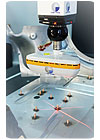
By digitizing the full geometry of complex “Christmas tree” features, car manufacturers verify the positioning of these features multiple times faster. Source: Metris
Boosting Productivity
New innovations in laser scanning technology and point cloud processing software are key enablers of an entirely digital inspection process. The concept of digitizing parts up front and running inspection on the digital copies of the samples streamlines metrology operations and embeds them into the CAD-centric design-through-manufacturing process. From measurement preparation to final report, this approach is significantly faster, provides more profound insight, and takes advantage of the typical flexibility and automation benefits of a digital process.A laser scanner essentially projects a precision laser stripe on a specimen while its built-in digital camera captures the projected laser line under a fixed angle. Today’s digital line scanners with advanced CMOS camera technology offering impressive point resolution and image acquisition rates capture more than 75,000 non-interpolated points per second. As they reconcile high point cloud density with tremendous scanning speed, they accurately digitize freeform surfaces and geometric features at high speed. Line scanners with a smaller field of view suit detailed inspection of smaller parts by offering measurement accuracy down to 5 microns.
To effectively scan surfaces with varying color or high reflectivity, laser scanners dynamically adapt laser source intensity point-per-point. This capability is essential in dealing with different sample materials and surface finishes without operator interaction or powder spraying, also for shiny surfaces and abrupt transitions under any lighting condition. Intelligent intensity adaptation helps automatically scan similar parts in different manufacturing stages-initially dealing with bare sheet metal parts and finally scanning finished products painted in any color.
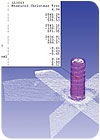
Digital line scanners reconcile high point cloud density with tremendous scanning speed. Source: Metris
3-D Geometry in a Single Scan
Line scanners may be stretched to their limits when digitizing parts with more complex surface shapes or numerous geometric features. For such applications, manufacturers better opt for a multi-line scanner, known as a cross scanner that incorporates three lasers in a cross pattern. These scanners realize full coverage on extremely concave surfaces, in between ribs and inside the cavities of deep pockets. By observing geometric features from three sides, a cross scanner is able to digitize the bore of a hole or the flanges of a notch in a single scan. A cross scanner enables full 3-D digitizing of features such as slots, notches and edges as well as specialized geometric features, including connection pins, welded bolts and T-studs.Where tactile measurement relies on a handful of accurate points to define the orientation of an elongated feature, optical inspection does a better job by fitting lines through hundreds of points acquired along the feature flange. In this way, geometric features can be extracted from the acquired point cloud with higher confidence and accuracy.
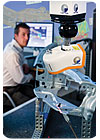
By observing a part from three directions, a cross scanner captures complex surfaces and features in a single scan. Source: Metris
Reducing CMM Time
Thanks to high scanning speed and short scanner motion paths with limited or no head indexing, laser scanners digitize freeform surfaces and geometric features in a fraction of the time.At car manufacturers, cross scanners automate the inspection of so-called “Christmas tree” features. Robots weld these complex metal features on sheet metal body parts to allow trim to be easily and securely connected by screws. In roughly 5 seconds, a cross scanner digitizes the complete geometry of a single Christmas tree feature in order to determine its actual welding position. Scanning avoids hours of manually mounting cylindrical extensions on the Christmas trees required for tactile measurement and removing them afterward. With laser scanning, the entire CMM inspection process is executed more than 10 times faster.
High standoff distance and field-of-view depth enable cross scanners to save time when inspecting automotive casted parts. To take a full 3-D scan of one side of an engine block, cylinder head or gearbox cover, the CMM only needs to move the scanner along parallel motion paths without indexing the head. With such limited CMM overhead, the scanner captures the complete surface, including full 3-D characteristics of ribs, holes, flanges and pockets, at record speed. One hour is sufficient to set up and execute inspection, whereas detailed tactile inspection often lasts more than a day.
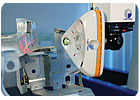
A scan macro is automatically being generated using point cloud simulation. Source: Metris
Reducing Inspection Preparation Time
Besides inspection cycle time reductions, laser scanning offers additional productivity gains. Considerable CMM time can be saved by programming a CMM off-line, allocating CMMs exclusively for serial inspection. Furthermore, laser scanning preparation is more straightforward than specifying individual touch sensor points for a tactile inspection job. It suffices to move the scanner along linear and polygon motion paths to keep part surfaces within the boundaries of the field-of-view depth of the laser scanner probe. Interactive software procedures offer a helping hand by streamlining the creation of scan macros.Clicking on a computer-aided design (CAD) surface area triggers the automatic generation of a scan path with optimum probe angles. Virtual point cloud simulation reveals where to generate additional scan paths for surface areas falling outside the scanner’s field of view.
Point cloud simulation also serves another important purpose. Obtaining the point cloud as if it would be acquired on a CMM enables operators to prepare the downstream analysis and reporting workflow before even switching on the CMM.
Flexible Analysis
A complete scan consists of a dense cloud of hundreds of thousands or even millions of accurate surface points covering the entire part, including potential anomalies that remain unnoticed through touch probing. Point cloud processing automatically filters the data and meshes the point cloud. The point cloud or mesh is then aligned with nominal CAD geometry using best-fit, feature-align or another method of choice. Graphic reports include part-to-CAD comparison plots with color-coded areas marking local geometry deviation and GD&T information comprising of pass/fail status and tolerance data. They indicate where molding and stamping equipment need adjustment, or illustrate how flush and gap evolves along complete spines between mating hood and front fender parts. Interactive reports can be evaluated from different viewpoints and underlying metrology data can be consulted by clicking any location of interest.The digital inspection process quickly delivers go/no-go status while keeping the acquired data available for more in-depth analysis should this be desired, even if the physical part is no longer available in the metrology lab.
Increased Productivity
As laser scanning provides complete and detailed 3-D data requiring minimum preparation and measurement time, it can provide insightful information sooner in every stage of the design-through-manufacturing process. This results in fewer iterations and shorter cycle times. Laser scanning responds to vehicle designers requesting that their manually tuned prototypes are converted into CAD overnight. A few hours are sufficient for a dual-horizontal-arm CMM equipped with laser scanners to generate a digital model of the full car.Setting up a plastic injection molding machine to start producing plastic trim components is a complex and tedious process that requires multiple iterations. Graphic part-to-CAD comparison charts obtained by digitizing first prototype samples instantly reveal how process settings can be optimized best in order to reduce the number of costly iterations.
Also when starting up new assembly lines, laser scanning enables car manufacturers to save time and cost. They virtually assemble digitized sheet metal body parts in order to identify potential part fitting issues before bringing together the physical parts from multiple remote fabrication plants. Besides eliminating expensive checking fixtures, they succeed in reducing time-to-market for new car models, increasing competitive edge in the fiercely competitive automotive industry.
Laser scanning not only brings increased productivity to the CMM lab, it also enables the metrology department to contribute to the success of the entire design-through-manufacturing process. Laser scanners can be retrofitted easily on any existing CMM installation, requiring limited capital while the return on investment can be significant. Q
Quality Online
For more information on laser scanning, visit www.qualitymag.com to read the following articles:“3-D Laser Scanning Accelerates Inspection”
“Laser, A Practical Tool for Inspection"
“Lasers Pinpoint Measurement"
Tech Tips
Looking for a reprint of this article?
From high-res PDFs to custom plaques, order your copy today!