Quality Test & Inspection: Laser Doppler Vibrometers Rewrite the Book
Laser vibrometry is rewriting how today’s engineers measure vibration in the lab, on the production floor and in the field.
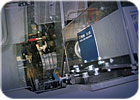
There are many ways to measure vibration, but when the item to be measured is very hot, very cold, small, easily damped, requires a large number of measurement points, is vibrating at ultrasonic frequencies or is physically inaccessible, collecting the data becomes much more challenging. Laser doppler vibrometers are extremely accurate and are an excellent tool to address any of these situations.
The laser doppler vibrometer is increasingly finding its place in R&D labs, the finite element analysis (FEA) verification process, the quality control department, on the production floor and as a maintenance tool. Laser doppler vibrometers are accurate enough to be used as a calibration reference source, and with a frequency response range starting just above DC and with the ability to measure up to 1.2 GHz, they have a wide range of uses.
Laser light does not have a resonant frequency so laser vibrometers have a flat response curve, and because they only touch the measured object with a light beam, it does not matter if the target object is hot, cold or easily damped.
With a scanning vibrometer, hundreds or thousands of data points can be measured far quicker than using any other method, and if the part is small, the laser can be routed through a lens (similar to a magnifying glass) or even through a microscope to measure on microscopic objects.
Single point industrial vibrometers are used in production testing because of their long life, accuracy and two-year calibration cycle, but mainly because they are easy to design into the test process, easy to install and easy to set up.
An advantage of using a laser in production test applications is the laser can be aimed in such a way that the normal act of mounting the part in the test fixture is all that is necessary to position the part to ready it for the vibration measurement. There is no need for expensive automatic robotic arms, or manual attachment of the sensors. Lasers are the sensor of choice for this type of application because the only thing that touches the part is a light beam.
If necessary, the laser can even be aimed through a window into a test chamber. This light beam can be aimed at a small target area that is in a confined space and it will still measure accurately. The laser’s ability to measure is not affected by the texture of a rough casting such as a turbocharger housing or engine block for a car, or by smooth surfaces such as an injection molded pump housing for a washing machine or a dishwasher.
Measuring for excessive vibration on the production floor as a pass/fail stage is just one application. There are many products that require a specific vibration frequency and amplitude for the product to work correctly, such as ultrasonic welders, vibrating razors, ultrasonic scent or medical dispersion systems, and vibrating surgical instruments.
Vibration measurement can be added at any stage in the production line, without changing how the line operates, making it an advantage of using lasers in production environments.
The measuring principle of a laser doppler vibrometer dictates that it cannot measure shape; this comes in particularly handy when measuring on a rotating shaft. This means the shaft can have scratches, be out of round or even have rust on the measuring surface, and the laser will ignore these physical flaws in the shaft and will only measure the shaft motion.
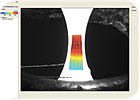
Seeing the entire part move in high definition, as opposed to seeing just data or seeing a few points of interest, adds a whole new level of understanding to the data. Manufacturers of hard disk drives have been using this data to optimize the design of the cantilever arm that holds the read-write head.
Manufacturers of home appliances such as washers, dryers and dishwashers use this data to make their products quieter. Companies that manufacture circuit boards use this data to improve the layout of their boards, particularly when these boards contain motion sensors or are experiencing wire bonds that are breaking.
A 3-D scanning laser uses three lasers measuring at exactly the same point to measures in-plane as well as out-of-plane movement. The in-plane motion can be used to calculate dynamic stress and strain. This is helpful when trying to characterize the dynamic strain of high temperature alloys.
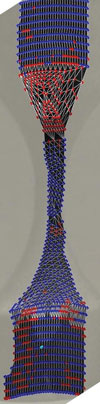
The scanning laser not only outputs highly detailed data that traditional strain gages cannot match, but it also can measure well above the maximum temperatures where strain gages fail, for example, >800 C.
The combination of these two advantages makes this a tool for measuring stress and strain on new alloy materials. In a demonstration of this capability, 1,122 data points were placed on a test sample that is 1.5 inches high and ⅜ inch wide, where the main area of interest was ¼ inch wide and ½ inch high. Measurements were taken at room temperature to prove the values matched strain gage values. The part was then heated to 850 C to collect the data desired.
The time required to measure 6,000 points is now less than one man day, making high resolution measured data, which looks like finite element models, now possible. The combination of using the same sensor for every data point, not touching or altering the measured part, and the high resolution data, all combine for very high modal assurance criteria (MAC) values.
In a blind comparison of a laser vibrometer vs. accelerometer to generate FEA verification data, approximately the same time was used to generate both sets of results. The measurement object was a right side engine cover from a motorcycle. The accelerometer measurements had MAC values of 0.64 and 0.41, and anything over 0.6 was considered a good MAC value.
The scanning vibrometer had MAC values of 0.99, 0.96, 0.93, 0.89 and 0.80.
In other FEA verification testing, laser vibrometry continued to show these high MAC values. These high MAC values mean that fewer iterations are needed to bring a part from concept to production. This equates to less time from concept to production and less cost.
Finite element models can be accurate, almost to the point where some companies feel they can skip the verification stage. As the frequencies of interest increase, or the part complexity increases, the need for verification becomes more important. The use of bonding agents in manufacturing also has increased the need for FEA verification. These bonding agents can have different structural characteristics based on their thickness or their temperature, and failing to verify a model can result in making assumptions about that bond that may not be valid.
During the past decade, dramatic improvements and innovations in the field of laser vibrometry have taken place. Laser vibrometers are becoming the sensor of choice on production machines and in the lab. Their accuracy, flat response curves and dynamic range make them desirable as single point sensors, and their ability as scanning units to render high definition data and images quickly is unequalled. In many ways the doppler laser vibrometer is rewriting how today’s engineers measure vibration.
Single point industrial vibrometers are used in production testing because of their long life, accuracy and two-year calibration cycle, but mainly because they are easy to design into the test process, easy to install and easy to set up.
An advantage of using a laser in production test applications is the laser can be aimed in such a way that the normal act of mounting the part in the test fixture is all that is necessary to position the part to ready it for the vibration measurement.
Laser vibrometers are portable, can measure from a safe distance and can measure directly on bearing housings or on a rotation shaft.
An advantage of using a laser in production test applications is the laser can be aimed in such a way that the normal act of mounting the part in the test fixture is all that is necessary to position the part to ready it for the vibration measurement. There is no need for expensive automatic robotic arms or manual attachment of the sensors. Source: Polytec Inc.
There are many ways to measure vibration, but when the item to be measured is very hot, very cold, small, easily damped, requires a large number of measurement points, is vibrating at ultrasonic frequencies or is physically inaccessible, collecting the data becomes much more challenging. Laser doppler vibrometers are extremely accurate and are an excellent tool to address any of these situations.
The laser doppler vibrometer is increasingly finding its place in R&D labs, the finite element analysis (FEA) verification process, the quality control department, on the production floor and as a maintenance tool. Laser doppler vibrometers are accurate enough to be used as a calibration reference source, and with a frequency response range starting just above DC and with the ability to measure up to 1.2 GHz, they have a wide range of uses.
Laser light does not have a resonant frequency so laser vibrometers have a flat response curve, and because they only touch the measured object with a light beam, it does not matter if the target object is hot, cold or easily damped.
With a scanning vibrometer, hundreds or thousands of data points can be measured far quicker than using any other method, and if the part is small, the laser can be routed through a lens (similar to a magnifying glass) or even through a microscope to measure on microscopic objects.
The scanning laser not only outputs highly detailed data that traditional strain gages cannot match, but it also can measure well above the maximum temperatures where strain gages fail. In this demonstration, 1,122 data points were placed on a test sample that is 1.5 inches high and 3⁄₈ inch wide, where the main area of interest was ¼ inch wide and ½ inch high. Measurements were taken at room temperature to prove the values matched strain gage values. The part was then heated to 850 C to collect the data desired. Source: Polytec Inc.
Production Testing
In production testing the part under test must be easily indexed to the next part coming down the line. Wires and cables often become a maintenance issue particularly if they must move with each part change. Shocks to other vibration sensors during mounting can result in damage to the sensor. The tradeoff between making a machine that can easily load and unload the parts for testing normally has an indirect relationship with how easily the sensor can be mounted. This is not true for laser vibrometers as they require no contact.Single point industrial vibrometers are used in production testing because of their long life, accuracy and two-year calibration cycle, but mainly because they are easy to design into the test process, easy to install and easy to set up.
An advantage of using a laser in production test applications is the laser can be aimed in such a way that the normal act of mounting the part in the test fixture is all that is necessary to position the part to ready it for the vibration measurement. There is no need for expensive automatic robotic arms, or manual attachment of the sensors. Lasers are the sensor of choice for this type of application because the only thing that touches the part is a light beam.
If necessary, the laser can even be aimed through a window into a test chamber. This light beam can be aimed at a small target area that is in a confined space and it will still measure accurately. The laser’s ability to measure is not affected by the texture of a rough casting such as a turbocharger housing or engine block for a car, or by smooth surfaces such as an injection molded pump housing for a washing machine or a dishwasher.
Measuring for excessive vibration on the production floor as a pass/fail stage is just one application. There are many products that require a specific vibration frequency and amplitude for the product to work correctly, such as ultrasonic welders, vibrating razors, ultrasonic scent or medical dispersion systems, and vibrating surgical instruments.
Vibration measurement can be added at any stage in the production line, without changing how the line operates, making it an advantage of using lasers in production environments.
Field Maintenance Analysis
Predictive maintenance requires moving from one measurement data location to the next quickly and collecting valid data. If any of these data locations are in areas that would be dangerous to access when the machinery is operating, the solution traditionally involved installing multiple permanently mounted sensors. It does not take long for the price of the sensors, cables, switchboxes and labor to become a major expense. Laser vibrometers provide a solution because they are portable, can measure from a safe distance and can measure directly on bearing housings or on a rotation shaft-something an accelerometer cannot do.The measuring principle of a laser doppler vibrometer dictates that it cannot measure shape; this comes in particularly handy when measuring on a rotating shaft. This means the shaft can have scratches, be out of round or even have rust on the measuring surface, and the laser will ignore these physical flaws in the shaft and will only measure the shaft motion.
Seeing the entire part move in high definition, as opposed to seeing just data or seeing a few points of interest, adds a whole new level of understanding to the data. Manufacturers of hard disk drives have been using this data to optimize the design of the cantilever arm that holds the read-write head. Source: Polytec Inc.
R&D Labs
Laboratory use of laser vibrometers normally involves a scanning vibrometer. The scanning vibrometer is essentially a single point vibrometer that utilizes galvanic mirrors to redirect the laser beam to different measurement locations. The scanning vibrometer allows a grid containing hundreds or thousands of measurement points to be placed on a part and then measured automatically, providing discrete data and visually modeled ODS images so the operator can quickly and easily see how the entire part moves.Seeing the entire part move in high definition, as opposed to seeing just data or seeing a few points of interest, adds a whole new level of understanding to the data. Manufacturers of hard disk drives have been using this data to optimize the design of the cantilever arm that holds the read-write head.
Manufacturers of home appliances such as washers, dryers and dishwashers use this data to make their products quieter. Companies that manufacture circuit boards use this data to improve the layout of their boards, particularly when these boards contain motion sensors or are experiencing wire bonds that are breaking.
A 3-D scanning laser uses three lasers measuring at exactly the same point to measures in-plane as well as out-of-plane movement. The in-plane motion can be used to calculate dynamic stress and strain. This is helpful when trying to characterize the dynamic strain of high temperature alloys.
The scanning laser not only outputs highly detailed data that traditional strain gages cannot match, but it also can measure well above the maximum temperatures where strain gages fail, for example, >800 C.
The combination of these two advantages makes this a tool for measuring stress and strain on new alloy materials. In a demonstration of this capability, 1,122 data points were placed on a test sample that is 1.5 inches high and ⅜ inch wide, where the main area of interest was ¼ inch wide and ½ inch high. Measurements were taken at room temperature to prove the values matched strain gage values. The part was then heated to 850 C to collect the data desired.
FEA Verification
FEA verification is simplified with the use of laser vibrometry. Because lasers do not touch the part, no dummy weights are needed; therefore, the part is measured in its real condition and no mass damping takes place.The time required to measure 6,000 points is now less than one man day, making high resolution measured data, which looks like finite element models, now possible. The combination of using the same sensor for every data point, not touching or altering the measured part, and the high resolution data, all combine for very high modal assurance criteria (MAC) values.
In a blind comparison of a laser vibrometer vs. accelerometer to generate FEA verification data, approximately the same time was used to generate both sets of results. The measurement object was a right side engine cover from a motorcycle. The accelerometer measurements had MAC values of 0.64 and 0.41, and anything over 0.6 was considered a good MAC value.
The scanning vibrometer had MAC values of 0.99, 0.96, 0.93, 0.89 and 0.80.
In other FEA verification testing, laser vibrometry continued to show these high MAC values. These high MAC values mean that fewer iterations are needed to bring a part from concept to production. This equates to less time from concept to production and less cost.
Finite element models can be accurate, almost to the point where some companies feel they can skip the verification stage. As the frequencies of interest increase, or the part complexity increases, the need for verification becomes more important. The use of bonding agents in manufacturing also has increased the need for FEA verification. These bonding agents can have different structural characteristics based on their thickness or their temperature, and failing to verify a model can result in making assumptions about that bond that may not be valid.
During the past decade, dramatic improvements and innovations in the field of laser vibrometry have taken place. Laser vibrometers are becoming the sensor of choice on production machines and in the lab. Their accuracy, flat response curves and dynamic range make them desirable as single point sensors, and their ability as scanning units to render high definition data and images quickly is unequalled. In many ways the doppler laser vibrometer is rewriting how today’s engineers measure vibration.
Tech Tips
Looking for a reprint of this article?
From high-res PDFs to custom plaques, order your copy today!


