Measurement: Multisensor Metrology Comes of Age
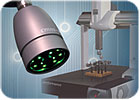
Multisensor CMMs may include a video sensor on an articulating head. Source: Hexagon Metrology Inc.
If one was to ask a typical metrology insider what multisensor metrology means, one is likely to get a variety of answers. An unscientific survey at a recent metrology training class proves the point. When asked to explain the topic, the students’ answers included “multiple ways to probe a part,” “using part temperature sensors,” “a machine that has multiple uses” and “different mechanisms inside the probe.” The reality that the term is not intuitively understood points to the fact that this area of metrology deserves some explanation.
Historically, when manufacturers talked about multisensor measurement, this strongly implied a vision-type machine that had one or more additional sensors, such as a touch probe or a laser point probe. Thus, multisensing could be as simple as combining vision and touch probing on a single machine, a capability that has been around for many years. However, in recent years the exploding variety of probing technologies has pushed this description to encompass many different kinds of measurement devices, from traditional coordinate measuring machines (CMMs) to vision machines-as long as they contained more than one type of sensor.
The reality of multisensor metrology today is best described as hardware and software capability and inspection technique, and not a specific type of metrology platform. In fact, various types of convergence means multisensor technology has made different types of metrology platforms more similar-and more capable-than ever.
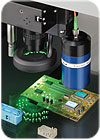
A vision based multisensor platform that includes (from left to right) touch probe, camera and white light sensor. Source: Hexagon Metrology Inc.
Platform Convergence
As mentioned above, traditional vision-based measurement platforms have incorporated multiple types of sensors for years. One might call them the original multisensor platforms. Some high-end systems are literally bristling with four or more different types of sensors, from vision to touch and various types of contact and noncontact scanning probes.Recently, with the advent of interchangeable noncontact probes for traditional CMMs, CMMs of all sizes and configurations-from small bridges to the largest gantries sporting touch, analog scanning, laser line and even video probes on the same system-are readily available.
In many cases, similar or identical sensors are available on both platforms. Basic sensor types that may appear on either type of platform include:
Vision: A camera-based sensor that measures using the pixels in the camera image.
Touch trigger: A sensor that returns a single measurement point by touching the part.
Analog scanning: A sensor that moves a tip over the surface of the part and returns a dense line of measurement points.
Laser point: A noncontact sensor that returns single points of data via a laser beam.
Laser line: A noncontact sensor that sweeps a laser line over the part to return many points of data.
White light: A noncontact sensor that uses a focused white light, or light of all wavelengths, to return a highly precise measurement point of a fine surface.
It might seem obvious that if a system has multiple types of sensors, one could use them in a single inspection program-leveraging the relative advantages of each type of sensor on a complicated part. However, this has not always been the case, either because the software could not support a multiple sensor setup, or the hardware could not, requiring multiple controllers on the same machine.
It also is generally the case that each type of platform still has its optimal uses. The vision platform is much better than a CMM for smaller parts where the majority of features are two-dimensional. The traditional bridge CMM is better for parts that are on the larger side and have three-dimensional features on multiple faces.
However, with the advent of multiple sensors, it is becoming more common that the capabilities of the two types of platforms are becoming more and more similar. Since this is the case, smart operators are learning to leverage the benefits of both platforms, and in some instances, even use both platforms in combination on the same parts.
CAD Integration and Programming
Since the majority of manufactured parts these days are designed in computer-aided design (CAD) software, most inspection software is CAD-integrated. The greatest advantage to CAD integration is the ease of programming, with the simplicity of point-and-click addition of features to inspect. Some software even allows one to click and drag to add whole groups of features at once-this is a huge time-saver on 2-D parts typical for vision systems.Ironically, the world of 2-D vision-based inspection has been late to incorporate CAD into its software, and as a result, software that has its roots in CMMs have the edge in CAD integration and utility.
A multisensor system should have the ability to program all of the sensors from the CAD model in the same programming environment. Having to switch between different software packages to use different sensors defeats the purpose of multisensor inspection. The capability to program directly from CAD also is essential to be able to develop part programs offline. Not having to program on the machine allows it to stay productive inspecting parts, instead of acting as a programming aid. Offline programming capability allows the simulation of an inspection routine, so one can get an idea of what will happen before the part is ever placed on the machine.
Cross Platform Software Compatibility
It is now possible to use the same measurement software package for both a CMM and a vision system. This has advantages beyond the most obvious benefit of a shorter learning curve and more flexibility in the programming staff. With common software it is possible to develop part programs offline from CAD and then use the same part program on either a vision platform or a CMM platform. Taking this idea one step further, it is possible to design a part program that is split into two segments, with inspection starting on one type of machine and then moving the part to another-with a common inspection report as the result.One example of a hybrid application might be turbine blades that are inspected on a traditional CMM for speed, accuracy and access to the geometric features, and then moved to a vision-based machine to visually inspect the cooling holes. With cross-platform software, these functions can be programmed offline with the same software from the same CAD model, even though the inspection functions will be performed on different physical platforms with different types of sensors.
The Application Drives Sensor Combinations
Since one can use multiple sensors in a single inspection routine, the choice of sensor combinations and technique can be driven by the application requirements. The best example of this is simply matching the data density required with the sensor, so taking low density data-such as touch probe-in areas where simple geometry is sufficient, and using a higher density collector-such as laser scanning-where knowledge of form is necessary, such as on a complex contour.However, sometimes managing the tradeoffs between multiple sensor types and the desired application can take a surprising turn, as in this real-world example: A manufacturer wishes to scan the contours of a surface with high density data (100 thousand points), at a very high accuracy (15 microns), very quickly (10 seconds). One hundred percent inspection was desired.
Here’s the tradeoff:
Laser Scanning. Density: Yes; Speed: Yes; Accuracy: No.
Analog Scanning. Density: Yes; Accuracy: Yes; Speed: No.
A multisensor machine can carry both types of sensors, but neither the individual sensors nor combining the two sensors in a single program will accomplish the goal. What is the solution? In this case, the answer was a multisensor CMM with a large physical table, where many parts could be set up on easy load pallets, using a laser sensor as a process capability go/no-go gage to monitor process variability. This allows many parts to be scanned quickly, even though the overall accuracy was not optimal. When feedback from the system indicates variability outside specified limits, the CMM automatically switches to the slower, but more accurate analog scanning probe to perform a high-precision inspection for further analysis.
In this case the combination of table size (the ability to set up hundreds of parts at once), multiple sensors and the ability to programmatically vary the inspection process allows a multiple sensor device to be used in a novel way.
Multisensor inspection has moved clearly into the mainstream and is here to stay. Advances in software, sensors and hardware platforms along with the key ingredient of integration have made multisensor systems more capable and useful than ever. The sophisticated metrology user now has more choices and capabilities to improve productivity and efficiency in inspection departments. Q
Quality Online
Visit www.qualitymag.com for more information on multisensor measurement, such as these features:“ABCs of Multisensor Measurement”
“Multisensor Measurement- Making Sense of It All”
“Multitasking with Multisensor Measurement”
Tech Tips
Since one can use multiple sensors in a single inspection routine, the choice of sensor combinations and technique can be driven by the application requirements.It is now possible to use the same measurement software package for both a CMM and a vision system.
Multisensor metrology today is best described as hardware and software capability and inspection technique, and not a specific type of metrology platform.
Looking for a reprint of this article?
From high-res PDFs to custom plaques, order your copy today!