Measurement: The Metrology Training Dilemma
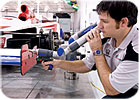
Verifying the position of aerodynamic parts on race cars was a difficult task before Andretti Autosport began using a precision mechanical arm. Source: Faro Technologies
Editor’s note: This article is an excerpt from Stephen Kyle’s white paper presentation given at the 2010 Coordinate Metrology Systems Conference (CMSC).
In the realm of metrology, there is a wide variety of instrumentation used for portable coordinate measurement (PCM) and large volume metrology (LVM). A precision mechanical arm captures accurate 3-D points and surfaces from a race car. A laser beam tracks a wireless probe, held by the operator and used to check critical dimensions on an automobile body. A photogrammetry system inspects the three-dimensional features of an aircraft door. A handheld laser line scanner is tracked by an imaging system as it builds up the surface shape of a car door. These high-precision dimensional measurement systems can be brought on site to help build, check and reverse engineer a wide range of large, manufactured objects.
These measurement technologies are not new. Many mobile optical systems delivering 3-D shape were developed by shrinking down mapping systems configured to measure large land masses and optimizing them for car bodies and aircraft wings. This shrinks down the error, too, and produces systems which can accurately measure to a few tenths of millimeters or a few tens of micrometers. Early applications of industrial photogrammetry (precise measurement from multiple images) or industrial surveying (precise measurement from multiple theodolites) date from around 1970.
Developments in electronic imaging and processing have since turned industrial photogrammetry into a range of sophisticated vision metrology tools and extend the multiple imaging methods into structured light triangulation systems for detailed measurement of surface form. Surveying systems have moved from multiple theodolite intersection systems to widespread use of single instrument systems based on industrial total stations (theodolites with built-in laser distance measurement) and the more recent developments, in the 1990s, of laser trackers and large volume spherical scanning systems.
The 1970s and 1980s also saw the development of articulated arm coordinate measuring machines (AACMMs), often called more simply CMM arms. The very high accuracy of conventional 3-axis coordinate measuring machines (CMMs), housed in specially built, climate-controlled rooms, was then complemented by the lower accuracy but more flexible CMM arm which could be taken to an operator’s workbench.
More choice is provided by systems such as the indoor Global Positioning System (iGPS) and the automation of what, until recently, have been mostly manually operated systems.
Clearly these are high-tech systems in regular use in high-tech and high-value industries. The biggest professional group to concern itself with the technologies of PCM and LVM is the Coordinate Metrology Society (CMS), based in the United States.
Last year, the CMS made a survey of industrial users, which produced the interesting result that around 66% of users who responded came from the aerospace and 20% from the automotive sectors. That may cover most of the applications at present, but it leaves plenty of room for growth in other smaller sectors where there are challenging tasks in coordinate metrology. We can expect portable coordinate metrology to increase its base.
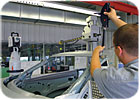
A handheld laser line scanner is tracked by an imaging system as it builds up the surface shape of a car door. Source: Leica Geosystems/Hexagon Metrology
The Metrology Training Dilemma
Is there a problem and can it be solved? Yes, there is. And, yes, it can. PCM and LVM now encompass a large body of knowledge. Their tools are critical to manufacturing success, but to make effective use of a high-precision metrology system, one needs to understand how it works, how to squeeze the best performance out of it, how to choose the optimal one for the application and what to do if something goes wrong-which never ever happens at a good time, does it?Customers also get demanding. They want proof that a manufacturer can deliver on the promise to measure dimensions smaller than the average human hair, so there is a need to know how to test a system’s performance, calibrate it if necessary and demonstrate that its output can be traced all the way back to the standard unit of length, the meter. A big help here would be certification and some independent recognition that people have the skills to do this.
These issues are only solved with a detailed knowledge of the technology. Unfortunately, it has not been easy to find a course of instruction or a good book from the library in order to acquire this. For most experts, it is on-the-job training and a certain amount of learning by trial and error. This is not efficient, nor cost effective, but things are looking up.
The CMS itself has a committee working to define the body of knowledge covered by PCM and LVM. This does not, for example, give the details of how a particular system works, but does identify the areas to be filled by a database of detailed knowledge.
On a more direct level, one member organization of that committee launched an entry-level course of instruction in portable coordinate measurement systems (PCMS) last year. This is the UK’s National Physical Laboratory (NPL), like NIST in the United States and the Physikalisch-Technische Bundesanstalt (PTB) in Germany, is responsible for maintaining national metrology standards.
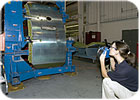
A photogrammetry system inspects the 3-D features of an aircraft door. Source: Geodetic Systems Inc.
Basic Training Courses
NPL develops training courses in metrology, both dimensional and nondimensional, at four distinct levels.Level 1 is an entry-level course for users of metrology who learn to question what they do.
The second level is designed for appliers of metrology who must select and implement solutions.
Level 3 is tailored for developers of metrology championing new solutions to problems.
Level 4 training is for definers of metrology who create those new measurement solutions. Level 4 gets a little stratospheric, and is fine for a master’s degree or advanced technology workshop, so most of the training is focused on levels 1 and 2.
NPL has already developed courses at level 1 and 2 for core dimensional metrology. These teach the important basics: measurement uncertainty, standards and traceability, coordinate systems and the use of simple, everyday instruments such as micrometers. The training curriculum progresses to full 3-D and the detailed understanding of portable coordinate measuring systems.
NPL has now created a new two-day PCMS Level 1 course that is already operational. The first day of the course consists of presentations mixed with system demonstrations or videos. Day 2 of the course concentrates on practical tasks. This course takes a 3-D view of the world and introduces the most commonly used PCMS tools. These have been identified as CMM arms, laser trackers and some vision metrology systems.
The practical work is defined in outline, not in detail, and its actual implementation is decided by the training course deliverer who sets up to three tasks for the students. In gaining this valuable hands-on experience, the students also learn to evaluate the working environment and plan, execute and report on a measurement job.
PCMS Level 2 is not yet operational, but the presentation material has been drafted. Level 2 completes the overview of current PCMS with background material on legacy theodolite systems and a review of a range of specialized technologies such as iGPS, 6-D laser tracking, single camera systems, hybrid and automated systems.
The presentations finish with a discussion of the performance evaluation of systems. Practical work is likely to be difficult to achieve with more specialized systems and perhaps increased use of video presentations is required. These are open issues still to be decided.
The core metrology courses and the PCMS Level 1 have all achieved accreditation and, in the UK at least, students who successfully attend the courses obtain a formal qualification.
There are several ideas for courses at Level 3. One hot topic is the measurement of surface form for which many systems of different design and concept exist. The technology is still undergoing extensive development and performance measurement of surface scanners, for example, is currently limited and in need of improvement. This would certainly be a worthwhile topic at Level 3.
Good reference material is still in short supply and an accessible knowledge base of PCMS would be an excellent tool to complement training courses, support self-learning and provide the basic material behind the body of knowledge defined by the Coordinate Metrology Society.
If portable coordinate metrology is your business, join the party and contribute your ideas. Q
Tech Tips
High-precision dimensional measurement systems can be brought on site to help build, check and reverse engineer a wide range of large, manufactured objects.There is a need to know how to test a system’s performance, calibrate it if necessary and demonstrate that its output can be traced all the way back to the standard unit of length.
A detailed knowledge of the technology has not been easy to come by.
Looking for a reprint of this article?
From high-res PDFs to custom plaques, order your copy today!