Resonant Inspection Increases Quality

Not only does PCRT streamline the production process, it also enables Remington to detect deviations in machine tooling. Source: Magnaflux Quasar Systems
Maximizing product output and production efficiency without compromising quality is a cornerstone for any successful manufacturing company. A company’s reputation and brand perception in part rests on its ability to produce a quality product consistently and efficiently over time. Remington Arms, founded in 1816 in upstate New York, is one of the nation’s oldest continuously operating manufacturers of firearms as well as one of the largest rifle and shotgun makers in the world. As such, there is a lot riding on the company’s reputation.
The 90 employees at Remington Arm’s Mayfield Firearms Plant (Hickory, KY) assemble, inspect and ship more than 130,000 rimfire and centerfire rifles a year to major distributors and retailers. With such a large volume of firearms in production, Remington’s Engineering Manager Gerald Vicars is well aware of the need to work as efficiently as possible while simultaneously ensuring a rock-solid grip on quality control. “The major concern driving our use of NDT is that structurally weak barrels are identified as early in the work flow as possible, maximizing process yield and minimizing the cost of production,” explains Vicars.
Barrel Manufacture
While outside suppliers provide some of the components used in the rifles made at the Mayfield plant, the parts that are most critical to the rifles’ accuracy, safety and durability are machined in-house. The rifle manufacturing process begins when the bar stock used for the gun barrels is received at the plant. The bar stock is cut to the correct length, drilled then rifled, which refers to the process that forms a helix-shaped pattern of lands and grooves into the barrel that cause the bullet to rotate in flight, stabilizing the trajectory. The next stop for the barrels is the computer numerical control (CNC) machine, where the outside profile is machined and the barrels are chambered. Finally, sections of the barrels are induction heat-treated to increase hardness. According to Vicars, it is at this step in the manufacturing process where flaws in the barrels can occur. “Barrels can develop fractures and material flaws from the heat-treating process,” explains Vicars. “If the heat treating is done incorrectly, it can cause hairline fractures in the material.” Other problems that can occur as the metal is heated are dimensional variances in the rifle bore, chamber and the various holes that are drilled in the barrel. If the material expands, contracts or changes shape beyond the required tolerances, the barrel is ruined and cannot be used.
The switch to PCRT allows Remington to both cut inspection and material handling labor. Source: Magnaflux Quasar Systems
NDT Barrel Testing
Because the heat-treatment process is a primary source of defects, the next step is nondestructive testing for each barrel. The Mayfield production line had long relied on magnetic particle inspection (MPI) as the primary method of NDT for detecting hairline cracks in the barrels. However, there are several drawbacks to the MPI process.In MPI, as the barrels come down the assembly line, a technician takes each one to a separate testing station, where the part is chemically cleaned, locally magnetized then dipped in magnetic particle fluid. The part is carefully wiped down and held under a black light for a visual inspection by the operator, who looks for hairline cracks or fractures. While this method works reasonably well for detecting cracks that extend to the surface of the barrel, it gives no information about hidden cracks, dimensional changes or missing features that might have occurred. Furthermore, MPI, though relatively straightforward in its procedure, is labor intensive due to material handling and manual inspection, requires disposal of used cleaning and testing fluids and usually results in the test station accumulating a “bank” of barrels that have just been tested or are about to be tested. But perhaps its biggest downside is that it is entirely dependent on a visual observation and judgment made by a human inspector, which introduces human error into the process.
Recognizing the need for improvement, the Mayfield plant enlisted Magnaflux Quasar Systems (Albuquerque, NM) to install one of its process compensated resonant testing (PCRT) test stations to improve the efficiency of the NDT phase of production. “This facility began using the Quasar NDT in 2001 when we added our centerfire production,” explains Vicars.
PCRT is an advanced form of resonant inspection (RI) that measures several resonances for each part that is being tested, comparing those resonant patterns against a reference data set made from known good barrels. Typically RI is sensitive to batch variation, or normal variations in the process that shift the frequency patterns and make frequent recalibration necessary. PCRT, however, calculates the effect of this process variation, so the resonance patterns can be adjusted, revealing the true underlying pattern. This true pattern is compared against the reference data set, reliably revealing any structural or dimensional defects that might not be found until the barrel had passed on to other stages of the process, which would increase cost and reduce overall yield.
Remington installed a single Quasar PCRT system at the Mayfield plant; it is comprised of the workstation, which contains the computer, display and support electronics, and the test station. The PCRT unit was integrated directly into the production process to further streamline operations. Rather than having to take the barrels to a separate MPI station for inspection and then bring them back to the assembly line, one worker now performs the heat treating as well as the subsequent NDT testing in one area. According to Vicars, this increased efficiency has contributed to higher throughput of barrels through the shop. “The primary impact on our process has been the inspection of barrels in a lean flow,” explains Vicars.
As the gun barrels come down the assembly line, the operator of the PCRT unit places a barrel on the test station fixture and then initiates the test by a push button. About 6 to 8 seconds later, either a green bar for a good part or a red bar for a bad part is displayed on the workstation. This test time compares favorably with that of MPI, which requires several minutes to handle, process and test a gun barrel. If the part is good, the operator places it on the assembly line so it can continue down the manufacturing process; if it is bad it is placed in a reject bin. “We trained the Quasar system to use several resonances on each barrel to ensure there are no cracks,” says Vicars. To make sure that all scrapped barrels are actually bad, the reject bin is re-tested with MPI in a batch process to verify that there were no false rejects that might be put back into production.
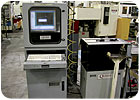
The PCRT testing station functions in-line, eliminating the need for off-line testing. Source: Magnaflux Quasar Systems
PCRT Success
On an immediate scale, the implementation of Quasar’s PCRT system means lower labor costs thanks to a more efficient testing method that eliminates material handling and testing time. It also has had a positive impact on material costs, which were lowered due to the elimination of the “bank” of parts at the MPI test station. In addition, the plant increased yields because of the reduced instances of false negatives-good barrels incorrectly identified as bad-and elimination of false positives-bad parts incorrectly classified as good.PCRT also has enabled the plant to maintain a history that allows it to analyze trends in the machining of the barrels. For example, if there were a trend toward consistent changes in dimensions as the barrels were machined, it would probably mean that the tooling needed to be replaced in order to maintain the engineering specifications. The Quasar unit allows Vicars and his technicians to pick up on these trends early on and correct them before they become a serious problem.
“There are several benefits that Remington has realized from PCRT,” says Vicars. “The least of which is the ability to check barrels without creating a step in the process that would require us to batch. Our big gain is that we have been able to maintain a history that allows us to analyze trends, have a much cleaner operation and detect problems other than cracking.”
- Magnaflux Quasar Systems
(505) 247-9660
www.quasarintl.com
Reply 38
Benefits
Looking for a reprint of this article?
From high-res PDFs to custom plaques, order your copy today!


