Infrared Thermography Advances

This mosaic image is composed of a number of smaller images; all can be viewed and modified at the same time using special software processing. Source: Thermal Wave Imaging
Infrared thermography is the science of detecting and measuring variations in heat emitted by an object and transforming them into visible images. It is a rapidly developing technology for nondestructive testing (NDT) in many applications. Recent advances in imaging equipment allow for more rapid data acquisition and higher spatial resolution, thus opening up new areas of application.
The primary benefit of thermal NDT has always been locating thermal differences and anomalies. In the past, the thermal image was recorded by photography or videotape-now data is stored as digital, electronic files, generally in the form of an image. The recorded image serves as a baseline measurement for comparison with later inspections. It also can be used to document faults and defects and as the basis for follow-up for maintenance service.
Infrared thermography can detect numerous conditions in which an anomaly is characterized by an increase or decrease in surface temperature or retained residual heat. These include high resistance heating of connection points in electrical systems; heat generated by abnormal friction in bearing surfaces; differences in heat transfer across an insulated surface, such as a wall or boiler; and moisture retained in insulation in a roofing system. Infrared imaging, when combined with software analysis tools, may also be used to quantify these types of thermal differences.
The use of thermography has grown rapidly in the aerospace industry in the past decade. As more composite materials are used, the need to monitor the quality of both their production and maintenance has increased. Traditional methods, such as radiography and ultrasonics, have been the mainstays of composite inspection to date. Although effective for inspecting composites with a variety of flaws, these methods can be both expensive and time-consuming in many situations.
Radiography requires access to both sides of the component and presents concerns about handling radiation sources. Ultrasonics requires direct contact with the part or the use of a couplant such as water, and at times it may require the part to be submerged, possibly resulting in fluid ingress. While both methods are useful, their limitations have slowed their use in the industry.

The center phase connector of this 480V breaker is warm due to abnormal resistance. Source: The Snell Group
The component being inspected is typically heated from one side and viewed from either the same side or the opposite side depending on the situation and requirements. The heat application must be relatively uniform throughout the area being inspected. Evenly applied heat energy promotes unidirectional heat flow through the material perpendicular to the surface. Uniform heating is best accomplished using any of several proven sources such as hot air guns, heat lamps or flash lamps.
As with all NDT technologies, it is essential to design and build inspection standards that prove the viability of both the inspection test method and the specific inspection procedure; these standards also are used to validate the calibration and operational protocol of the inspection process, as well as to characterize the signatures of typical discontinuities to be located.
When a thermal gradient exists within a component, the movement of heat energy from the heated surface into the cooler component is a function of the material’s thermal diffusivity. Thermal diffusivity describes the ratio of the material’s thermal conductivity to its thermal capacitance. In a component in thermal equilibrium with its environment, the direction of heat flow, after the application of heat to the front surface, is theoretically unidirectional, from the front surface to the back surface. The heat will diffuse throughout the component until it encounters a discontinuity.
Most flaws are discontinuities having thermal properties that differ from the base material in the composite structure. A delamination, disbond or void will typically have a lower rate of thermal conductivity, resulting in heat being temporarily trapped over the discontinuity. This build-up of heat results in the surface of the component over the discontinuity becoming warmer, indicating the location and approximate size of the discontinuity. High capacitance flaws, such as the ingress of water or other fluids into the composite structure, result in a cooler surface over the flaw area soon after heat is applied to the surface.
There are several specific techniques used to detect subsurface flaws in aerospace components with infrared thermography. The differentiation among methods is based primarily on how heat energy is transferred into the component. These methods can be loosely classified as passive, active, active-pulse thermography and vibrothermography.
The exact methodology selected depends on several factors including the thermal characteristics of the part to be inspected; the types, sizes and orientation of flaws to be found; the method of inducing heat to the component; the sensitivity and spatial resolution of the infrared (IR) imager; and the budgetary constraints with respect to the total system cost.

High capacitance flaws result in a cooler surface over the flaw area soon after heat is applied to the surface. Source: Thermal Wave Imaging
Vibrothermography
Vibrothermography, which employs the use of induced ultrasonic waves into the component, has shown its ability to detect surface and near-surface cracks that conventional NDT thermography simply cannot detect. In this method the ultrasonic waves cause vibrations within the crack, resulting in a frictional heating.With recent advances in high-speed data capture, new attention has been given to this method, which was first used in the early 1980s. Although this method has shown conclusive results in effectively finding cracks in a variety of materials, specific procedures and test limitations are still under development. Packaged systems are now available that integrate a high-speed thermal imager, ultrasonic transducer, digital storage and image processing.

An F-18 Carbon-Epoxy Honeycomb Panel with induced flaws is shown here. Source: Thermal Wave Imaging
Passive Thermography
In passive thermography, the part or component is inspected during or after it has gone through a thermal operational cycle. This thermal cycle could be part of the manufacturing process or part of the normal operation of the aerospace component. An example of this would be inspecting an aircraft for water ingress immediately after it lands from a high altitude. The water, having a high thermal capacitance, would remain cooler than surrounding material for a period of time, allowing for the thermal inspection of the component.Another example of passive inspection is in the manufacture of components that go through a thermal process such as autoclave curing. If a part is inspected immediately as it emerges from the thermal cycle, it may be possible to observe comparative thermal images. In the automotive industry glue bonding of laminate and composite materials is commonly inspected with thermal imaging systems.
The key to passive thermography is that the inspector must be at the right place at the right time. This could be easy to set up in a manufacturing situation with an automated thermal system, but can be more challenging with transient thermal occurrences such as the landing aircraft. Another concern with passive thermography is that the thermal cycle the component goes through may be different each time, thus yielding inconsistent results.
Passive thermography should not, however, be quickly dismissed, as it presents unique opportunities to inspect large areas of aircraft quickly without taking the aircraft out of service. It is most effective when looking for strong thermal indications that have persistence, such as water or other fluid ingress. This method does not require expensive radiometric imaging equipment. Simpler, nonradiometric imaging systems are more than adequate for this work.

Composite Radome Surface damage-early image. Source: Thermal Wave Imaging
Active Thermography
Active thermography involves the intentional heating or cooling of the surface of the component by the thermographer to induce a thermal gradient into the object. Heating sources include hot air guns, quartz lamps or any other source of heat that can be controlled by the thermographer. The sun also can be used by bringing the vehicle or component into its presence for a prescribed amount of time. The component is then either moved out of the sun or shaded.Advantages of active thermography are that the thermographer has more control of the thermal cycle than in the passive method. This is important because the thermographer can control when the thermal cycle will be initiated, as well as match the intensity and the duration of the applied heat to the thermal characteristics of the component. In thermally slow materials-materials that are made of thick or poor thermal conductors-this is especially useful. This method is most appropriately used to find thermal flaws presenting persistent indications. Data can be saved to videotape which allows for less costly post-processing.
If repeatable results are required, great care must be taken to input consistent amounts of heat during each inspection. While this method works well on thermally slow materials with relatively deep or thermally persistent flaws, it may not be effective for identifying flaws in thin or thermally fast materials. Normal operation may involve two people, the thermographer and an assistant who operates the heating system and manipulates the inspected component.

Water incursion-later image. Source: Thermal Wave Imaging
Pulse Active Thermography
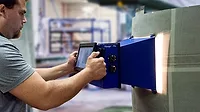
If there has been one thing that has held back thermal NDT from being recognized as a mainstream NDT method, it is the lack of repeatability and automation. All of that has changed in the past several years with the maturation of pulse active thermography.Most of today’s active systems are composed of several components, including an IR camera with high spatial resolution; integrated, high-power xenon flash lamps to provide heat; and a computer to capture and process the thermal data. Regardless of what label is used-pulse, flash or thermal wave thermography-this method is now widely used for both production and repair of commercial and military aerospace components.
When the flash lamps discharge, the pulse of light energy is absorbed by the surface of the component. As the heat conducts and diffuses into the component, numerous images are captured at rates of up to 500 frames per second. The thermal properties of the material and the amount of computer memory resident on the computer determine the image capture frame rate. It is common to average a series of consecutive images together to decrease noise and improve image quality.
Powerful software analysis in combination with trained and qualified operators allow for the detection of flaws in thin and highly conductive materials. Transient thermal events, presenting themselves for only hundredths of a second, can readily be detected. Because the entire process takes only a few seconds, the area covered by a single flash pulse-up to about 3 square feet-can be inspected in a short time. The biggest advantage of pulse thermography is that it delivers highly repeatable results due to the uniformity of the heat input and the high-speed image capture.
As with any NDT method, considerable testing and validation is required to establish a reliable test procedure to detect flaws in critical components. Both Boeing and Airbus have approved pulse active thermography for performing an NDT evaluation on commercial aircraft.
In recent years, Thermal Wave Imaging Inc. (Ferndale, MI) has developed Thermographic Signal Reconstruction (TSR), a process where the computer image data from the infrared camera is “reconstructed” into a mathematical representation of the temporal response of each detector element of the IR camera array. This methodology improves the ability to resolve deeper and more subtle subsurface features, and also performs quantitative measurement.
TSR, when combined with the ability to stitch together sequential images of a component, has played a significant role in the growth of thermography in real-world manufacturing and in-service inspection applications. A composite image can be created showing each flaw at its optimum thermal contrast in the entire component. In addition, the system can be fully integrated with robotics to control the movement and placement of the flash head. Post processing of images now allows automated measurement of both flaw size and depth. It is this type of automation that holds great promise for pulse active thermography to become a mainstream NDT method.
Thermal NDT methods have continued to evolve with the advancements in thermal imaging and image processing. Although passive and active methods will continue to be used successfully on appropriate materials, the future growth in thermal NDT will be in automated systems performing repeatable inspections. The aerospace industry will continue to expand its use of thermal NDT by increasing the validation process for greater numbers of composite and other structural materials. NDT
Looking for a reprint of this article?
From high-res PDFs to custom plaques, order your copy today!