Smart Cameras Get Smarter
Today’s intuitive software takes smart cameras to the next level.
Smart cameras provide many benefits in an array of applications, including 1-D and 2-D code reading, robot guidance, assembly verification and package inspection. Each of these applications is well suited for smart cameras because in each scenario the smart camera must perform independently of other application processes-using a processor dedicated to image analysis-to carefully perform inspections and ensure that no defect is missed. With this design, a smart camera can capture an image and notify a reject mechanism, when necessary, in a reliable and deterministic manner. However, for some of today’s more complex application environments-such as those requiring dynamic lighting control, complex measurements, surface flaw detection and multiple interfacing cameras-certain smart cameras may not provide a complete solution.
Traditionally, smart cameras have used preset, easy-to-configure onboard tools that were specialized in a few functions. PC vision was used to solve the more complex applications. This involved taking cameras from one vendor, interfacing hardware from other vendors and writing custom code. Today, that is changing-and these changes are distinguishing smart cameras from “smarter cameras” in an array of machine vision applications.
An additional benefit is reliability. Because smart cameras contain few or no moving parts, they are less prone to mechanical wear and subsequent hardware failure, as well as better equipped to handle harsh environments. This reliability also extends into overall operations. Because smart cameras have a dedicated processor in each unit, they are well suited for manufacturing line inspections requiring multiple cameras. With this arrangement, if one camera malfunctions, it does not affect the other cameras; conversely, if a PC vision system experiences a malfunction, the entire system will likely be thwarted.
PC vision, although more complex to integrate and at times prone to reliability issues, offers operators the flexibility to program the precise inspection parameters needed for their distinct application. These systems use complex algorithms usually written in code by a programmer-facilitating custom inspections, but requiring a specially trained individual for setting parameters. The simple-to-use software traditionally offered by most smart cameras did not allow for the flexibility of creating a solution tailored to a specific application.
Due to the variety of applications and ongoing innovations that differentiate one manufacturing process from the next, inspection needs are commonly becoming unique to a single task. Though two machine vision applications may involve inspecting the same part, each manufacturer may require different inspection criteria, such as product size or surface defects. Many also employ different communication protocols-such as MODBUS, serial communications or TCP/IP-and different user interfaces. For instance, some companies want their operators to have access to all inspection parameters, while others prefer more limited access.

Smarter cameras merge the ease-of-use advantages of a smart camera with the programming flexibility once reserved for PC vision solutions. These cameras provide configuration through a software design that allows operators to drag and drop algorithms into an inspection program without writing lines of complex code. With this design, engineers without an extensive programming background can set up and modify inspections using simple software tools. By taking complex, advanced algorithms and making them easy to set up and deploy, these smarter cameras place sophisticated inspection capabilities within reach for operators at virtually all levels and applications.
Smarter cameras also may use an integrated development environment (IDE) programming style. Similar to some programming languages used on PCs, these IDEs allow the operator to design and debug the programming code and, when finished, view the graphical interface that operators will view during the application process. This software includes several features that deliver increased functionality. Event-driven tasks, for example, allow certain algorithms to run on some event other than an application image, such as receiving serial data, a TCP/IP string or a separate electrical trigger. Algorithms can be simply applied in multiple ways using features such as subroutines, which allow frequently used algorithms to be employed in several areas of the program, and looping, to call certain algorithms multiple times in sequential order.
To assist users in applying the inspection data, a branching feature allows operators to make necessary decisions during image processing. This is possible because the program can take information from one tool and determine which set of logic should be executed based on that information. This data can then be shared between algorithms or presented to an outside device such as a PLC or monitor. It is here that the true flexibility comes into play with smarter cameras: operators can add or manipulate data from almost any section of the program and apply the resulting algorithms in whatever program area desired-allowing engineers to efficiently customize their logic. In addition, the IDE often includes scripting ability so that programmers can write lines of code when desired.
To enhance the usability of the IDE, smarter cameras offer access to a variety of algorithms prepackaged in tools, which can be selected from a tool pallet and dropped into the programming logic. Tools include edge find for detecting edges in the attained image; blob analysis for finding like-colored connected pixels; locate to search an image for a known feature; pattern find to identify a taught pattern within a search area; and template for comparing a trained “golden” image with the current image the smart camera has attained from the application.
This logic is built like an outline. Each tool can access application data from the other tools, saving configuration time. After the tool is dropped into the logic, the software allows the operator to set up the tool through a step-by-step process, and each tool can be tested individually or together as a single task. After the software outline is built, they can then switch from the programming design to the display. The display allows the engineer to see all tools, along with the image, in one view. This makes debugging and program modifications much simpler.
Due to these advances, smarter cameras are solving applications that were once reserved to PC vision solutions, plus other applications that were not possible before. To help distinguish between the many cameras on the market, the Automated Imaging Association (AIA) has divided the smart camera market into three segments. These segments are based on the competitive advantages and disadvantages of each offering, including price, program flexibility, processing power and camera resolution.
Segment one generally contains cameras that provide a lower price but fewer features. Segment two cameras come with a higher price but offer increased functionality. Segment three contains a similar price bracket to segment two but includes models with further enhanced features.
Few smart camera families offer models that satisfy all segments, but smarter cameras now are available at all levels-for example, a segment one smarter camera provides a lower price and, while offering fewer features than segment two or three offerings, still provides high functionality and capabilities compared to traditional smart cameras at this level.
With these new software features, smarter cameras allow operators to combine the integrated design benefits of smart cameras with comprehensive software capabilities to provide high reliability and cost-effective inspection results. Faster to integrate and easier to program, with the flexibility to tackle applications ranging from simple to complex, smarter cameras can deliver an excellent solution for adding quality and value to virtually any manufacturing line. V&S
Smarter cameras merge the ease- of-use advantages of a smart camera with the programming flexibility once reserved for PC vision solutions.
These cameras provide a software design that allows users to drag and drop algorithms into an inspection program without writing lines of complex code.
With this software design, engineers without an extensive programming background can set up and modify inspections using simple software tools.
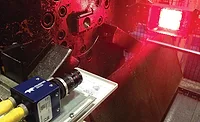
Smart cameras combine image acquisition, processing and several interfaces in an all-in-one design for simple installation and use. With few or no moving components, the cameras additionally provide reliable operation. Source: PPT Vision
Smart cameras provide many benefits in an array of applications, including 1-D and 2-D code reading, robot guidance, assembly verification and package inspection. Each of these applications is well suited for smart cameras because in each scenario the smart camera must perform independently of other application processes-using a processor dedicated to image analysis-to carefully perform inspections and ensure that no defect is missed. With this design, a smart camera can capture an image and notify a reject mechanism, when necessary, in a reliable and deterministic manner. However, for some of today’s more complex application environments-such as those requiring dynamic lighting control, complex measurements, surface flaw detection and multiple interfacing cameras-certain smart cameras may not provide a complete solution.
Traditionally, smart cameras have used preset, easy-to-configure onboard tools that were specialized in a few functions. PC vision was used to solve the more complex applications. This involved taking cameras from one vendor, interfacing hardware from other vendors and writing custom code. Today, that is changing-and these changes are distinguishing smart cameras from “smarter cameras” in an array of machine vision applications.
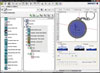
Smarter cameras that use an integrated development environment (IDE) programming style allow users to efficiently design programming code using algorithms prepackaged in tools. Using an IDE, engineers can develop customized programs without writing lines of complicated code. Source: PPT Vision
The Smart Camera Solution
A smart camera is an integrated machine vision system that incorporates image acquisition, a processor and multiple interfaces within a compact, single-package hardware design. The all-in-one design is a key benefit of smart cameras, as they involve few components and minimal installation time. This makes the cameras generally less expensive than alternative PC vision solutions, which require several auxiliary components to integrate.An additional benefit is reliability. Because smart cameras contain few or no moving parts, they are less prone to mechanical wear and subsequent hardware failure, as well as better equipped to handle harsh environments. This reliability also extends into overall operations. Because smart cameras have a dedicated processor in each unit, they are well suited for manufacturing line inspections requiring multiple cameras. With this arrangement, if one camera malfunctions, it does not affect the other cameras; conversely, if a PC vision system experiences a malfunction, the entire system will likely be thwarted.
PC vision, although more complex to integrate and at times prone to reliability issues, offers operators the flexibility to program the precise inspection parameters needed for their distinct application. These systems use complex algorithms usually written in code by a programmer-facilitating custom inspections, but requiring a specially trained individual for setting parameters. The simple-to-use software traditionally offered by most smart cameras did not allow for the flexibility of creating a solution tailored to a specific application.
Due to the variety of applications and ongoing innovations that differentiate one manufacturing process from the next, inspection needs are commonly becoming unique to a single task. Though two machine vision applications may involve inspecting the same part, each manufacturer may require different inspection criteria, such as product size or surface defects. Many also employ different communication protocols-such as MODBUS, serial communications or TCP/IP-and different user interfaces. For instance, some companies want their operators to have access to all inspection parameters, while others prefer more limited access.
Smarter cameras provide a wide variety of algorithms prepackaged in tools, which are chosen from a tool pallet and dropped into the logic. Source: PPT Vision
Becoming Smarter
To meet these demands, smart cameras needed to adapt-essentially, they needed to become smarter. Thus, the true differentiator between a traditional smart camera and the new smarter camera is the software, or what might be called the brain of the camera.Smarter cameras merge the ease-of-use advantages of a smart camera with the programming flexibility once reserved for PC vision solutions. These cameras provide configuration through a software design that allows operators to drag and drop algorithms into an inspection program without writing lines of complex code. With this design, engineers without an extensive programming background can set up and modify inspections using simple software tools. By taking complex, advanced algorithms and making them easy to set up and deploy, these smarter cameras place sophisticated inspection capabilities within reach for operators at virtually all levels and applications.
Smarter cameras also may use an integrated development environment (IDE) programming style. Similar to some programming languages used on PCs, these IDEs allow the operator to design and debug the programming code and, when finished, view the graphical interface that operators will view during the application process. This software includes several features that deliver increased functionality. Event-driven tasks, for example, allow certain algorithms to run on some event other than an application image, such as receiving serial data, a TCP/IP string or a separate electrical trigger. Algorithms can be simply applied in multiple ways using features such as subroutines, which allow frequently used algorithms to be employed in several areas of the program, and looping, to call certain algorithms multiple times in sequential order.
To assist users in applying the inspection data, a branching feature allows operators to make necessary decisions during image processing. This is possible because the program can take information from one tool and determine which set of logic should be executed based on that information. This data can then be shared between algorithms or presented to an outside device such as a PLC or monitor. It is here that the true flexibility comes into play with smarter cameras: operators can add or manipulate data from almost any section of the program and apply the resulting algorithms in whatever program area desired-allowing engineers to efficiently customize their logic. In addition, the IDE often includes scripting ability so that programmers can write lines of code when desired.
To enhance the usability of the IDE, smarter cameras offer access to a variety of algorithms prepackaged in tools, which can be selected from a tool pallet and dropped into the programming logic. Tools include edge find for detecting edges in the attained image; blob analysis for finding like-colored connected pixels; locate to search an image for a known feature; pattern find to identify a taught pattern within a search area; and template for comparing a trained “golden” image with the current image the smart camera has attained from the application.
This logic is built like an outline. Each tool can access application data from the other tools, saving configuration time. After the tool is dropped into the logic, the software allows the operator to set up the tool through a step-by-step process, and each tool can be tested individually or together as a single task. After the software outline is built, they can then switch from the programming design to the display. The display allows the engineer to see all tools, along with the image, in one view. This makes debugging and program modifications much simpler.
Today’s smarter cameras offer software to tackle the most challenging inspections. Source: PPT Vision
Additional Advances
Some smarter camera software even allows for a fully customizable graphical user interface, permitting operators to easily integrate machine vision into their work environment. Image displays and overlays, data displays and inputs, graphing and charting, buttons and controls-all of these can be moved and sized to create a unique interface by dragging and dropping them into an interface “canvas.” This design offers engineers all the flexibility of a software programmer, without requiring them to write lines of code. Engineers also can choose what information is displayed and which parameters they want operators to be able to access. By customizing an interface that is intuitive for the operator, the learning curve is decreased while productivity is increased.Due to these advances, smarter cameras are solving applications that were once reserved to PC vision solutions, plus other applications that were not possible before. To help distinguish between the many cameras on the market, the Automated Imaging Association (AIA) has divided the smart camera market into three segments. These segments are based on the competitive advantages and disadvantages of each offering, including price, program flexibility, processing power and camera resolution.
Segment one generally contains cameras that provide a lower price but fewer features. Segment two cameras come with a higher price but offer increased functionality. Segment three contains a similar price bracket to segment two but includes models with further enhanced features.
Few smart camera families offer models that satisfy all segments, but smarter cameras now are available at all levels-for example, a segment one smarter camera provides a lower price and, while offering fewer features than segment two or three offerings, still provides high functionality and capabilities compared to traditional smart cameras at this level.
With these new software features, smarter cameras allow operators to combine the integrated design benefits of smart cameras with comprehensive software capabilities to provide high reliability and cost-effective inspection results. Faster to integrate and easier to program, with the flexibility to tackle applications ranging from simple to complex, smarter cameras can deliver an excellent solution for adding quality and value to virtually any manufacturing line. V&S
Tech Tips
Looking for a reprint of this article?
From high-res PDFs to custom plaques, order your copy today!