Tried and True UV Inspection
Ultraviolet inspection techniques are a staple in the nondestructive testing world to detect flaws and indications on a variety of parts.

Ultraviolet (UV) NDT inspections may be thought of as “low tech” when compared with some of the more sophisticated techniques available with expensive equipment, but there is a reason UV has been around for decades-it does its job. Two types of UV inspections are magnetic particle inspection (MPI) and fluorescent penetrant inspection (FPI). Both use an ultraviolet light during the inspection process to detect flaws on a part. Because of the nature of the inspection process, ideally, parts should be non-porous-though they may be large or small, ranging from steel gears to shafts, small aluminum brackets, engine blocks, connecting rods, missile housings and jet engine blades.
“These methods were developed a long time ago and there is still nothing in this high-tech world that has made UV inspection not useful,” says Bob Foley, an NDT supervisor and Level III certified inspector at Protective Coatings (Kent, WA), an aerospace parts finisher. Foley and his team at Protective Coatings perform both MPI and FPI to check for flaws on steel, titanium or aluminum parts before coatings are applied.
Brian MacCracken, a Pratt and Whitney (East Hartford, CT) Level III certified senior NDT engineer, uses UV FPI and MPI inspections for gears, castings and forgings on critical parts in the aerospace industry. Pratt and Whitney also performs NDT inspections with UV videoscopes-a relatively newer use of the technology. “UV borescopes have been around many years, but UV videoscopes came into play the last nine years. We use them to inspect cavities like shafts where using dental mirrors or the typical UV borescope or handheld UV light is not useful. We use them for drum rotors or spools or other complex configured IDs,” MacCracken says.
But despite the availability of UV borescopes, fiberscopes and videoscopes for remote UV inspections, this NDT technique still is most often used for visual inspections.
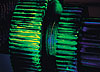
Magnetic particle inspection is an ideal NDT method for detecting inclusions, while fluorescent particle inspection does a better job of detecting shrinkage and porosity, according to MacCracken. Inclusions are pieces of metal that have not been homogenized with the other metal of the part or the shell from the casting mold. “Inclusions are bad for the life of the part because it can set it up for a crack during the service life of the part,” MacCracken says.
There are automatic, semi-automatic and multi-directional MPI machines available in the marketplace, such as those made by Magnaflux (Glenview, IL) and Gould-Bass Inc. (Pomona, CA), which the inspector can use to magnetize and demagnetize the part. While the inspector still needs to visually examine the part and evaluate it, this type of automation can help save time.
Demagnetizing the part after inspection is important. “If you don’t [demagnetize], the part will retain the magnetic field. You have to ensure the parts are nonmagnetic when done,” Foley emphasizes.
That is not the only important step in MPI, however. The inspection technique can be used for either wet or dry methods. “Dry is usually for field inspections in a lot of cases or for a higher temperature environment because you don’t want the fluids [from wet inspection] to burn,” explains Paul Dunnwald, equipment business unit manager at Magnaflux.
Magnetic particle inspection only can be used with alloys or metals that can be magnetized, such as steel. “If you can’t magnetize it, you can’t use MPI,” Foley notes. The technique detects surface and subsurface indications or defects. This can be seen as an advantage over FPI, since penetrant inspection only shows surface defects.
While MPI works well with ferrous materials, FPI, or penetrant inspection, can be used on just about any non-porous surface. This is because a porous material can hold the penetrant in a lot of non-defect areas and it can make it much more difficult for actual defects to stand out. Typical FPI inspections include washing and drying the part, applying a penetrant, washing the part, applying a developer and inspecting the part.
“Cleaning the part is very important. Penetrant and mag are designed to be fast processes and if a part is not prepared right then it slows everything down. If the preparation is right, you can really trust what you are seeing. If you did not prepare it right-this can cause bad readings,” Foley explains.
A part that is improperly washed can show false indications or defects. In the event that a valid inspection cannot be performed, the inspection process must be restarted from the beginning. While the amount of time FPI takes to perform varies with the volume of parts and type of part being inspected, Foley averages that the non-automated FPI process from cleaning through inspection takes about three to four hours.

At Pratt and Whitney, says MacCracken, due to the nature of the critical components being inspected, they do not allow 0.5 to be used. “For major rotating parts such as shafts, discus, hubs and spaces, we only allow a level 4 post emulsified. It’s a critical component, so we want to use the most sensitive penetrant we can use,” he explains.
Penetrants-which can be applied several different ways including dipping, spraying or brushing-are available as water soluble or water wash, and post emulsified-which is further broken down into hydrophilic and lipophilic. “Some penetrants work better with higher or lower temperature washes,” Foley says. “You use whatever makes the best sense [for your application].” The types of defects and the parts to inspect will help make the call for which products to use. Emulsified penetrants, for example, tend to be a little more sensitive than water wash and are at less risk of over washing when compared with water wash penetrants. Over washing can cause false or difficult readings.
According to MacCracken, most of the aerospace industry uses hydrophilic post emulsified and water wash penetrants. “Water wash is the most simplified: you apply penetrant and wash it off under a UV light to make sure you don’t over wash it,” he explains. Once the part is completely dry, a dry developer is applied to the part, which acts as a blotter to soak up or draw out the penetrant from a discontinuity. After a specific waiting time or dwell time, the developer causes a capillary reaction, which draws the penetrant out and makes it visible to the inspector under UV light.
Inspection using a post emulsified hydrophilic penetrant calls for a pre-rinse after the penetrant is applied, which removes 80% to 90% of the surface penetrant off the part, according to MacCracken. “A hydrophilic emulsifier, which acts like a soap, is applied and makes the oily penetrant that you applied earlier water soluble,” he explains. The part is then rinsed again to remove the emulsified penetrant/emulsifier, dried and a developer is applied.
“The chief issue over the years was getting the UV light down the tubes with the borescope. With reduction in price of lighting technologies such as fiberoptics and LED, we are seeing a shift,” Dunnwald says.
Often, most of these attachments are white light capable and UV capable. The inspector will use the white light mode to get to the part of the cavity or piece they would like to inspect and then turn on the UV light to inspect for defects.
“For many years, only fiberscopes offered the availability [of UV inspection]. Using a videoscope with an external cable is something that has just recently been more available because of the demand for magnification and measurement capability,” says Richard Walsh, national sales manager for remote visual inspection and NDT portable products at Olympus NDT (Waltham, MA).
“Today, a single UV videoscope can now deliver UV light and imaging in a single package, whereas in the past, inspectors had to introduce two components: one element for delivering UV light and another for imaging,” says Gene McGarry, general manager at Karl Storz Industrial-America Inc. (El Segundo, CA). Having the lighting and imaging in a single, small diameter package makes it easier to access even smaller areas than were previously possible with a multiple component system, he notes.
White light borescopes can be used for traditional remote inspection applications, however, operators may not be able to see certain minute or subsurface characteristics, such as voids, porosity or small cracks, McGarry says. With the addition of UV light, inspection professionals can now identify smaller defects.
Another benefit of UV borescope and fiberscope applications, according to McGarry, is scrap reduction. “You get a more detailed inspection of internal parts that you couldn’t see before. You can now do an FPI and salvage a part; without a borescope, you have to section the parts, at some defined sample interval for evaluation, and then scrap the part once confident the production process is consistent. In most industrial applications, especially aviation, these parts are extremely expensive,” he says.
“The process is never designed to catch all defects all the time,” Foley says. For example, he says, his company does not consider UV particularly reliable for finding very large defects.
Other defects, including dents, will not show up as indications under UV light either. “Part of our inspection procedure includes a fairly good white light inspection as well to make sure there are no dents, etc. We check for dents and large defects,” Foley explains.
Another important consideration with UV NDT inspection is that, like other visual inspections, operators can get bored or complacent-making the inspection process only as detailed as the person performing the inspection.
“[Many inspectors] have been doing the job for many years and never find anything-there is not really anything new and they can get complacent,” MacCracken says. One way to help combat this, he adds, is through regular training and audits. The more trained, prepared and motivated NDT inspectors are, the more successful the plant’s UV NDT inspection program will be.
UV NDT inspection remains a constant in the manufacturing world. Consistent results and highly-trained professionals make UV inspection a technique that has withstood the test of time and will continue to do so into the future. By following the appropriate inspection techniques, using quality products such as penetrants and washes, and ensuring that staff is continually trained and educated thoroughly on the technique, manufacturers can use UV inspections to test a range of parts both large and small in a variety of industries. NDT
Ultraviolet inspections can be used to inspect large or small parts, ranging from steel gears to shafts, small aluminum brackets, engine blocks, connecting rods, missile housings and jet engine blades.
Magnetic particle inspection can detect surface and subsurface defects or indications.
Typical fluorescent penetrant inspection inspections include washing and drying the part, applying a penetrant, washing the part, applying a developer and inspecting the part.
For more information on the organizations mentioned in this article, visit:
Karl Storz Industrial-America Inc., www.karlstorzindustrial.com
Magnaflux, www.magnaflux.com
Olympus NDT, www.olympus-ims.com
Pratt and Whitney, www.pratt-whitney.com
Protective Coatings Inc., www.protectivecoatingsinc.com
Fluorescent penetrant is used to show an indication on a metal cylinder. Source: Magnaflux
Ultraviolet (UV) NDT inspections may be thought of as “low tech” when compared with some of the more sophisticated techniques available with expensive equipment, but there is a reason UV has been around for decades-it does its job. Two types of UV inspections are magnetic particle inspection (MPI) and fluorescent penetrant inspection (FPI). Both use an ultraviolet light during the inspection process to detect flaws on a part. Because of the nature of the inspection process, ideally, parts should be non-porous-though they may be large or small, ranging from steel gears to shafts, small aluminum brackets, engine blocks, connecting rods, missile housings and jet engine blades.
“These methods were developed a long time ago and there is still nothing in this high-tech world that has made UV inspection not useful,” says Bob Foley, an NDT supervisor and Level III certified inspector at Protective Coatings (Kent, WA), an aerospace parts finisher. Foley and his team at Protective Coatings perform both MPI and FPI to check for flaws on steel, titanium or aluminum parts before coatings are applied.
Brian MacCracken, a Pratt and Whitney (East Hartford, CT) Level III certified senior NDT engineer, uses UV FPI and MPI inspections for gears, castings and forgings on critical parts in the aerospace industry. Pratt and Whitney also performs NDT inspections with UV videoscopes-a relatively newer use of the technology. “UV borescopes have been around many years, but UV videoscopes came into play the last nine years. We use them to inspect cavities like shafts where using dental mirrors or the typical UV borescope or handheld UV light is not useful. We use them for drum rotors or spools or other complex configured IDs,” MacCracken says.
But despite the availability of UV borescopes, fiberscopes and videoscopes for remote UV inspections, this NDT technique still is most often used for visual inspections.
The shaft of a gear component is ideal for magnetic particle inspection. Source: Magnaflux
Differences
Determining which type of inspection to perform is typically left up to the Level III certified personnel at a facility; however, there are a few large differences between MPI and FPI techniques that can help point inspectors in the right direction.Magnetic particle inspection is an ideal NDT method for detecting inclusions, while fluorescent particle inspection does a better job of detecting shrinkage and porosity, according to MacCracken. Inclusions are pieces of metal that have not been homogenized with the other metal of the part or the shell from the casting mold. “Inclusions are bad for the life of the part because it can set it up for a crack during the service life of the part,” MacCracken says.
There are automatic, semi-automatic and multi-directional MPI machines available in the marketplace, such as those made by Magnaflux (Glenview, IL) and Gould-Bass Inc. (Pomona, CA), which the inspector can use to magnetize and demagnetize the part. While the inspector still needs to visually examine the part and evaluate it, this type of automation can help save time.
Demagnetizing the part after inspection is important. “If you don’t [demagnetize], the part will retain the magnetic field. You have to ensure the parts are nonmagnetic when done,” Foley emphasizes.
That is not the only important step in MPI, however. The inspection technique can be used for either wet or dry methods. “Dry is usually for field inspections in a lot of cases or for a higher temperature environment because you don’t want the fluids [from wet inspection] to burn,” explains Paul Dunnwald, equipment business unit manager at Magnaflux.
Magnetic particle inspection only can be used with alloys or metals that can be magnetized, such as steel. “If you can’t magnetize it, you can’t use MPI,” Foley notes. The technique detects surface and subsurface indications or defects. This can be seen as an advantage over FPI, since penetrant inspection only shows surface defects.
While MPI works well with ferrous materials, FPI, or penetrant inspection, can be used on just about any non-porous surface. This is because a porous material can hold the penetrant in a lot of non-defect areas and it can make it much more difficult for actual defects to stand out. Typical FPI inspections include washing and drying the part, applying a penetrant, washing the part, applying a developer and inspecting the part.
“Cleaning the part is very important. Penetrant and mag are designed to be fast processes and if a part is not prepared right then it slows everything down. If the preparation is right, you can really trust what you are seeing. If you did not prepare it right-this can cause bad readings,” Foley explains.
A part that is improperly washed can show false indications or defects. In the event that a valid inspection cannot be performed, the inspection process must be restarted from the beginning. While the amount of time FPI takes to perform varies with the volume of parts and type of part being inspected, Foley averages that the non-automated FPI process from cleaning through inspection takes about three to four hours.
Magnetic particle inspection reveals an indication on the end of a pipe. Source: Magnaflux
Penetrant Options
Penetrants are broken down into five sensitivity levels: 0.5, 1, 2, 3, 4. “There are different concentrations of dyes in the penetrant that fluoresce more than others,” Foley explains.At Pratt and Whitney, says MacCracken, due to the nature of the critical components being inspected, they do not allow 0.5 to be used. “For major rotating parts such as shafts, discus, hubs and spaces, we only allow a level 4 post emulsified. It’s a critical component, so we want to use the most sensitive penetrant we can use,” he explains.
Penetrants-which can be applied several different ways including dipping, spraying or brushing-are available as water soluble or water wash, and post emulsified-which is further broken down into hydrophilic and lipophilic. “Some penetrants work better with higher or lower temperature washes,” Foley says. “You use whatever makes the best sense [for your application].” The types of defects and the parts to inspect will help make the call for which products to use. Emulsified penetrants, for example, tend to be a little more sensitive than water wash and are at less risk of over washing when compared with water wash penetrants. Over washing can cause false or difficult readings.
According to MacCracken, most of the aerospace industry uses hydrophilic post emulsified and water wash penetrants. “Water wash is the most simplified: you apply penetrant and wash it off under a UV light to make sure you don’t over wash it,” he explains. Once the part is completely dry, a dry developer is applied to the part, which acts as a blotter to soak up or draw out the penetrant from a discontinuity. After a specific waiting time or dwell time, the developer causes a capillary reaction, which draws the penetrant out and makes it visible to the inspector under UV light.
Inspection using a post emulsified hydrophilic penetrant calls for a pre-rinse after the penetrant is applied, which removes 80% to 90% of the surface penetrant off the part, according to MacCracken. “A hydrophilic emulsifier, which acts like a soap, is applied and makes the oily penetrant that you applied earlier water soluble,” he explains. The part is then rinsed again to remove the emulsified penetrant/emulsifier, dried and a developer is applied.
Remote UV
An additional use of UV light is for remote inspections with borescopes and fiberscopes, and even more recently, with videoscopes. Previously, delivering the UV light deep into a cavity was difficult and cumbersome. More recently, given newer technology and products, some manufacturers offer lighting options as ancillary components to the scope, while others offer UV light options that enter into the part parallel with the scope for UV inspections.“The chief issue over the years was getting the UV light down the tubes with the borescope. With reduction in price of lighting technologies such as fiberoptics and LED, we are seeing a shift,” Dunnwald says.
Often, most of these attachments are white light capable and UV capable. The inspector will use the white light mode to get to the part of the cavity or piece they would like to inspect and then turn on the UV light to inspect for defects.
“For many years, only fiberscopes offered the availability [of UV inspection]. Using a videoscope with an external cable is something that has just recently been more available because of the demand for magnification and measurement capability,” says Richard Walsh, national sales manager for remote visual inspection and NDT portable products at Olympus NDT (Waltham, MA).
“Today, a single UV videoscope can now deliver UV light and imaging in a single package, whereas in the past, inspectors had to introduce two components: one element for delivering UV light and another for imaging,” says Gene McGarry, general manager at Karl Storz Industrial-America Inc. (El Segundo, CA). Having the lighting and imaging in a single, small diameter package makes it easier to access even smaller areas than were previously possible with a multiple component system, he notes.
White light borescopes can be used for traditional remote inspection applications, however, operators may not be able to see certain minute or subsurface characteristics, such as voids, porosity or small cracks, McGarry says. With the addition of UV light, inspection professionals can now identify smaller defects.
Another benefit of UV borescope and fiberscope applications, according to McGarry, is scrap reduction. “You get a more detailed inspection of internal parts that you couldn’t see before. You can now do an FPI and salvage a part; without a borescope, you have to section the parts, at some defined sample interval for evaluation, and then scrap the part once confident the production process is consistent. In most industrial applications, especially aviation, these parts are extremely expensive,” he says.
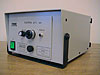
UV light sources enable an inspection professional to find defects and indications on a range of parts from large to small. Source: Karl Storz Industrial-America Inc.
What UV Won't Find
While UV inspection has been around for decades and does a great job of helping professionals find indications and defects, not all defects show up with UV light.“The process is never designed to catch all defects all the time,” Foley says. For example, he says, his company does not consider UV particularly reliable for finding very large defects.
Other defects, including dents, will not show up as indications under UV light either. “Part of our inspection procedure includes a fairly good white light inspection as well to make sure there are no dents, etc. We check for dents and large defects,” Foley explains.
Another important consideration with UV NDT inspection is that, like other visual inspections, operators can get bored or complacent-making the inspection process only as detailed as the person performing the inspection.
“[Many inspectors] have been doing the job for many years and never find anything-there is not really anything new and they can get complacent,” MacCracken says. One way to help combat this, he adds, is through regular training and audits. The more trained, prepared and motivated NDT inspectors are, the more successful the plant’s UV NDT inspection program will be.
UV NDT inspection remains a constant in the manufacturing world. Consistent results and highly-trained professionals make UV inspection a technique that has withstood the test of time and will continue to do so into the future. By following the appropriate inspection techniques, using quality products such as penetrants and washes, and ensuring that staff is continually trained and educated thoroughly on the technique, manufacturers can use UV inspections to test a range of parts both large and small in a variety of industries. NDT
Tech Tips
For more information on the organizations mentioned in this article, visit:
Karl Storz Industrial-America Inc., www.karlstorzindustrial.com
Magnaflux, www.magnaflux.com
Olympus NDT, www.olympus-ims.com
Pratt and Whitney, www.pratt-whitney.com
Protective Coatings Inc., www.protectivecoatingsinc.com
Looking for a reprint of this article?
From high-res PDFs to custom plaques, order your copy today!