Test & Inspection
Time for Environmental Testing
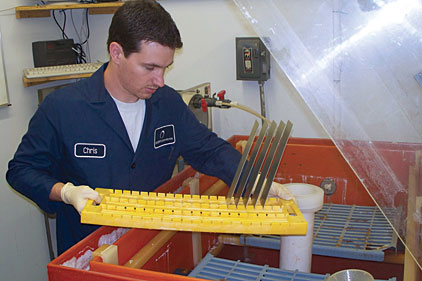
Materials testing, including environmental testing, plays an increasingly significant role in the entire manufacturing process.
 |
In particular, comparing the effects of these environmental conditions on your product against competitor or historical products can provide beneficial information in the area of product performance. Additionally, many clients find environmental testing results useful for marketing claims.
Once in the marketplace, routine production testing is usually required, typically to satisfy customer-driven or regulatory requirements to specifications. Test methods commonly utilized by materials laboratories include the following.
Fluid Immersion of Nonmetallic Materials
ASTM D471 testing evaluates the ability of rubber and rubber-like compositions to withstand the effect of liquids. For example, rubber components, seals, gaskets, hoses, diaphragms and sleeves may be exposed to oils, greases, fuels, and other fluids during service. Properties of rubber components can deteriorate during exposure to these liquids, affecting the performance of the rubber part, which can result in failure.
Effect of Condensation on Coatings
ASTM D4585 is used primarily to determine the water resistance of organic coatings by controlled condensation. Condensation is produced in the laboratory by exposing the test surface of the sample to a heated, saturated mixture of air and water vapor, while the reverse side of the sample is cooled to room temperature air. The resulting heat transfer causes the vapor to condense on the test surface. Analysts observe and report effects such as color change, blistering, loss of adhesion, softening or embrittlement.
UV Weathering of Nonmetallic Materials
ASTM G154 is used to determine the effects of the UV portion of sunlight, moisture and heat. These exposures may include a means to introduce moisture to the test specimen. Alternatively, the exposure may simulate the effects of sunlight through window glass. Typically, exposures would include moisture in the form of condensing humidity. While the effect of UV light on some coatings, such as paints, may be purely aesthetic and thus, not a safety or true performance issue, a significant number of polymers can experience material property deterioration by prolonged exposure to UV rays.
Effects of Sunlight, Moisture and Heat on Nonmetallic Materials
ASTM G155 is used to induce property changes associated with in-service conditions, including the effects of sunlight, moisture and heat. These exposures may include a means to introduce moisture to the test specimen uses xenon arc light and water apparatus intended to reproduce the weathering effects that occur when materials are exposed to sunlight (either direct or through window glass) and moisture as rain or dew in actual use.
Effect of Humidity on Coatings
Testing to ASTM D1735, ASTM 2247 and ASTM D4585 evaluates the resistance of coatings to condensation and humidity. Water, condensation and humidity can cause the degradation of coatings, so this information is helpful for evaluating how a coating will perform in service.
Salt Spray (Fog) and Corrosion
ASTM B117 includes testing of a material in a controlled corrosive environment which has been used to produce relative corrosion resistance information for specimens of metals and coated metals. It provides an accelerated degradation environmental for relative evaluation of specimens. From long-term experience in testing their products, some manufacturers have been able to incorporate an exposure time frame to an acceptable in service performance.
ASTM G85 applies to ferrous and nonferrous metals as well as organic and inorganic coatings, and includes salt spray (fog) testing for specification purposes. It includes five climate modification to the basic ASTM B117 salt spray test including acetic acid salt spray, cyclic acidified salt spray (MASTMAASIS), seawater acidified (SWAAT), Sulphur dioxide (SO2) salt spray (SO2), and dilute electrolyte fog/dry (PROHESION) tests.
ASTM D1654 includes basic corrosion performance testing of the substrate, pretreatment, or coating system, or combination thereof, after exposure to corrosive environments. The test method covers the treatment of previously painted or coated specimens for accelerated and atmospheric exposure tests and their subsequent evaluation in respect to corrosion, blistering associated with corrosion, loss of adhesion at a scribe mark, or other film failure.
NASM 1312-1 is a test method used to simulate highly humid and salt atmospheric conditions to determine a fastener’s relative resistance to corrosion.
ASTM G110 is useful for evaluating the adequacy of quenching when performed on material in the as-quenched condition. The practice may also be used to study the effect of subsequent thermal processes (for example, paint or bonding cures) or of actual precipitation treatments on the inherent type of corrosion. Intergranular corrosion resistance of heat treatable aluminum alloys is often directly related to the quenching conditions applied after solution heat treatment and to the subsequent aging treatment. Evaluations during alloy development and for evaluating production where it may serve as a control test on the quality of successive lots of the same material.
Intergranular Attack
ASTM A262 covers the standard practices for detecting susceptibility to intergranular attack in austenitic stainless steels. These practices include five intergranular corrosion tests.
ASTM A763 includes detecting susceptibility to intergranular attack in ferritic stainless steel. Different method of preparing steel test specimens are presented. Four practices, including Practice W, X, Y and Z, are used for determining susceptibility to intergranular attack in ferritic stainless steel. These practices cover the following tests: oxalic acid etch test, ferritic sulphate-sulfuric acid test, copper-copper sulphate-50% sulfuric acid test, and copper-copper sulphate-16% sulfuric acid test.
ASTM A923 is used in detection of detrimental intermetallic phase in duplex austenitic/ferritic stainless steel to the extent that toughness and corrosion resistance is affected significantly. Test methods include: A: sodium hydroxide etch test; B: Charpy impact test; C: ferric chloride corrosion test shall be made for classification of structures of duplex stainless steels.
ASTM G28 describes the procedure for conducting the boiling ferric sulfate—50 % sulfuric acid test which measures the susceptibility of certain nickel-rich, chromium-bearing alloys to intergranular corrosion, which may be encountered in certain service environments. The uniform corrosion rate obtained by this test method, which is a function of minor variations in alloy composition, may easily mask the intergranular corrosion components of the overall corrosion rate on alloys N10276, N06022, N06059, and N06455.
ASTM G34 method covers a procedure for constant immersion exfoliation corrosion (EXCO) testing of high-strength 2XXX and 7XXX series aluminum alloys. This test method was originally developed for research and development purposes; however, it is referenced, in specific material specifications, as applicable for evaluating production material. Use of this test method may help serve as a useful prediction of the exfoliation corrosion behavior of these alloys in various types of outdoor service, especially in marine and industrial environments. The test solution is very corrosive and represents the more severe types of environmental service.
Crevice and Pitting Resistance
ASTM G46 includes evaluation of pitting. It is important to be able to determine the extent of pitting, either in a service application where it is necessary to predict the remaining life in a metal structure, or in laboratory test programs that are used to select the most pitting-resistant materials for service. Identification and examination of pits aid in the evaluation of pitting corrosion to determine the extent of its effect. The importance of this corrosion evaluation is to be able to determine the extent of pitting, either in a service application where it is necessary to predict the remaining life in a metal structure, or in laboratory test programs that are used to select the most pitting-resistant materials for service.
ASTM G48 includes evaluation of the resistance of stainless steels and related alloys to the initiation of pitting and crevice corrosion. The results may be used for ranking alloys in order of increasing resistance to pitting and crevice corrosion initiation under the specific conditions of these methods.
Passivation
AMS-STD-753 describes general and detailed methods of sampling and testing for surface passivity of corrosion-resistant steel parts. These tests may also be useful to determine if there is a need for passivation.
Ineffective quality and engineering efforts can result in products that may disappoint or even have safety issues. Consumer disappointment results in a tarnished image of the product, the manufacturer, or distributor. If safety has been compromised then the rebuilding of customer confidence will require a long term effort and carries the potential for costly litigation.
Materials testing, including environmental testing such as corrosion, UV, salt spray, weathering and others, plays an increasingly significant role in the entire manufacturing process—from early R&D stages and production testing, to investigating warranty claims or failures.
|
TECH TIPS
|
Looking for a reprint of this article?
From high-res PDFs to custom plaques, order your copy today!