Quality Magazine logo
search
cart
facebook twitter linkedin youtube
  • Sign In
  • Create Account
  • Sign Out
  • My Account
Quality Magazine logo
  • NEWS
  • PRODUCTS
    • FEATURED PRODUCTS
    • SUBMIT YOUR PRODUCT
  • CHANNELS
    • AUTOMATION
    • MANAGEMENT
    • MEASUREMENT
    • NDT
    • QUALITY 101
    • SOFTWARE
    • TEST & INSPECTION
    • VISION & SENSORS
  • MARKETS
    • AEROSPACE
    • AUTOMOTIVE
    • ENERGY
    • GREEN MANUFACTURING
    • MEDICAL
  • MEDIA
    • A WORD ON QUALITY PUZZLE
    • EBOOK
    • PODCASTS
    • VIDEOS
    • WEBINARS
  • EVENTS
    • EVENT CALENDAR
    • IMTS
  • DIRECTORIES
    • BUYERS GUIDE >
      • Supplier Insights
    • NDT SOURCEBOOK
    • VISION & SENSORS
    • TAKE A TOUR
  • INFOCENTERS
    • Digital Quality Management Systems
    • NEXT GENERATION SPC & QUALITY ANALYTICS
  • AWARDS
    • ROOKIE OF THE YEAR
    • PLANT OF THE YEAR
    • PROFESSIONAL OF THE YEAR
  • MORE
    • Expert Columns
    • NEWSLETTERS
    • QUALITY STORE
    • INDUSTRY LINKS
    • SPONSOR INSIGHTS
  • EMAG
    • eMAGAZINE
    • ARCHIVES
    • CONTACT
    • ADVERTISE
  • SIGN UP!
NDT

Fatigue Crack Growth Testing 101

A testing method to determine the rate of growth of a crack under repeated loading.

By Guy Connelly
June 4, 2014

We are all acquainted with the various ways that materials break when they are loaded past their limit: the brittle snap of a plastic part or the tearing of a pop top tab are the familiar results of a large overload. A more insidious type of gradual failure can occur when a component is subjected to a cyclic load. In this case, cracks can develop and grow over time even when the peak stresses from the load are much lower than the material’s tensile strength. This type of progressive failure due to multiple applications of load is known as “fatigue.”

While direct cyclic loading of components can be used to evaluate fatigue resistance, testing of small standardized samples of a material is more often performed. The types of test used for this are broadly separated into those that use smooth samples and those which contain a crack. The former combines the entire life cycle of fatigue from the initiation of a crack from a small, sometimes microscopic flaw, through crack growth to failure of the sample. The latter type of test uses a sample that contains a sharp crack. It addresses only the growth stage of the fatigue process. Such fatigue crack growth rate (FCGR) testing provides a relationship between a crack growth parameter, described below, and the associated rate of crack growth. This information can then be used to predict the life of structures containing cracks of known size in locations where stresses can be determined.

Fatigue Crack Growth Specimen

For fatigue crack growth rate testing, a representative sample of material is machined from the material of interest. Specimens typically have a simple shape which contains a notch to concentrate stress in order to grow a crack from a controlled position. One common type of specimen that uses a small amount of material is the “compact tension specimen.”

A machined notch is not acute enough to resemble a natural crack, so as a first step of the test procedure a small fatigue starter crack is grown from the notch at a very low cyclic load to establish a repeatable starting condition approximating a natural crack.

Test Apparatus and Method

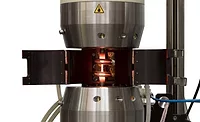
FCGR testing is conducted using a servohydraulic test frame. A hydraulic actuator under computer control applies a cyclic force to a specimen which is in turn connected to and measured by a load cell, thereby completing a closed control loop.

The crack growth rate, defined as the change in length of a crack per number of load cycles (“da/dn”), can be determined from visual measurements made at intervals of load application. However, automated methods compatible with computer control are now widely used. Advantages of these automated methods include unattended operation and the ability to gradually speed up or slow down the crack growth rate.

One of the methods of crack length measurement compatible with computer control is the compliance method. This approach uses the change in compliance (a measure of “springiness”) of the sample that occurs as the crack lengthens to calculate a value of crack length. This is done by making measurements of displacement between known locations on the sample along with simultaneous measurements of load. These provide input to a mathematical relationship in the control program specific to the sample that determines crack length as a function of compliance. The sensor that provides the displacement measurement is called a clip gage, which is comprised of two metallic arms instrumented with strain gages. The ends of the arms contain notches that fit into sharp mounting edges on the specimen which are the displacement reference points.

The other commonly used way to determine crack length in metallic samples is the potential drop method where a current of several amperes flows through the specimen in a path that travels around the crack. The electrical resistance of this conductive path creates a small drop in the voltage potential measured at fixed points on the sample. As the crack grows, the length and area of the conductive path changes, which changes the measured potential. The control computer utilizes a functional relationship between crack length and the potential for the specimen geometry to determine a value of crack length.

Results

A parameter called “stress intensity factor,” K, which is a function of remote stress and crack length, describes the stress state near the tip of a crack. The difference in K between the highest and lowest values of a load cycle, ΔK, has been found to correlate with the rate of fatigue crack growth. A typical fatigue crack growth experiment result is shown in the Fatigue Crack Growth Rates graph, where Log(ΔK) is plotted against Log(da/dn). Logarithmic scales are used because fatigue crack growth rates can vary from millions of cycles to advance a crack by one millimeter to only tens of cycles to grow the same distance just before failure. Crack growth rate data enables estimates to be made of the remaining fatigue life of a component before a dangerous crack size is reached.

The overall shape of this curve is characteristic of many materials. At the right of the plot where high values of ΔK are present there is rapid crack growth. In the middle of the plot in the so-called Paris region a linear relationship between Log (ΔK) and the Log (da/dn) is often displayed. For many materials there is a marked decrease in the fatigue crack growth rate for values of ΔK lower than the Paris region. The value of ΔK that corresponds to a crack growth rate is 10-7 mm/cycle or less is called the “threshold” stress intensity. If the combination of load and crack size in a cracked structure results in a ΔK that is less than the threshold value, then for most practical purposes it is the equivalent of a crack which will not grow.

 Fatigue crack growth rate information is important to the design process in order to provide a safe lifetime, and essential to the inspection process of critical components to determine the remaining life of a structure when a flaw is found.  

KEYWORDS: fatigue crack growth rate fatigue testing tensile strength

Share This Story

Looking for a reprint of this article?
From high-res PDFs to custom plaques, order your copy today!

Guy Connelly is a senior engineer at Laboratory Testing Inc. For more information, call (800) 219-9095, email [email protected] or visit www.labtesting.com

Recommended Content

JOIN TODAY
to unlock your recommendations.

Already have an account? Sign In

  • 2024 Quality Rookie of the Year Justin Wise 1440x750px banner with "Quality Rookie of the Year" logo inset

    Meet the 2024 Quality Rookie of the Year: Justin Wise

    Justin Wise is an exceptional individual who has been...
    Aerospace
    By: Michelle Bangert
  • Man with umbrella and coat stands outside while it rains at night looking at a building.

    Nondestructive Testing: Is there an ethics problem?

    I was a whistleblower who exposed fraudulent activities...
    NDT
    By: Dale Norwood
  • Unraveling Deflategate: Football stadium with closeup of football on field

    Unraveling the Tom Brady Deflategate

    The Deflategate scandal erupted following the 2014 AFC...
    Measurement
    By: Greg Cenker and Henry Zumbrun
Manage My Account
  • eMagazine Subscriptions
  • Newsletters
  • Online Registration
  • Subscription Customer Service
  • Manage My Preferences

More Videos

Sponsored Content

Sponsored Content is a special paid section where industry companies provide high quality, objective, non-commercial content around topics of interest to the Quality audience. All Sponsored Content is supplied by the advertising company and any opinions expressed in this article are those of the author and not necessarily reflect the views of Quality or its parent company, BNP Media. Interested in participating in our Sponsored Content section? Contact your local rep!

close
  • Key Takeaways for Quality Leaders
    Sponsored byComplianceQuest

    Key Takeaways for Quality Leaders from the 2026 Gartner Magic Quadrant™ for QMS

  • This image shows a person seated next to a Bobcat T66 compact track loader.
    Sponsored byPolyWorks by InnovMetric

    Supercharging Digital Gauging at Bobcat North America

  • Dorsey Calibration Lab photo by Tom LaBarbera Picture this Studios
    Sponsored byDorsey Metrology International

    Ensuring Product Quality in a Competitive Manufacturing Landscape

Popular Stories

This image shows a person seated next to a Bobcat T66 compact track loader.

Supercharging Digital Gauging at Bobcat North America

a professional in the aviation field performing maintenance, repair, and overhaul (MRO) work

Manufacturing Retention: Strategies for Improving Company Culture, Engagement and Skill Development

Dorsey Calibration Lab photo by Tom LaBarbera Picture this Studios

Ensuring Product Quality in a Competitive Manufacturing Landscape

2026 Quality Professional of the Year!

Events

June 22, 2026

Automate 2026

Automate is North America's largest robotics and automation event — and the best place to take your ideas from insight to impact.
 
Our show floor features the world’s leading automation solutions, from AI and robotics to motion control, vision systems, and more. Plus, our educational conference is second to none, led by the brightest minds in automation today.
 
Ready to transform the way you work? Take the next step at Automate.
July 14, 2026

Quality Leaders Forum: Better Communication, Better Quality Data

The Quality Leaders Forum is a quarterly, editor-moderated fireside chat series hosted by Quality Magazine, featuring candid conversations with senior manufacturing and operations executives shaping enterprise-level quality.

View All Submit An Event

Products

Lean Manufacturing and Service Fundamentals, Applications, and Case Studies

Lean Manufacturing and Service Fundamentals, Applications, and Case Studies

See More Products
Quality Podcast Channel Custom Content

Related Articles

  • Cyclic thermal loading using a TMF loadstring. Source: Instron

    Fatigue Testing 101

    See More
  • Fusion line crack

    Magnetic Particle Testing 101: A Tutorial

    See More
  • leak testing

    Leak Testing 101

    See More

Related Products

See More Products
  • Mechanical and Non-Destructive Testing DVD

  • Creating a Kaizen Culture: Align the Organization, Achieve Breakthrough Results, and Sustain the Gains

See More Products

Related Directories

  • American Institute of Nondestructive Testing

    The American Institute of Nondestructive Testing offers online and hands-on training in RT, UT, ET, MT, PT and VT nondestructive testing methods. Let us customize an NDT training program that fits your company's needs. We offer training online, at your facility or at our 22,000 Sq Ft facility.
×

Stay in the know with Quality’s comprehensive coverage of
the manufacturing and metrology industries.

Newsletters | Website | eMagazine

JOIN TODAY!
  • RESOURCES
    • Advertise
    • Contact Us
    • Directories
    • Manufacturing Division
    • Store
    • Want More
  • SIGN UP TODAY
    • Create Account
    • eMagazine
    • Newsletters
    • Customer Service
    • Manage Preferences
  • SERVICES
    • Marketing Services
    • Market Research
    • Reprints
    • List Rental
    • Survey/Respondent Access
  • STAY CONNECTED
    • LinkedIn
    • Facebook
    • YouTube
    • X (Twitter)
  • PRIVACY
    • PRIVACY POLICY
    • TERMS & CONDITIONS
    • DO NOT SELL MY PERSONAL INFORMATION
    • PRIVACY REQUEST
    • ACCESSIBILITY

Copyright ©2026. All Rights Reserved BNP Media, Inc. and BNP Media II, LLC.

Design, CMS, Hosting & Web Development :: ePublishing