Quality Magazine logo
search
cart
facebook twitter linkedin youtube
  • Sign In
  • Create Account
  • Sign Out
  • My Account
Quality Magazine logo
  • NEWS
  • PRODUCTS
    • FEATURED PRODUCTS
    • SUBMIT YOUR PRODUCT
  • CHANNELS
    • AUTOMATION
    • MANAGEMENT
    • MEASUREMENT
    • NDT
    • QUALITY 101
    • SOFTWARE
    • TEST & INSPECTION
    • VISION & SENSORS
  • MARKETS
    • AEROSPACE
    • AUTOMOTIVE
    • ENERGY
    • GREEN MANUFACTURING
    • MEDICAL
  • MEDIA
    • A WORD ON QUALITY PUZZLE
    • EBOOK
    • PODCASTS
    • VIDEOS
    • WEBINARS
  • EVENTS
    • EVENT CALENDAR
    • IMTS
  • DIRECTORIES
    • BUYERS GUIDE >
      • Supplier Insights
    • NDT SOURCEBOOK
    • VISION & SENSORS
    • TAKE A TOUR
  • INFOCENTERS
    • Digital Quality Management Systems
    • NEXT GENERATION SPC & QUALITY ANALYTICS
  • AWARDS
    • ROOKIE OF THE YEAR
    • PLANT OF THE YEAR
    • PROFESSIONAL OF THE YEAR
  • MORE
    • Expert Columns
    • NEWSLETTERS
    • QUALITY STORE
    • INDUSTRY LINKS
    • SPONSOR INSIGHTS
  • EMAG
    • eMAGAZINE
    • ARCHIVES
    • CONTACT
    • ADVERTISE
  • SIGN UP!
MeasurementQuality 101

CMM Styli

By Edward McMenamin
CMM Styli
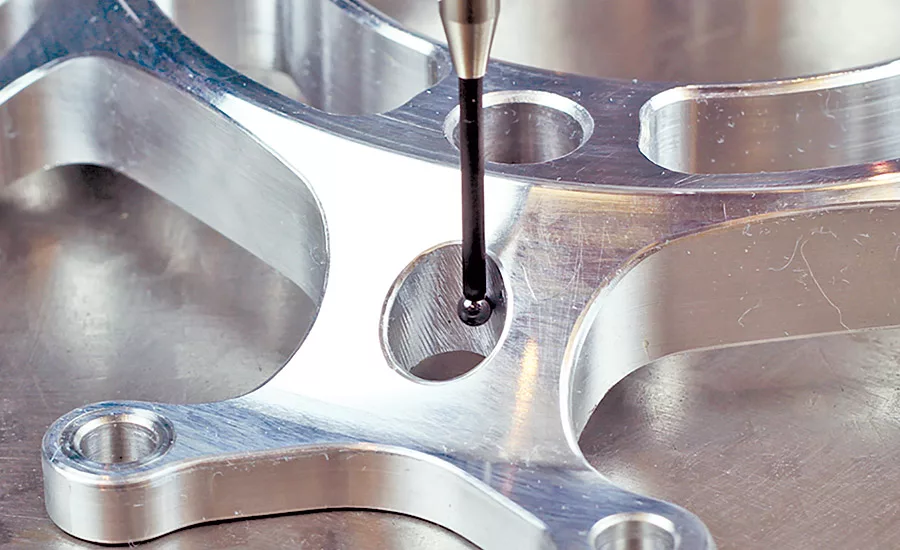
A 3 mm silicon nitride ball stylus probes a race car wheel center. Source: Q-Mark Manufacturing Inc.
Renishaw Styli
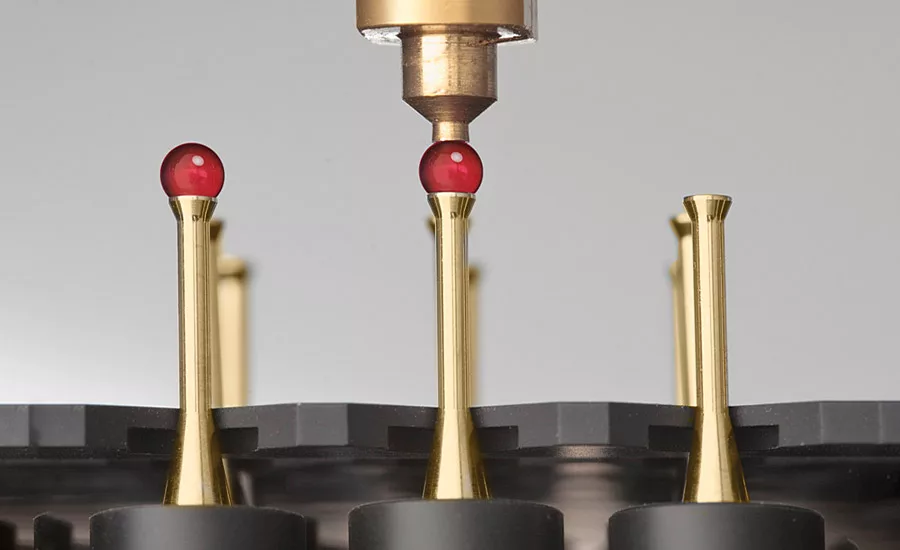
These Renishaw styli have ruby tips on titanium nitride stems. Source: Renishaw
Styli check
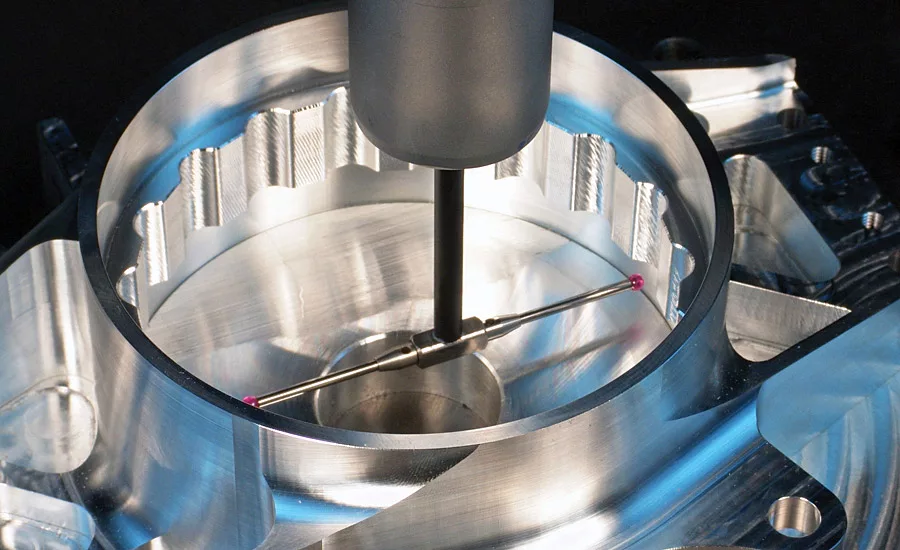
Opposing 3 mm ruby ball styli check an internal feature on a race car suspension part. Source: Q-Mark Manufacturing Inc.
CMM Styli
Renishaw Styli
Styli check
February 1, 2016

Choosing the right stylus for a coordinate measuring machine probe is a balancing act of size, weight, rigidity and hardness.

As the contact point for a CMM’s discovery and measurement of an object’s various geometries, choosing the right stylus is an important first step towards accuracy.

Tip Material Choices

The stylus itself is composed of three components—base, stem and tip.

The measuring tip usually features a ball, but occasionally is in the shape of a half-sphere, cylinder or other custom shape. Ruby is the most common material for the ball.

“It has some real significant advantages,” explains Q-Mark Manufacturing Inc. President Mark Osterstock. “Ruby is fairly inexpensive because it’s man-made and produced in quantities; it’s a good choice for CMM styli. And they are finished into very high tolerances of sphericity.”

Another big advantage of ruby is that it’s very hard, second only to diamond.

“And it has a relatively low coefficient of friction, meaning it tends not to stick to things when you touch them. So in probing you want a clean touch and getaway, and ruby is really great at that.”

Ruby’s biggest limitation is measuring aluminum objects.

“Ruby will actually accumulate particulars of that material on the ball, and over time will actually build up to the point where there’s a lump on the ball, which is extremely difficult to dislodge or get off,” he continues. “So most people, when they get that buildup, they just throw it away.”

A popular alternative to ruby for use with aluminum is silicon nitride.

“Silicon nitride has all the advantages of ruby, plus it does not suffer the build-up that ruby does,” Osterstock says. “The disadvantage is, it’s significantly more expensive than ruby, particularly because of the machining to put a hole into it (to connect to the stylus stem) is very difficult.”

A more recent innovation, especially for difficult aluminum surfaces, is full diamond.

“In side-by-side comparisons, Diamond!Scan styli were clean where build-up had initiated on both ruby and silicon nitride spheres,” said Laura Bock Carlson, aftermarket product manager of Zeiss Industrial Metrology.  “This has a direct correlation to your process stability, and decreases down-time due to sphere inspections and cleaning.”

A third common tip material is ceramic. It is generally used when a large ball—typically larger than 10 mm in diameter—is needed to measure larger parts, such as an engine block.

One drawback to ceramic is it’s not as spherical as ruby or silicon nitride, which can result in less accuracy.

“Usually that tiny drop off in accuracy is overshadowed by the fact that the needed measurement itself is not as precise as you might have with a smaller part used in medicine, for example,” he says.

Occasionally steel balls will be used for tip, primarily for unusual ball sizes.

“Sometimes people need a very specific and unusual diameter ball, and the only material available is hard steel because people make hard steel balls in virtually every diameter,” Osterstock continues. “And they’re readily available off the shelf. So if a customer needs a very specific and unusual diameter ball, often the only alternative is hard steel. The disadvantage with hard steel is it rusts. It takes a lot of care to use hard steel.

Other materials sometimes used for the tip include sapphire, zirconium, tungsten carbide and diamond.

Stem Material Choices

Like the tip, the application and needs of the measuring task determine what material is best for the stem.

Stems are made from steel, tungsten carbide, ceramic or carbon fiber.

Steel is usually used for stems shorter than 30 mm, and with ball diameters greater than 2 mm, according to information from Renishaw.

Tungsten carbide is the best choice when the ball diameter is less than 1 mm and the stylus is up to 50 mm long.

Ceramic is useful when the ball diameter is greater than 3 mm and the stylus is longer than 30 mm, because it offers the stiffness of stainless steel but is a lighter option than Tungsten carbide.

Carbon fiber is used for especially long styli.

“Primarily, what it boils down to is the weight of the material and the length that you’re going out,” says Michael Litwin, CMM business manager, Renishaw. “The farther out you go, the more bending you’ll get in that stylus stem. So to offset that, if you have a very long stylus, you might go with the tungsten carbide.

“The tungsten carbide will be stiffer but also a little bit heavier. It’s always a little bit of a trade-off, but certainly you want to keep it as stiff as possible to get the best performance of the stylus.

“Carbon fiber is lighter, so once you start going out longer, say I need a 200 mm stylus, you start getting into a lot of weight. When you get into a lot of weight, it triggers the probe—false triggers, we call them.”

The brittleness of ceramic has advantages as a mechanical fuse.

“A lot of times you might prefer to have an inexpensive stylus break before it breaks a more expensive probe or the machine,” he explains.

The thermal stability of the stem material is also an important factor.

Of the common stem materials, steel offers the worst thermal stability. Tungsten carbide and ceramic provide average thermal stability. Carbon fiber has the best thermal stability, which is essential in the shop floor environment, adds Bock Carlson.

“Temperature is the biggest foe in metrology – this applies for workpieces as well as for room temperature,” she says. “Temperature is invisible but has a huge effect on result which makes it so tricky.”

The Base

The base holds the stem and connects to the probe arm. It is usually made from either stainless steel or titanium.

“Stainless steel is inexpensive, it’s easy to machine and it doesn’t corrode,” Osterstock says. “It lasts a long time, it’s just an excellent choice for bases. But steel is heavy. Now we’re talking about weight again and every gram counts when you’re approaching the weight limit on your probe system. So in many applications, people prefer titanium.

“Titanium is about one-third lighter than stainless steel, so right off the bat you’re saving significant weight.”

In addition, it’s rigid, corrosion resistant and durable, but more expensive than steel.

Trends

“The drive is for lighter styli,” Osterstock says. “The probing systems are being miniaturized, and as a result they demand lower-weight stylus systems. So we are seeing a real push to lightweight, but very rigid, styli.”

Along with lightweight, he’s also seeing demand for smaller and smaller styli, especially for measuring medical parts.

“Users are also becoming more sophisticated,” adds Bock Carlson.  “They are thinking in terms of their measurement accuracy, considering the total application requirements to achieve process stability.”

KEYWORDS: CMMs coordinate measurement machine (CMM) styli

Share This Story

Looking for a reprint of this article?
From high-res PDFs to custom plaques, order your copy today!

Ed McMenamin is a former editor of Quality Magazine.

Recommended Content

JOIN TODAY
to unlock your recommendations.

Already have an account? Sign In

  • 2024 Quality Rookie of the Year Justin Wise 1440x750px banner with "Quality Rookie of the Year" logo inset

    Meet the 2024 Quality Rookie of the Year: Justin Wise

    Justin Wise is an exceptional individual who has been...
    Aerospace
    By: Michelle Bangert
  • Man with umbrella and coat stands outside while it rains at night looking at a building.

    Nondestructive Testing: Is there an ethics problem?

    I was a whistleblower who exposed fraudulent activities...
    NDT
    By: Dale Norwood
  • Unraveling Deflategate: Football stadium with closeup of football on field

    Unraveling the Tom Brady Deflategate

    The Deflategate scandal erupted following the 2014 AFC...
    Measurement
    By: Greg Cenker and Henry Zumbrun
Manage My Account
  • eMagazine Subscriptions
  • Newsletters
  • Online Registration
  • Subscription Customer Service
  • Manage My Preferences

More Videos

Sponsored Content

Sponsored Content is a special paid section where industry companies provide high quality, objective, non-commercial content around topics of interest to the Quality audience. All Sponsored Content is supplied by the advertising company and any opinions expressed in this article are those of the author and not necessarily reflect the views of Quality or its parent company, BNP Media. Interested in participating in our Sponsored Content section? Contact your local rep!

close
  • Key Takeaways for Quality Leaders
    Sponsored byComplianceQuest

    Key Takeaways for Quality Leaders from the 2026 Gartner Magic Quadrant™ for QMS

  • This image shows a person seated next to a Bobcat T66 compact track loader.
    Sponsored byPolyWorks by InnovMetric

    Supercharging Digital Gauging at Bobcat North America

  • Dorsey Calibration Lab photo by Tom LaBarbera Picture this Studios
    Sponsored byDorsey Metrology International

    Ensuring Product Quality in a Competitive Manufacturing Landscape

Popular Stories

This image shows a person seated next to a Bobcat T66 compact track loader.

Supercharging Digital Gauging at Bobcat North America

a professional in the aviation field performing maintenance, repair, and overhaul (MRO) work

Manufacturing Retention: Strategies for Improving Company Culture, Engagement and Skill Development

Dorsey Calibration Lab photo by Tom LaBarbera Picture this Studios

Ensuring Product Quality in a Competitive Manufacturing Landscape

2026 Quality Professional of the Year!

Events

June 22, 2026

Automate 2026

Automate is North America's largest robotics and automation event — and the best place to take your ideas from insight to impact.
 
Our show floor features the world’s leading automation solutions, from AI and robotics to motion control, vision systems, and more. Plus, our educational conference is second to none, led by the brightest minds in automation today.
 
Ready to transform the way you work? Take the next step at Automate.
July 14, 2026

Quality Leaders Forum: Better Communication, Better Quality Data

The Quality Leaders Forum is a quarterly, editor-moderated fireside chat series hosted by Quality Magazine, featuring candid conversations with senior manufacturing and operations executives shaping enterprise-level quality.

View All Submit An Event

Products

Lean Manufacturing and Service Fundamentals, Applications, and Case Studies

Lean Manufacturing and Service Fundamentals, Applications, and Case Studies

See More Products
Quality Podcast Channel Custom Content

Related Articles

  • Custom CMM Styli

    See More
  • QM 0923 Quality 101 Intro image option 1

    Styli and Probe Extensions: Small Accessories Have A Big Impact On CMM Accuracy

    See More
  • Specialty Styli for CMM Operators and Machinists

    Specialty Styli for CMM Operators and Machinists

    See More

Events

View AllSubmit An Event
  • June 9, 2026

    Future-Proof your Quality Processes with Advanced 3D Optical CMM Technology

    On Demand Discover how to effortlessly capture complex data, leverage true multi-sensor automation, and ensure continuous operation without creating inspection delays.
  • June 12, 2025

    Remastering Quality Inspection With the MAESTRO CMM Platform

    On Demand Learn how advances in AI, machine learning, and data connectivity are transforming manufacturing inspections to improve speed, accuracy, and adaptability in an evolving industry.
View AllSubmit An Event

Related Directories

  • Paul W. Marino Gages Inc.

    PWMG Fixtures, CMM Styli and Accessories, Measurement and Standards: KOBAStep gages, Ball Bars, Sphere Beams, Ball Step, Gage Blocks, Reference Spheres, Non-Contact Optical Calibration Artifacts. Dimensional Measurement specialists, special gages, US made American Modular Tooling (AMT), design and engineering services for any industry. See us at pmargage.com
  • Q-Mark Manufacturing Inc.

    SAME-DAY STYLI. Q-Mark Manufacturing Inc. offers same-day order fulfillment on machine tool & CMM probe styli. Proudly made in the USA and unconditionally guaranteed since 1992. The Q in Q-Mark stands for quality. We are ISO 9001:2015 certified. Custom designs welcome. Fits all probes.
×

Stay in the know with Quality’s comprehensive coverage of
the manufacturing and metrology industries.

Newsletters | Website | eMagazine

JOIN TODAY!
  • RESOURCES
    • Advertise
    • Contact Us
    • Directories
    • Manufacturing Division
    • Store
    • Want More
  • SIGN UP TODAY
    • Create Account
    • eMagazine
    • Newsletters
    • Customer Service
    • Manage Preferences
  • SERVICES
    • Marketing Services
    • Market Research
    • Reprints
    • List Rental
    • Survey/Respondent Access
  • STAY CONNECTED
    • LinkedIn
    • Facebook
    • YouTube
    • X (Twitter)
  • PRIVACY
    • PRIVACY POLICY
    • TERMS & CONDITIONS
    • DO NOT SELL MY PERSONAL INFORMATION
    • PRIVACY REQUEST
    • ACCESSIBILITY

Copyright ©2026. All Rights Reserved BNP Media, Inc. and BNP Media II, LLC.

Design, CMS, Hosting & Web Development :: ePublishing