Quality Magazine logo
search
cart
facebook twitter linkedin youtube
  • Sign In
  • Create Account
  • Sign Out
  • My Account
Quality Magazine logo
  • NEWS
  • PRODUCTS
    • FEATURED PRODUCTS
    • SUBMIT YOUR PRODUCT
  • CHANNELS
    • AUTOMATION
    • MANAGEMENT
    • MEASUREMENT
    • NDT
    • QUALITY 101
    • SOFTWARE
    • TEST & INSPECTION
    • VISION & SENSORS
  • MARKETS
    • AEROSPACE
    • AUTOMOTIVE
    • ENERGY
    • GREEN MANUFACTURING
    • MEDICAL
  • MEDIA
    • A WORD ON QUALITY PUZZLE
    • EBOOK
    • PODCASTS
    • VIDEOS
    • WEBINARS
  • EVENTS
    • EVENT CALENDAR
    • IMTS
  • DIRECTORIES
    • BUYERS GUIDE >
      • Supplier Insights
    • NDT SOURCEBOOK
    • VISION & SENSORS
    • TAKE A TOUR
  • INFOCENTERS
    • Digital Quality Management Systems
    • NEXT GENERATION SPC & QUALITY ANALYTICS
  • AWARDS
    • ROOKIE OF THE YEAR
    • PLANT OF THE YEAR
    • PROFESSIONAL OF THE YEAR
  • MORE
    • Expert Columns
    • NEWSLETTERS
    • QUALITY STORE
    • INDUSTRY LINKS
    • SPONSOR INSIGHTS
  • EMAG
    • eMAGAZINE
    • ARCHIVES
    • CONTACT
    • ADVERTISE
  • SIGN UP!
Quality 101

Quality 101

Ins and Outs of Height Gages

Know your height gages for efficient and accurate measurements.
By Michal Grosenbach
Ins and Outs of Height Gages

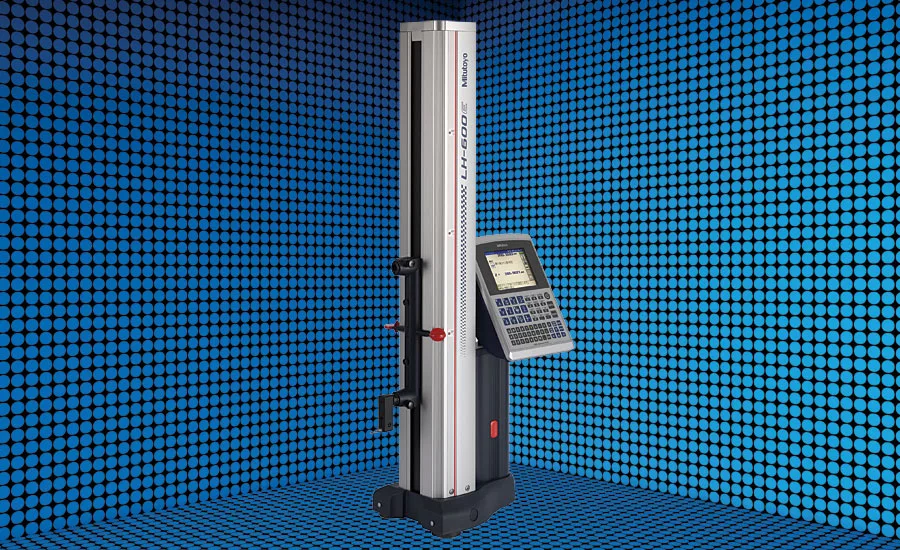
Tools in this group have increased accuracy, and may have additional features including tolerance setting, ID/OD measurement, max/min, TIR and probe compensation. Source: Mitutoyo
Ins and Outs of Height Gages

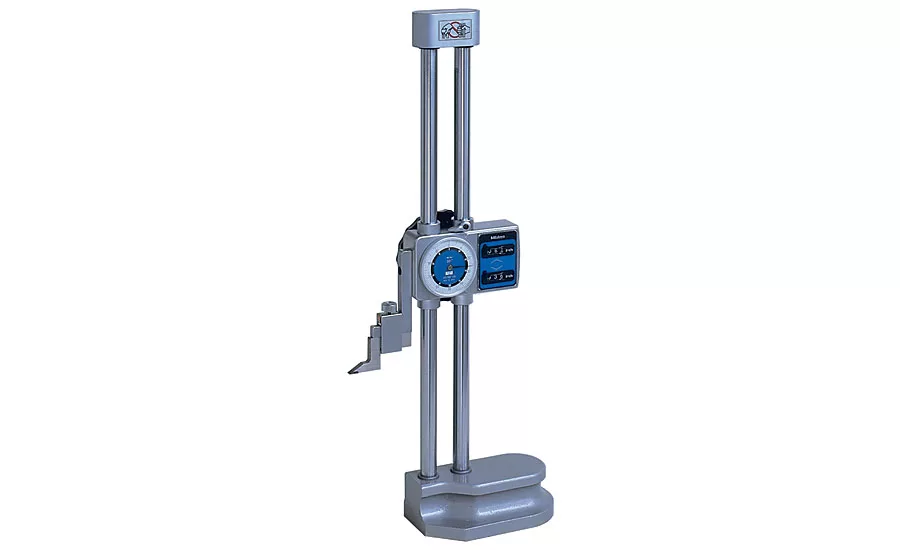
Digital counter height gages with dial and dual-digit counters decrease the time necessary to measure a part.
Source: Mitutoyo
Ins and Outs of Height Gages

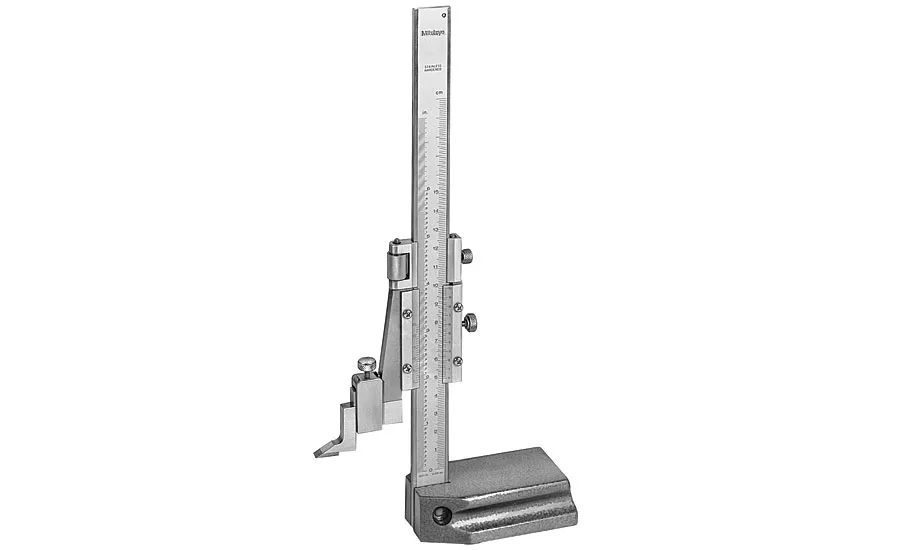
An advantage of Vernier height gages is the available range of sizes, generally from six inches to six feet. Source: Mitutoyo
Ins and Outs of Height Gages

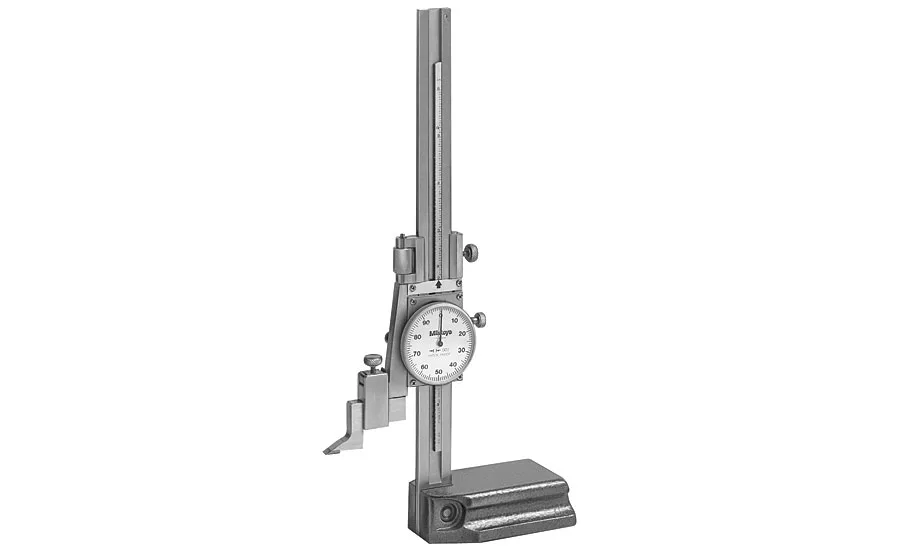
The relatively small size of dial height gages makes them ideal as a personal height gage that can be stored in a toolbox.
Source: Mitutoyo
QM0716-DEPT-101-p6-height_gage.jpg

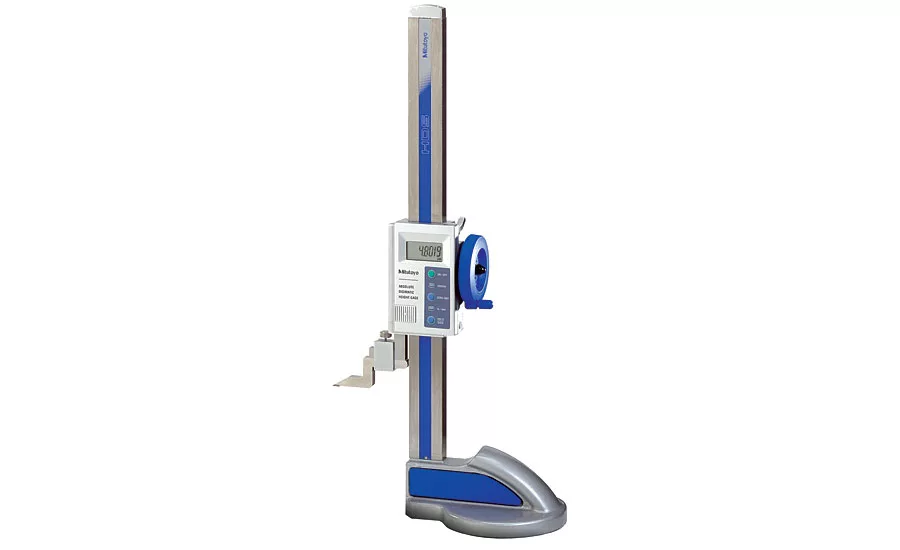
Height gages such as these generally have inch/metric conversion, absolute zero and floating zero, as well as data output. Source: Mitutoyo

Ins and Outs of Height Gages
QM0716-DEPT-101-p6-height_gage.jpg
July 1, 2016

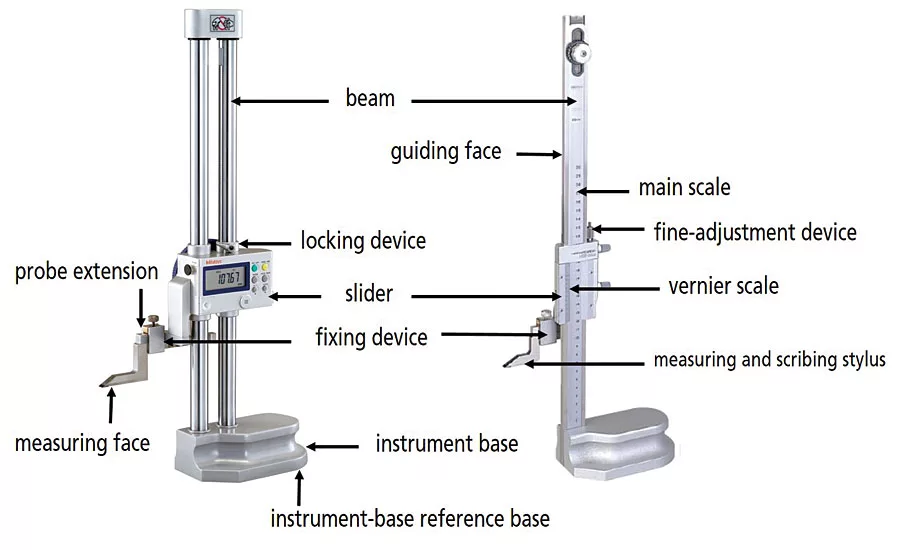
A height gage does exactly as its name indicates—measures the height of a workpiece. A height gage is a measuring instrument in which a slider with a measuring stylus moves relative to a measuring scale on a beam and in which this motion is along a single vertical axis nominally perpendicular to a reference plane on the instrument base.

Height gages are normally used on a granite surface plate to measure and/or scribe part features from a datum plane. Generally a scriber, test indicator, touch probe or CMM-style probe is used to locate the measured feature. Height gages are an indispensable instrument for quality control.

There are several types of mechanical and electronic height gages to choose from, depending on a company’s needs and budget.

Mechanical height gages have been used in flat plate layout for many years. There are three basic types of mechanical height gages:

  1. Vernier height gages are available from six inches to six feet in height, a chief advantage over other height gages. It can have one or two (both inch and metric) scales on the beam.
  2. Dial height gages are generally available only in sizes below 12 inches/300 mm. It is easier to read than a Vernier height gage, and the small size makes it ideal as a personal height gage that can be stored in a machinist’s toolbox.
  3. Digital counter height gages with dial and dual-digit counters decrease the time needed to lay out a part. Not only is the dial easier to read than a Vernier scale, but the dual-digit counters allow one counter to be set at the reference datum and the other to be used as a floating zero.

Electronic height gages can be divided into three distinct groups.

The first group has accuracies similar to mechanical height gages. Generally, they will have inch/metric conversion, absolute zero and floating zero, and data output.

The second group includes all of the first group features, however, the accuracy of the tool is a magnitude of order better and may have additional features, such as tolerance setting, ID/OD measurement, max/min, TIR and probe compensation.

In general, the last group has all the features of the second group and a higher accuracy rating. Most height gages in this class will have air bearings, a motorized touch probe, the ability to generate and store part programs, and a computer interface, allowing for SPC. They also can measure a part feature in two dimensions by rotating the workpiece. Use these height gages when higher accuracies are required, or to help reduce the demand on your CMM. 

TAKING MEASUREMENTS

Most height gages are supplied with a scriber, which serves to locate the top of the workpiece. When more accurate measurements are required, a test indicator or LVDT high-accuracy probe can be used. With dial height gages, a scriber or test indicator can be used, while digital gages can be equipped with a scriber or touch probe. The touch probe allows the operator to automatically detect zero, as well as the difference between two distances. 

With digital height gages, a touch-probe option allows measurements to be sent to a data collector or indicates that the measurement is complete and a reading can be taken. The touch probe helps eliminate human error.

There are some distinct advantages to using a digital display on the height gage: it is easier to read than a dial indicator, easily switch between units of measurement and resolution, zero set anywhere and the ability to use an electronic data collector.

One measurement conventional height gages with a scriber have difficulty with is distance between centers. This shortcoming was resolved when the height gage with calculation power was introduced. This allows the height gage to memorize the highest and lowest point within a sweep. This height gage is still a 2D gage, but peaks and valleys can be stored and recalled with the push of a button. The ball probe can be interchanged with smaller ones to reach narrow slots. Most height gages with a scriber have been used to measure steps or heights that face upward. Measuring the bottom edge of a slot or groove wasn’t really an option until a ball probe combined with a microprocessor to compensate for the ball diameter, making the process of measuring distances such as center-to-center quicker and easier.

At the same time, a set of gage blocks should be used to validate all dimensions taken by a height gage. With the gage blocks—the most accurate artifact standard—the height gage no longer measures from the bottom to the top. Instead it serves as a transfer stand and compares the unknown part against a known gage block. 

BEFORE MEASUREMENT

The presence of gage blocks on a granite plate is required. Make sure that the surface of the granite plates and the bottom of the height gage are kept clean. Poor conditions on the contact surfaces will affect the outcome. 

It is recommended that before taking measurements, the gage be flipped on its side so the bottom can be inspected. Use a rubber stone or cera stone to remove burrs, scratches or other deformations. Clean the base with denatured alcohol to remove any residue from the stoning process. The surface plate also should be wiped clean to remove any dust oil or other contaminants that may cause the gage to stick to the plate. 

To check that the surfaces mate correctly, mount a test indicator to the scriber and bring the indicator to the surface or reference part. Zero the gage and then gently press down on the corners of the base. If the indicator moves, the surface is not level and should be re-stoned until a smooth surface is obtained.

Similar to the base and granite surface, regular maintenance is necessary for the column(s) of the height gages. Stone and wipe the columns to remove any burrs or scratches. For the rack on the column, use a soft brush to remove any buildup. Failure to do so can result in the pinion moving unevenly, resulting in miscounting of both dial and digital height gages.

Knowing the type of height gage, as well as properly maintaining it, will help ensure efficient and accurate measurements.
 

KEYWORDS: height gage measurement systems

Share This Story

Looking for a reprint of this article?
From high-res PDFs to custom plaques, order your copy today!

Michal Grosenbach is the product manager, sensor & small tools, at Mitutoyo America Corp. (Aurora, IL). He can be reached at [email protected]. For more information, visit www.mitutoyo.com or call (888) 648-8869.

Recommended Content

JOIN TODAY
to unlock your recommendations.

Already have an account? Sign In

  • 2024 Quality Rookie of the Year Justin Wise 1440x750px banner with "Quality Rookie of the Year" logo inset

    Meet the 2024 Quality Rookie of the Year: Justin Wise

    Justin Wise is an exceptional individual who has been...
    Aerospace
    By: Michelle Bangert
  • Man with umbrella and coat stands outside while it rains at night looking at a building.

    Nondestructive Testing: Is there an ethics problem?

    I was a whistleblower who exposed fraudulent activities...
    NDT
    By: Dale Norwood
  • Unraveling Deflategate: Football stadium with closeup of football on field

    Unraveling the Tom Brady Deflategate

    The Deflategate scandal erupted following the 2014 AFC...
    Measurement
    By: Greg Cenker and Henry Zumbrun
Manage My Account
  • eMagazine Subscriptions
  • Newsletters
  • Online Registration
  • Subscription Customer Service
  • Manage My Preferences

More Videos

Sponsored Content

Sponsored Content is a special paid section where industry companies provide high quality, objective, non-commercial content around topics of interest to the Quality audience. All Sponsored Content is supplied by the advertising company and any opinions expressed in this article are those of the author and not necessarily reflect the views of Quality or its parent company, BNP Media. Interested in participating in our Sponsored Content section? Contact your local rep!

close
  • Key Takeaways for Quality Leaders
    Sponsored byComplianceQuest

    Key Takeaways for Quality Leaders from the 2026 Gartner Magic Quadrant™ for QMS

  • This image shows a person seated next to a Bobcat T66 compact track loader.
    Sponsored byPolyWorks by InnovMetric

    Supercharging Digital Gauging at Bobcat North America

  • Dorsey Calibration Lab photo by Tom LaBarbera Picture this Studios
    Sponsored byDorsey Metrology International

    Ensuring Product Quality in a Competitive Manufacturing Landscape

Popular Stories

This image shows a person seated next to a Bobcat T66 compact track loader.

Supercharging Digital Gauging at Bobcat North America

a professional in the aviation field performing maintenance, repair, and overhaul (MRO) work

Manufacturing Retention: Strategies for Improving Company Culture, Engagement and Skill Development

Dorsey Calibration Lab photo by Tom LaBarbera Picture this Studios

Ensuring Product Quality in a Competitive Manufacturing Landscape

2026 Quality Professional of the Year!

Events

June 22, 2026

Automate 2026

Automate is North America's largest robotics and automation event — and the best place to take your ideas from insight to impact.
 
Our show floor features the world’s leading automation solutions, from AI and robotics to motion control, vision systems, and more. Plus, our educational conference is second to none, led by the brightest minds in automation today.
 
Ready to transform the way you work? Take the next step at Automate.
July 14, 2026

Quality Leaders Forum: Better Communication, Better Quality Data

The Quality Leaders Forum is a quarterly, editor-moderated fireside chat series hosted by Quality Magazine, featuring candid conversations with senior manufacturing and operations executives shaping enterprise-level quality.

View All Submit An Event

Products

Lean Manufacturing and Service Fundamentals, Applications, and Case Studies

Lean Manufacturing and Service Fundamentals, Applications, and Case Studies

See More Products
Quality Podcast Channel Custom Content

Related Articles

  • Quality Measurement: Ins&Outs of ID/OD Comparative Gaging

    See More
  • The Ins and Outs of Ballbar Calibration

    See More
  • document control, a calculator

    The ins and outs of document control

    See More

Related Products

See More Products
  • ZEuCDwAAQBAJ.jpg

    Lean Six Sigma In The Age Of Artificial Intelligence: Harnessing The Power Of The Fourth Industrial Revolution

  • Fundamentals of Plant Floor Layout DVD Package

See More Products

Related Directories

  • Dow Gage (div. of Sirois Tool)

    Dow Gage specializes in the engineering, design, and manufacture of a line of Dow-Gages used on the shop floor for in-process and post-process inspection of precision-machined parts.
  • Suburban Tool Inc.

    Suburban Tool Inc. has 50+ years of experience in manufacturing the highest quality work holding products and inspection equipment. We offer a complete line of workholding & inspection devices including optical comparators, electronic height gages, digital readouts and hand-held measuring instruments. Visit us at www.subtool.com and on YouTube.com/SuburbanToolInc
×

Stay in the know with Quality’s comprehensive coverage of
the manufacturing and metrology industries.

Newsletters | Website | eMagazine

JOIN TODAY!
  • RESOURCES
    • Advertise
    • Contact Us
    • Directories
    • Manufacturing Division
    • Store
    • Want More
  • SIGN UP TODAY
    • Create Account
    • eMagazine
    • Newsletters
    • Customer Service
    • Manage Preferences
  • SERVICES
    • Marketing Services
    • Market Research
    • Reprints
    • List Rental
    • Survey/Respondent Access
  • STAY CONNECTED
    • LinkedIn
    • Facebook
    • YouTube
    • X (Twitter)
  • PRIVACY
    • PRIVACY POLICY
    • TERMS & CONDITIONS
    • DO NOT SELL MY PERSONAL INFORMATION
    • PRIVACY REQUEST
    • ACCESSIBILITY

Copyright ©2026. All Rights Reserved BNP Media, Inc. and BNP Media II, LLC.

Design, CMS, Hosting & Web Development :: ePublishing