Quality Measurement: Ins&Outs of ID/OD Comparative Gaging

Circles are the most frequently produced machined form. Generated by many different processes-including turning, milling, centerless grinding, boring, reaming and drilling-there are, correspondingly, a wide variety of gaging methods used to measure inside and outside diameters. At the low end, a hole could be measured with a scale or a fixed go/no-go gage. At the other extreme, any number of precision measuring machines, including coordinate measuring machines (CMMs) and optical or vision machines are available. However, in production environments, most inside diameters and outside diameters (ID/ODs) can be accurately measured using one of several varieties of comparator gage.
ID/OD comparator gages come in two basic flavors-benchtop and portable-and are meant to be used in high-volume, high-performance applications by operators with shopfloor-level skills. Because they provide a comparative measurement, these gages require a master to set a zero reference point for determining part deviation. Comparator gages have relatively limited travel, but this allows the use of high-resolution dial or digital indicators or very high resolution electronic probes with amplifier readouts.
The choice between benchtop and portable styles depends mainly on the size of the part being measured, and whether the part will be brought to the gage or vice versa. Benchtop comparative gages are typically used on small parts and are generally restricted to measuring single dimensions or features that are less than 255 millimeters, or 9 inches, in diameter and not more than 25 millimeters, or 1 inch deep. Portable ID/OD gages can go as large as 2,500 millimeters, or 8 feet, and as deep as 125 millimeters, or 5 inches. If a manufacturer needs to go deeper than that, bore or plug gages are a better choice.
Benchtop Gages
Benchtop gages are capable of higher precision than portables, with resolutions of 0.0005 millimeter, or 0.00002 inch, readily achievable. Typical of these are the “plate gages” seen in the bearing industry or anywhere that fast accurate readings of ODs or IDs are needed. Recognized by their tilting stage plates-used to set and locate the part being gaged-this basic design has been around for more than 50 years. Plate gages are convenient for fast, comparative gaging of flat, relatively thin-walled parts, such as ball and roller bearing rings, where diameter measurements must be made in a plane parallel to at least one of the faces, and sometimes at a particular depth on the ID or OD.The gage includes a plate that is ground flat, and on which the part is rested. Sometimes the plate incorporates wear strips, but in many cases, the plate is no more than a protective surface for the gaging mechanism. Instead of resting the part on the plate, the gaging surface is built into the sensitive and reference contacts of the gage. It is much easier and less costly to replace the contacts on this design, than to replace or regrind a reference plate. This design also provides less surface area for dirt or chips to get into the measuring loop. There are two types of contact arrangements in these gages: a “T” plate design and a “V” plate version. With either version, movable reference and sensitive contacts are set close to the diameter to be measured.

The T plate design is the most common. Because the reference contact and the sensitive contact are in line, the gaging principle is the same as in a portable snap gage. There is a difference, however, in that the contacts are not flat and parallel but curved or donut-shaped. This means that the gage may not necessarily pick up the maximum or minimum diameter of the part every time, and some slight “swinging” of the part through the contacts is necessary. The second reference contact on the T can help locate the part. However, it should be set to produce a reading slightly outside of the minimum or maximum value. Otherwise-if it is set to be exactly on the “zero” diameter-any other position will produce a chord reading, and not the true diameter of the part.
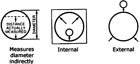
The V plate design incorporates two reference stops, one at the top of each arm of the “V” that must be adjusted symmetrically to ensure that the part is staged on the center plane of the V. This double stop has a locating effect similar to that of a vee block, and provides positive and precise location of the part on the gage. This greatly speeds up the measuring process, taking some of the operator involvement out of the measurement, and is particularly useful on parts with odd-lobing characteristics from the machining process.
However, there is a drawback to this type of contact arrangement. Because the sensitive and reference contacts are not in a direct line, there is not a one-to-one relationship between sensitive contact movement and the diameter. Rather, the measurement result is determined by a multiplier based on the angle between the reference contacts, just like when using a vee block. In most cases this angle is 60 degrees and the ratio is 4:5. Thus, for every four units seen by the indicator, five units come out, which is another way of saying the sensitive contact is multiplied by 1.25 to get the correct result.
Portable Gages
If the part is large or awkward to manipulate, or if it is set up on a machine and is to be measured there, then a portable, beam-type gage is needed. Beam-type gages are available with maximum capacities from 125 millimeters, or 5 inches, to about 2,500 millimeters, or 8 feet, the largest ones being used to measure bearings and castings for jet engines and similarly large precision parts. Range of capacity is typically about 150 millimeters, or 6 inches, while the measurement range is determined by the indicator installed.Most portable ID/OD gages lack centralizing stops, so they must be “rocked” like a bore gage to find the true diameter. When rocking the gage, use the fixed contact as the pivot, and allow the sensitive contact to sweep across the part. Likewise, if the gage must bear its own weight against the part, make sure that weight is borne by the fixed contact, not the sensitive one.
A special fixture with sliding stops at major increments is used to master large ID measurements. Gage blocks are inserted in the fixture to “build out” the desired dimension. For OD measurements, calibrated “end rods” are often used; there is nothing fancy about these rods-they are simply lengths of steel, carefully calibrated for length. When mastering and measuring large dimensions, the gage, the master and the part must all be at the same temperature. Otherwise, thermal influences will throw off the measurement.
Even so, do not expect very high precision when measuring dimensions of a foot or more. Most indicators on these large-capacity gages will have minimum grads of 0.01 millimeter, or 0.0005 inch. This is adequate, given the inability of most machine tools to hold tolerances much tighter than about 0.05 millimeter, or 0.002 inch, for parts that large. Beware the gage claiming to measure more than 900-millimeter, or 3-foot, ID/OD capacity with 0.001-millimeter, or 0.00005-inch, resolution; it is probably not capable of repeatable measurements.
There is another set of concerns with portable ID/OD gages when they get larger than 915 millimeters, or 36 inches. That is, they start to get heavy and require two operators to use them. To help lighten the load, high tech carbon fiber reinforced plastic tubing is employed on gages larger than 1,000 millimeters, or 39 inches.
Plastic in a gage is tantamount to blasphemy in the metrology world, but it is not really that bad. This is because of the nature of the check. First, the tolerance for these large diameters is usually pretty wide, and second, this is a comparative measurement and there is usually an end rod available at the time of measurement to zero out that gage. Becaue the measurement is made almost immediately after the zeroing, there is little chance of thermal change influencing the measurement.
To accelerate the gaging process with either benchtop or portable gages, mechanical dial indicators can be replaced with electronic indicators. The dynamic measurement capabilities of the latest generation of digital indicators enable them to capture minimum or maximum readings, or calculate the difference between the two. This frees operators from having to carefully monitor the motion of a rapidly swinging needle on a dial indicator when rocking a portable gage, or checking for deviation on a benchtop version.
Special Feature ID/OD Checks
Sometimes small or large ID/OD checks are complicated by parts that do not present themselves in a straightforward fashion. Usually these checks are on the inside of some type of large bearing, measuring the diameter of an internal surface behind a shoulder, for example, where the entry diameter is smaller than the diameter being measured; or measuring a ring groove in a bore, the pitch diameter of an internal thread, the effective diameter of a barrel roller bearing, or the included angle of a tapered bore.Measuring this type of ID requires that the gage have some unique characteristics. These include the high repeatability of a comparative gage, long-range jaw retraction to allow entry into the part, and the ability to set the depth of the contact to make the measurement at the correct point.
One way to achieve this result is to use a long-range digital indicator as part of the measuring frame. This has the benefit of actually referencing the measurement based on the accuracy built into the gage’s own long-range slide. Of course, the contacts must be designed to handle the depth and gaging pressures, but the beauty of this gage is that its long range offers the ability to measure any number of depths within its range. So, besides measuring a depth at a particular location, it can measure two diameters at different depths. The combination of the long-range, high-resolution digital indicator on a soundly designed mechanical frame can provide a universal ID or OD gage for those hard-to-reach inside measurement applications.
In the future-possibly near term-this capability will probably extend with longer range ID/OD gages that can measure similar sized parts with less mastering for set up. This could eliminate the need to have one gage for each size and reduce master costs. This will require higher performance long range indicators, precision slide mechanisms and designs that ensure precise alignments of the contacts over their full measuring range. Q
George Schuetz is director precision gages at Mahr Federal Inc. (Providence, RI). For more information, e-mail [email protected] or visit www.mahr.com.
Tech Tips
• In production environments, most ID/ODs can be accurately measured using one of several varieties of comparator gage.• The choice between benchtop and portable styles depends mainly on the size of the part being measured, and whether the part will be brought to the gage or vice versa.
• Benchtop gages are capable of higher precision than portables.
• If the part is large or awkward to manipulate, or if it is set up on a machine and is to be measured there, then a portable, beam-type gage is needed.
Looking for a reprint of this article?
From high-res PDFs to custom plaques, order your copy today!