Turn and Face the Strain
A Q&A with Instron’s Peter Bailey and Exova’s Jonathon Pugh on the evolution of fatigue testing in the aerospace sector.
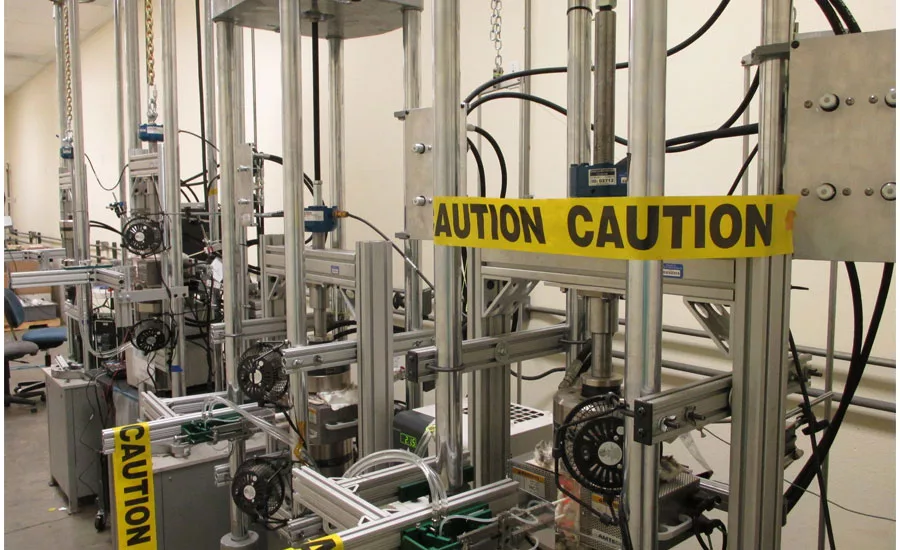
Typical creep and fatigue CMC test frames. Source: Exova
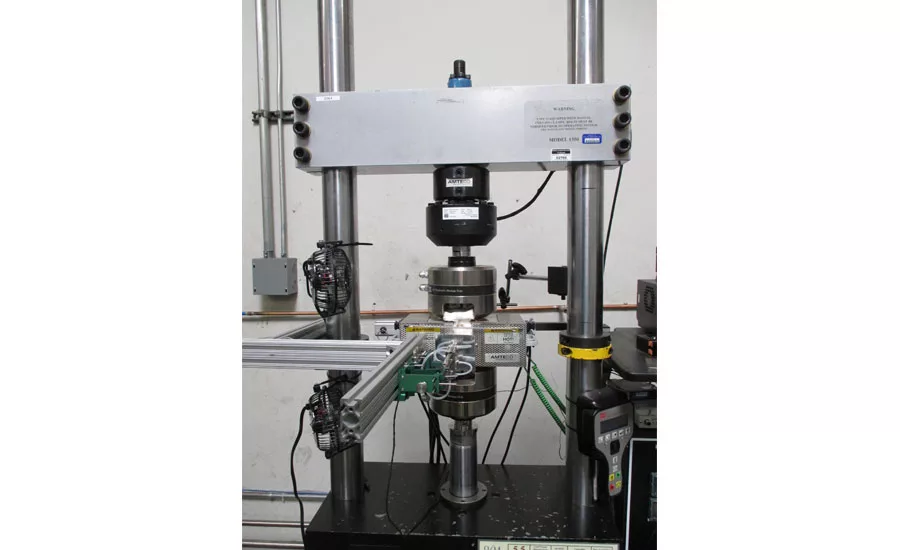
Typical creep and fatigue test frames. Source: Exova
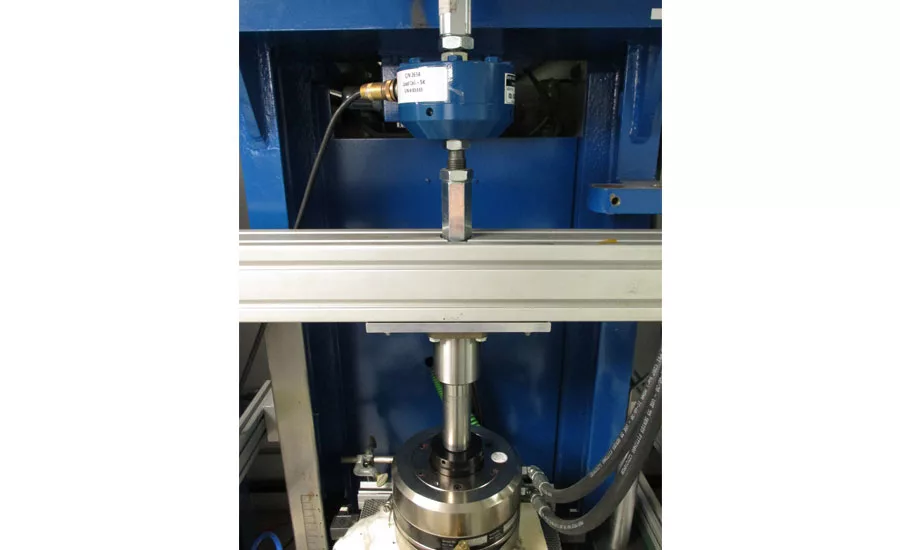
Example of creep frame bearing structure to allow it to meet tight alignment requirements. Source: Exova
When it comes to testing aerospace components, the costs of imperfections go far beyond the financial. Thus it is critical that nondestructive testing (NDT) for aerospace vehicles and parts is made foolproof in finding even the tiniest hint of damage or defect.
In addition to static testing and other inspections such as SEM failure analysis, fatigue testing—whether it be force controlled, strain controlled, or displacement controlled—is of utmost importance in guaranteeing that an aerospace vehicle is safe and ready to fly.
To find out more about the history of fatigue testing at two of the most prominent companies servicing the aerospace industry, as well as how the testing has evolved and improved over the years, Quality reached out to Peter Bailey, Ph.D., Instron’s Senior Applications Specialist, and Jonathon Pugh, general manager of NDT at Exova.
QUALITY: INSTRON WAS FOUNDED IN 1946. WHEN DID THE COMPANY BEGIN TESTING IN THE AEROSPACE SECTOR?
Peter Bailey, Instron: You could argue that this was the origin of our business. Our founders, Harold Hindman and George Burr, formed Instron after working together at MIT on a joint project investigating suitable substitutes for silk that could be used in the manufacture of parachutes.
Instron has always been involved in testing of nearly all industries and markets. The manufacture and deployment of jet engine aircraft in the 1950s produced the need for environmental testing of materials, most significantly at elevated temperatures. Our involvement with aerospace started with the acquisition of SATEC, a company that began testing aerospace materials in the early 1960s. Over time, as new development and advancements were made in aerospace around using new materials, like composites, we were equipped with the right systems and experience to continue our involvement of testing for aerospace customers.
EXOVA HAS OVER 90 YEARS OF EXPERIENCE IN TESTING. WHEN DID THE NDT-AEROSPACE TESTING BEGIN?
Jonathon Pugh, Exova: Exova has been testing in the aerospace sector for over 50 years. It operates 17 Nadcap approved laboratories in seven countries, which are situated in proximity to customers’ R&D and production facilities around the world.
HOW HAS AEROSPACE TESTING AT INSTRON EVOLVED OVER THE YEARS?
Bailey: Standardization of materials testing methods has developed enormously throughout the last 70 years. First, for metals, generic tests became much better defined, giving truer and more comparable results. Over time, we experienced the development of highly-specific areas of measurement, such as fracture mechanics, driven by engineering safety needs and scientific understanding. Most recently, we have seen gradual and small refinements that improve the overall precision and repeatability.
About 30 years ago, this entire cycle started again with the advent of structural polymer matrix composites. We have now arrived at a point where the creation of new test methods is minimal and existing standards are being refined. Right now, with the relatively sudden arrival of commercialized additive manufacturing, we are at the very start of that same cycle. In fact, just this week, I attended ASTM workshops on standardization needs and barriers to adoption for A.M. technology.
In terms of the actual testing, the working environment has not really changed that much, but the equipment and expectations have. The biggest changes in the equipment have been driven by electronic measurement technology. This happened slowly at first with the development of electronic measurement methods and changes from valve technology to discrete semiconductors to micro-electronics. Then [there was] a step-change in the 1980s as we adopted digital electronics, followed by the integration of ever more sophisticated computer control. The last two decades have probably seen the most rapid changes for the user demands in terms of automated analysis and ease of use from smarter software. Now, the test practitioner can expect standards of personal safety and data reliability which were unimaginable 70 years ago, and would have been challenging even just 20 years ago.
HOW HAS AEROSPACE TESTING EVOLVED OVER THE YEARS AT EXOVA?
Pugh: Testing in the aerospace sector has evolved a great deal, and continues to do so as materials evolve. In particular, we see a constant change and evolution in composites testing.
Twenty years ago, we couldn’t even have imagined the types of testing that we do as standard now. Advancements in manufacturing and computing have led to improved technology and equipment; and research at all levels, including at universities, has led to enormous innovations in the testing field.
HOW DOES FATIGUE TESTING DIFFER WHEN TESTING DIFFERENT MATERIALS— SAY, COMPOSITES VERSUS METALS?
Bailey: For metals, the tests we need to perform are very well specified and there is clear consensus in regards to good practice and appropriate use. Major aerospace companies and OEMs effectively use the same metrics for the vast majority of component metals and applications, and materials suppliers have a clear understanding of what they need to supply.
By contrast, for composites, industry (and researchers) are still far from overall consensus, leading to a prolific number of different tests used in different areas and by different commercial groups. This can lead to a lot of extra work—and potentially confusion—for materials producers supplying across the industry.
Pugh: Metals and composites have different qualities and defects so there is a lot of variety in the testing. All testing in tailored to the material and the methods are regularly changing and evolving. For example, testing for honeycomb and carbon laminate and carbon sandwich/layered composites requires regular updates and innovations due to the rapid advancements in the materials themselves, and testing while in service.
HOW DOES EXOVA PROVIDE SUPPORT THROUGH EACH STAGE OF THE PRODUCT CYCLE?
Pugh: Exova can provide testing solutions through each stage of the product cycle, from beginning to end. Our mechanical and metallurgical testing capabilities focus on raw materials, where our capabilities include fracture toughness and fatigue testing, and our nondestructive testing capabilities focus on the end product, ensuring it is free from cracks, voids, and other defects. These capabilities span all of our aerospace labs, and across several countries.
All of Exova’s testing is completely bespoke for the customer and product, and we provide technically demanding services based on their requirements. We focus on ensuring a sellable product with guaranteed performance and integrity, based around a customer’s timescales.
WHAT ARE THE TOP TOOLS THAT INSTRON USES FOR TESTING AEROSPACE VEHICLE PARTS?
Bailey: The bulk of Instron fatigue testing systems for the aerospace sector is supported by servohydraulic test frames. This is ultimately due to the requirements of moderate to high-load capacity and flexibility of this well-established technology. In terms of sheer numbers, the majority are 100 kN-250 kN load frames, which are used for everything from quasi-static tests and high-cycle fatigue, to fracture toughness and crack propagation, to composites fatigue tests, to uniaxial test of components. However, we also supply many servo-electric systems for high precision, high-temperature tests that are critical for turbine materials. We also provide very large (above meganewton – ie. >100 tonne) systems for large plate or substructure testing.
WHAT TESTING PROCEDURES HAVE BEEN RECENTLY DEVELOPED OR UPDATED AT YOUR COMPANY?
Pugh: Some of the more recent updates to testing in the aerospace sector include advancements in immersion ultrasonic testing, which ensures weld integrity and composite integrity; increased capabilities for testing on precision-cut samples; and new capabilities in Elevated Temperature Tensile (ETT) and Stress Rupture (S/R) testing, among others.
Bailey: We continually maintain our software to ensure that it complies with the latest revisions to international standards, enabling our customers to meet the requirements of Nadcap. We also produce fixtures appropriate to new test methods as required.
One modified method, which Instron itself has developed in response to customer demand, is the provision of a frequency control method for composites fatigue testing. Specimen temperature variation is a serious problem for composites fatigue test—over 10° C fluctuation is not uncommon, and would be quite unacceptable in quasi-static tests. For this reason, we developed a system to automatically optimize and control test frequency, enabling temperature stability within +/-0.5° of a user-specified target, [which provides] both confidence in test conditions and potential for significant reduction in total machine time for a composites fatigue test program. We are engaged with the international standards committees and will be working to help add this approach as an annex.
Looking for a reprint of this article?
From high-res PDFs to custom plaques, order your copy today!