What should I know about CoaXPress 2.0?
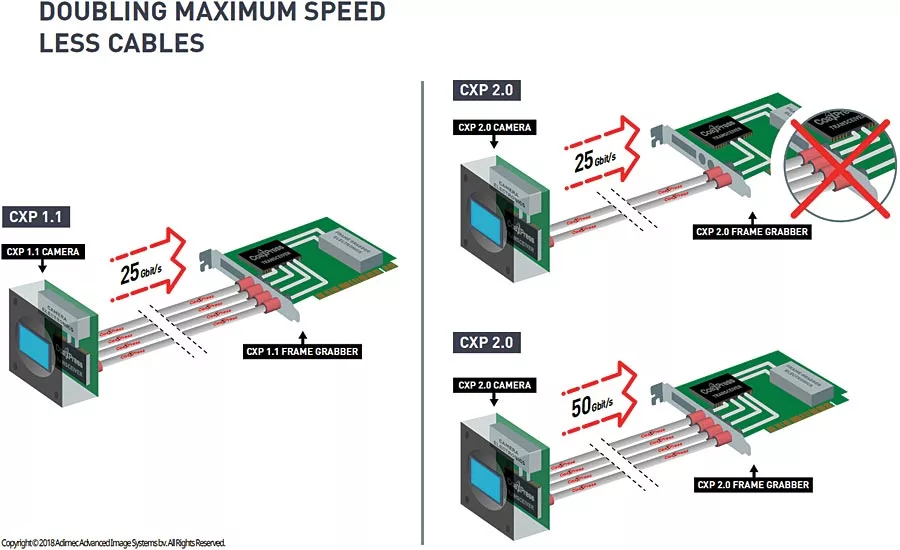
Figure 1: The most important difference between CoaXPress 1.1 and 2.0 is the increased data rate per cable. This will allow for a larger frame rate or the use of less cables.
The electronics industry is driven by the trend for more GOPS (Giga-Operations per Second) per mm3. This requires smaller technology nodes in wafer manufacturing, a drive to advanced packaging, as well as back-end inspection of the smaller interfacing components like micro-bumps, distribution layers, etc.
The smaller nodes result in more details that require visual inspection and metrology. At the same time the inspection throughput of the inspection tools needs to remain the same or increase when looking at the surface area that needs to be inspected. Furthermore, it is desired to reduce the number of false positives and negatives. The actual inspection task thus becomes more challenging.
To fulfill these requirements, the optical inspection and metrology equipment need faster motion to bring the device under test to the measurement point, faster and more complex algorithms to analyze the defects, and more accurate and faster electro-optical vision modules. In these EO-modules cameras with a throughput of 5 Gigapixels per second are needed to support the required resolutions and frame rate combination. This asks for an interface which goes beyond existing available standards. With CoaXPress 1.1 (CXP1.1) using four channels, data rates up to 2.5 Gigapixels per second can be achieved. The new CoaXPress 2.0 (CXP2.0) standard supports up to 12.5 Gbit/s per coax channel, which allows an affordable design of cameras that can run up to 5 Gigapixels per second with four CXP channels; one channel represents one cable.
CXP2.0 with four channels at CXP12 allows you achieve 5 Gigapixels per second data throughput. With CXP1.1 this is also possible, but requires doubling the number of channels on both the camera and frame grabber to eight each. In this case especially, the camera will increase in size and more cables are required, making the system design more complex and expensive. In terms of power and thermal management four CXP2.0 channels at CXP12 is likely to win as well. When you need 5 Gigapixels or more, going to CXP2.0 is the most logical step.
The CoaXPress 2.0 video interface supports the next step of highly reliable throughput requirements with an easy migration from the current CXP1.1 interface.
What I should know about CoaXPress 2.0?
1. CoaXPress 2.0 is compatible with CoaXPress 1.1
All cameras and frame grabbers will start up in CXP1.1, only switching to CXP2.0 when both the frame grabber and the camera support CXP2.0.
This means that a CXP1.1 camera works on both the CXP1.1 and CXP2.0 frame grabber. This also means that a CXP2.0 camera works on a CXP1.1 frame grabber, although you will not be able to benefit from the advantages CXP2.0 has to offer.
2. Doubling of the maximum speed
The most obvious improvement is the increased data rate. As previously mentioned the CXP2.0 can reach up to 12.5 Gbit/s. This 12.5 Gbit/s mode is referred to as CXP12. Due to overhead the actual effective bandwidth is approximately 9.6 Gbit/s.
Just to give an example of what would become possible, let’s consider a sensor resolution of 5120x5120 and a bit depth of 10 bit. With four CXP2.0 channels at CXP12 the theoretically possible frame rate could be about 146 FPS. CXP1.1 with 4 channels at CXP6 would only achieve up to 73 FPS in this case.
One thing that needs attention from a system engineer’s point of view would be that while for CXP1.1 PCIe gen2 x8 or gen3 x4 is sufficient for most cases, for CXP2.0 PCIe gen3 x8 will become a minimum common requirement.
3. New connector type
The CXP2.0 standard will support the new micro BNC connector. CoaXPress started with the normal BNC connector, being a big connector, than the smaller DIN 1.0/2.3 connector became more commonly used. Unfortunately the DIN 1.0/2.3 connector resulted in some complaints from the market and it does not support the CXP12 high frequency signals.
Switching to the micro BNC connector does solve these issues. The micro BNC is in size comparable to the DIN connector, while retaining the robustness of the normal BNC connector. The micro BNC supports the required high frequency signals for CXP12 and even can achieve a smaller pitch if needed when placed next to each other. Furthermore the micro BNC connector is a well-established industry standard in the broadcast industry. Although being slightly more expensive compared to the DIN connector, it will give you a very reliable connector being able to do CXP12 speeds.
4. Stream to multiple hosts
Sometimes the computer is the limiting factor in processing speed. This can be the case if a lot of calculations have to be performed on the images. For these situations CXP2.0 supports configurations where one camera is used with multiple frame grabbers in multiple computers such that the calculations can be performed in parallel. This is an optional part of the standard, so ask the camera/frame grabber manufacturer which configurations they support.
The main supported configurations are:
- Duplicate one image to multiple frame grabbers/PCs
- Example: camera has four CXP connectors; each connector is connected to a different frame grabber in a different PC. One image is recorded by the camera and the complete image is sent to all four PCs.
- Divide one image in parts and send to multiple frame grabbers/PCs
Example: camera has four CXP channels, each channel is connected to a different frame grabber in a different PC. The image can be divided in four horizontal or vertical stripes such that each stripe can be sent to a single PC for further processing.
5. Heartbeat, events and timestamps
Missing from CXP1.1, but being part of GenICam for many years is the heartbeat, events and timestamp. These GenICam features will now be supported by CXP2.0.
Heartbeat
The heartbeat allows for synchronization between cameras. Each camera has its own clock and timing. With the heartbeat message, the frame grabber can compute the exact actual time of the camera and link this to its own time clock. Often, the frame grabber clock can be synchronized with the Precision Time Protocol (PTP) IEEE 1588. When multiple cameras are connected to the frame grabber, the frame grabber can use the heartbeat to calculate the relative timing between the cameras and when synchronized with the PTP IEEE 1588, timing between cameras connected to different frame grabbers can be calculated as well. The heartbeat is required to allow for determining the exact moment an event occurred with respect to an event in another camera.
Events and timestamps
Events allow the camera to inform the frame grabber about the occurrence of certain events at a certain time. The time the event occurred is indicated by a timestamp as made possible by the heartbeat. Example events are start or end of exposure or reaching a too high temperature. Events are actively pushed from the camera to the frame grabber. No requests have to be sent to the camera (no polling is required) to monitor for the occurrence of events.
6. Faster Trigger
CXP2.0 will allow for a higher upstream data rate when operating at CXP10 and CXP12. CXP6 and lower use the CXP1.1 upstream data rate. This higher upstream data rate directly reduces the minimum trigger latency by half compared to CXP1.1. From a latency of 3.4 µs it goes to a latency of 1.7µs.
Here the latency is defined as the delay between the moment a trigger is being send and the actual moment the camera has received the trigger and can start the exposure.
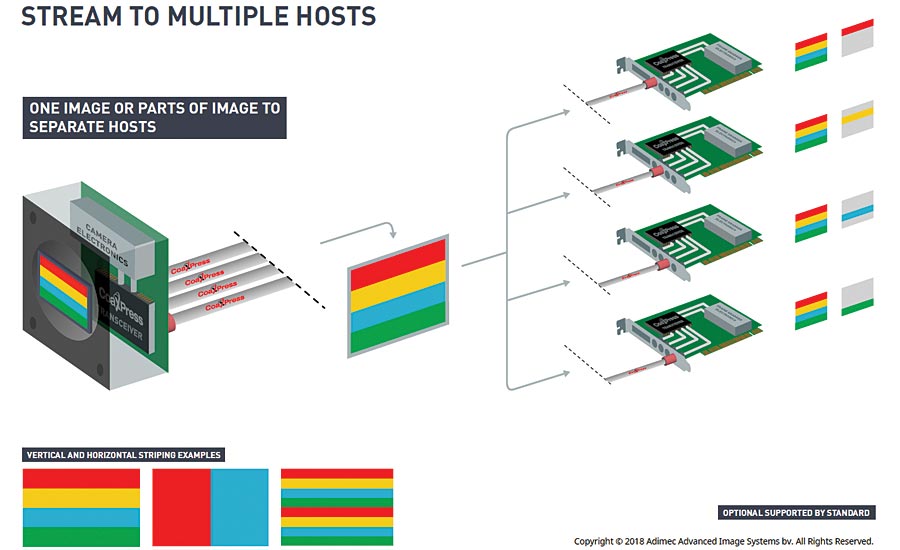
Figure 2: The CoaXPress 2.0 standard optionally supports streaming one image or parts of images to separate hosts.
7. Other advantages
While the above changes are the most important there are some smaller changes with less impact that are worth mentioning as well.
Save the default connection configuration
Camera manufacturers often set the default connection configuration to the configuration that supports the fastest frame rate, e.g. often this is a four channel configuration. In CXP1.1 this default start-up configuration cannot be changed. So if you want to use only one cable instead of four then you have to run a script every time the camera reboots to set the one cable connection configuration. In CXP2.0, the one cable configuration can be saved as a start-up default.
Improved communication reliability
The communication protocol has been updated when operating in CXP 2.0, such that the reliability has improved. Although compared to other interfaces the chance on miscommunication was already small, this chance has been reduced further.
Improved troubleshooting
Additional features are defined to make troubleshooting easier. With these features more information is available in case troubleshooting is needed.
Two chip manufacturers
For CXP1.1 the communication chip set was made by only one manufacturer, for CXP2.0 communication chip sets are now available from two manufacturers. This is a good development for availability and price competition.
Conclusion
With CoaXPress 2.0 you will be able to further innovate your imaging system on resolution and frame rate, while benefitting from the added features that further simplify usability of CoaXPress cameras and frame grabbers. The most important CoaXPress 2.0 properties are:
- CXP2.0 is compatible with CoaXPress 1.1
- CXP2.0 doubles the maximum data throughput
- CXP2.0 supports the new, more robust Micro BNC connector
- CXP2.0 optionally supports streaming to multiple hosts
- CXP2.0 supports heartbeat, events and timestamps Q
Looking for a reprint of this article?
From high-res PDFs to custom plaques, order your copy today!