Quality Web Exclusive
Optimizing 5S with Durable Surface Safe Labels
For facility operations managers, starting a 5S lean manufacturing program can reduce waste and optimize productivity through better workplace organization. With each S (Sort, Set in order, Shine, Standardize, and Sustain) accounting for a separate 5S stage, the process can seem intimidating, but does not need to be.
“You don’t have to get the 5S process perfect right away,” says Tina Huff, group product manager at Avery Products Corporation, a commercial and industrial label manufacturer. “Just get started and keep improving over time.”
Because nothing is set in stone, using industrial labels for organization and identification that are designed to be applied and removed as well as customized can help to optimize each stage of the process.
Sort
The first 5S stage, Sort, removes clutter and unneeded items from the work area. This leaves just the parts, tools, machines, and supplies necessary for daily use on the manufacturing or warehouse floor. In this stage, temporary labels can be put on items as the facility’s staff sorts through them.
According to Huff, designated areas for sorting could include: Leave, Relocate, Dispose/Recycle, or TBD (to be determined). "Leave” is for items that can stay where they are with no changes needed. “Relocate” is for any item that needs a new home because it is more logical or efficient. “Dispose/Recycle” applies to unneeded items that can be discarded or recycled. “TBD” is for items that you are not sure of yet.
“One method is to mark items as TBD, and then wait a month or so,” says Huff. “When you use an item, consider how it’s used or who uses it to determine its permanent home. If you haven’t used it in that time, consider discarding it.”
For best results, be sure to use labels that won’t fall off during the Sort stage, yet don’t cause damage or leave behind residue when you need to remove them.
Set in order
The second stage, Set in order, locates parts, people, tools and equipment in the most efficient and ergonomic positions, so operators do not waste time or effort searching for needed items.
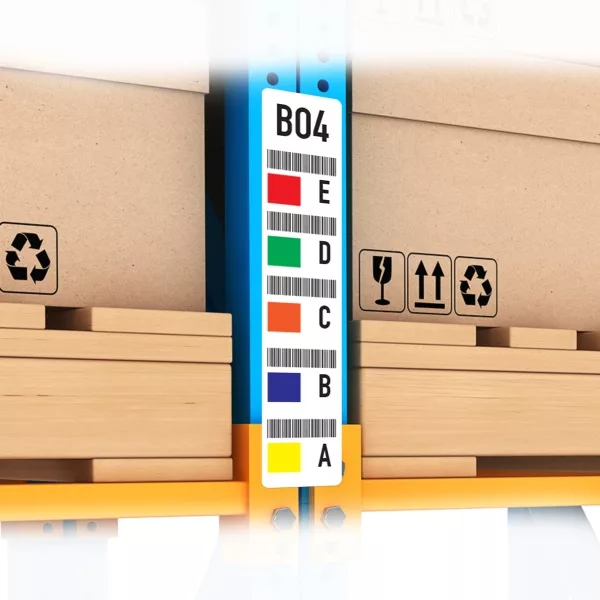
To improve workplace efficiency, identification labels can be integrated to identify and classify parts, tools, and equipment, so items are easy to find and everything has a home. Racks, shelves and cabinets also make sense to label, as do smaller portable items like bins, totes, and toolboxes, which help with organization.
Color coding labels can add another level of organization to items. With labels that are printed on a laser or inkjet printer, it’s easy to include color, icons, or even photos on labels. This makes it easier to quickly identify items and determine where they belong.
“For larger facilities, adding barcodes to labels can further improve efficiency because scanning a barcode is much faster and more accurate than manual entry,” says Huff. “This is vital for activities like inventory counts or pulling orders for shipment.”
According to Huff, this approach works with traditional one-dimensional (1D or linear) barcodes, and for two-dimensional (2D) barcodes, which hold far more data in less space. While 1D barcodes typically encode data such as location and department, 2D barcodes can contain not only website addresses but also images and voice recordings.
Shine
The third stage, Shine, ensures the workplace stays free of clutter, grime, and malfunction. This helps to prevent serious work breakdowns or slowdowns. In this process, cleaning and inspecting is critical. However, labels that are not durable can become torn or otherwise unreadable, which is a particular problem with barcode labels.
“During inspection, it’s good to replace any damaged or inaccurate labels,” says Huff. Also, keep track of machine maintenance with inspection labels so routine maintenance isn’t forgotten. This helps to prevent costly downtime and improve safety by reducing malfunction-related accidents. Make sure there is a process in place so whomever is responsible knows which machines they need to inspect and how often. A good inspection label will include areas for marking the date and the person who conducted the inspection.
To reliably perform through the Shine stage, however, it is important to use ID labels that are designed to withstand daily wear and tear, dirt, grease, oil, chemicals, and wash-downs while providing good barcode readability.
Standardize
The fourth stage, Standardize, systematizes the most efficient work methods with clear standards. Utilizing schedules, checklists, and standard operating procedures is a key part of this process.
Without standard operating procedures and clear processes, a facility will not run consistently and smoothly, even if everything is labeled accurately. Wherever possible, it is helpful to put procedures and checklists on labels posted near work areas.
“Placing labels on work area equipment provides employees with a recurrent reminder of standard operating procedures, so no one can say ‘I didn’t know,’” says Huff. This is especially critical for reminders or instructions, since labels are less likely than sheets of paper to get lost or damaged.
Sustain
The fifth stage, Sustain, trains employees on and maintains company standards and procedures until they become a habit and are consistently followed. Because 5S is a continuous process, however, organizations will reorganize or improve processes throughout the year, as well as accommodate changes in data, format, and regulation.
As such, easily removing old labels and printing custom, updated ones is important. Otherwise, employees can waste time scraping old labels off, using heat guns or even razor blades. They may be reluctant to update labels if the old ones are difficult to take off, so they may make do with substandard situations.
The ideal solution is to use industrial labels for organization and identification that are easy to adhere and durable enough to endure harsh conditions, yet come off cleanly when necessary, leaving no trace.
“Industrial labels used for signage and identification must be more durable than those used in an office, but should remove cleanly when they need to come down,” says Huff. “The key to accomplishing this [is to use] an adhesive that holds well but can be removed when needed.”
With all the equipment, supplies, racks, etc. used in industrial settings, the ability to conveniently print new 5S sign and identification labels in minutes, while also being able to cleanly remove the old labels, will go a long way toward keeping facilities efficiently up to date without the hassle, mess, or cost.
For more information, visit www.Avery.com/industrial.
Looking for a reprint of this article?
From high-res PDFs to custom plaques, order your copy today!